Manufacturing guy-at-large.

Not 10 times as hard

Added on by Spencer Wright.

From TechCrunch's excellent article about Google X:

No idea should be incremental. This sounds terribly clichéd, DeVaul admits; the Silicon Valley refrain of "taking huge risks" is getting hackneyed and hollow. But the rejection of incrementalism, he says, is not because he and his colleagues believe it's pointless for ideological reasons. They believe it for practical reasons. "It's so hard to do almost anything in this world," he says. "Getting out of bed in the morning can be hard for me. But attacking a problem that is twice as big or 10 times as big is not twice or 10 times as hard."
Old models

Added on by Spencer Wright.

These are robot door parts I designed in 2012. And I gotta say, this (the black rod in the middle of the photos) was a dumb but kinda clever solution to a shitty problem.

Departure from the default

Added on by Spencer Wright.

Daniel Kahneman, in Thinking, Fast and Slow. Emphasis mine:

People expect to have stronger emotional reactions (including regret) to an outcome that is produced by action than to the same outcome when it is produced by inaction. This has been verified in the context of gambling: people expect to be happier to gamble and win than if they refrain from gambling and get the same amount. The asymmetry is at least as strong for losses, and it applies to blame as well as to regret. The key is not the difference between commission and omission but the distinction between default options and actions that deviate from the default. When you deviate from the default, you can easily imagine the norm - and if the default is associated with bad consequences, the discrepancy between the two can be the source of painful emotions. The default option when you own a stock is not to sell it, but the default option when you meet your colleague in the morning is to greet him. Selling a stock and failing to greet your coworker are both departures from the default option and natural candidates for regret or blame.

In a compelling demonstration of the power of default options, participants played a computer simulation of blackjack. Some players were asked "Do you wish to hit?" while others were asked "Do you wish to stand?" Regardless of the question, saying yes was associated with much more regret than saying no if the outcome was bad! The question evidently suggests a default response, which is, "I don't have a strong wish to do it." It is the departure from the default that produces regret.

The Wrong Idea

Added on by Spencer Wright.

Lou Lenzi, GE General Manager of Industrial Design, talking with The Atlantic about outsourcing: 

“What we had wrong was the idea that anybody can screw together a dishwasher,” says Lenzi. “We thought, ‘We’ll do the engineering, we’ll do the marketing, and the manufacturing becomes a black box.’ But there is an inherent understanding that moves out when you move the manufacturing out. And you never get it back.”

Take note of this. Look around the hardware world today, and you'll see dozens of consultancies & outsourcing platforms that are dedicated to making manufacturing a black box. Their aims are good: to alleviate the strains of launching a hardware product. But the results can be highly problematic.

Designers who aren't knee deep in the making of their products are taking huge, unknown risks. Out of sight/out of mind is a recipe for avoidable mistakes.

Old (ish) goals

Added on by Spencer Wright.

Me, last June

i have spent a while recently thinking about what, exactly, i have liked about my career. a few points:

  1. i like being appreciated.
  2. i like being compensated.
  3. i like being a little over my head. i prefer to stay right on the edge between the things i know i don't know and the things i don't know that i don't know.
  4. i like collaborating with people who are better at what they do than i am.
  5. i like having an understanding of long-term objectives, and i like being a significant factor in the achievement of those objectives.
  6. i like working with people like myself.
  7. i like being fully responsible for the execution of a project, however large or small.
  8. i like working on a new thing that will change some part of the world.
  9. i like working in emerging markets.
  10. i like working on things that people like me want, and want to interact with intimately.
  11. i like for the product values and interests that i have to overlap significantly with those of my collaborators and our product's users.
  12. i like being rewarded for my ability to identify, assess, analyze and solve problems, and i like it when those problems require me to learn about a new area of the world.
  13. i like clear objectives - and clear metrics by which they can be judged - over aesthetic, or "gut" feelings.
  14. i like working on general purpose technologies.
  15. i like working on cross-functional teams, and having responsibilities in many categories of business

I like this. Probably worth updating.

What should we all do

Added on by Spencer Wright.

Steven Sinofsky, talking on the a16z podcast about how real-time metrics tracking has changed the nature of management (edited for readability):

If you think about the average large company meeting, the vast majority today start off with somebody showing up and passing out a printed version of a work product. You just don't see that in a company of less that a thousand people. And the interesting thing about it is that it's not just that everybody got emailed the attachment for the meeting. It's that [managers] are looking at things like live data. So when managers at a small company look at their current telemetry of their app, their site, their service, they're all looking at the actual tools that are used by the marketing team to manage that information. They're not looking at a snapshot from even a few hours earlier. So you cut out all of this "well, those numbers aren't ready, let me go do them." You don't have presentations where a picture of the numbers are embedded in the presentation. 

These are these huge cultural shifts in how you manage an organization. What a manager's role is in a meeting is not to be reported to, because if you wanted to know, you should just go visit the place that everybody on the team is using to keep track of their information. 

Then when you get everybody together, it shouldn't be to argue the pros and cons of how the information was gathered or is it the right number... It should be: We all agree, this is the number. What should we all do to change that number?

Mere potential

Added on by Spencer Wright.

Zakary Tormala, writing about our surprising preference for potential - even over achievement. Emphasis mine.

We designed several ads in Facebook promoting a comedian who was growing in popularity at the time of our study. One ad said, “Critics say he has become the next big thing,” and another said, “Critics say he could become the next big thing.” The “potential” ads produced more than three times the click-through rate and five times the fan rate.

Matrix managing

Added on by Spencer Wright.

I had never heard this term, but I like it. From an interview in Solid State Technology with Margaret Blohm, Chief Scientist and Leader of Nanotechnology at GE Global Research, emphasis mine:

Q: What challenges do you face in managing nanotechnology research programs and scientists?

The challenge of dealing with a lot of enthusiasm and making sure we stay on track with business impact and not just really cool technology. It can be hard on folks who have a good idea that’s not ready for a specific business use. An even bigger challenge is doing matrix managing. I’ve never been a fan, but I love it now. Matrix managing is the process of influencing organizations or departments or other structures where you don’t have individuals directly reporting to you, to help them recognize the mutual benefit of what they are working on.

I matrix manage the people on the various research teams. I reach in to their team and work with them. For example, a chemist is on one team and can join my team as well. It’s usually a management nightmare, but it has worked here. It’s communication both ways. They aren’t isolated from business challenges and opportunities. Matrixing helps do that.

Search terms

Added on by Spencer Wright.

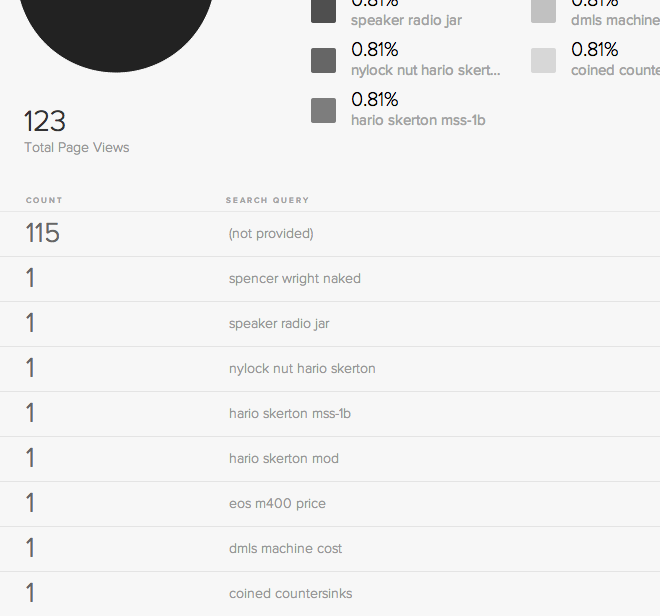
I can't tell whether to be flattered by this or what.

FWIW I am proud of most of these, especially "coined countersinks," for which I am *bafflingly* the top result. I also have reason to believe that a good number of the unprovided search results are for DMLS pricing, which is more exciting to me than the fact that someone wants to see me (or some lesser Spencer Wright) in the nude.

PCBA

Added on by Spencer Wright.

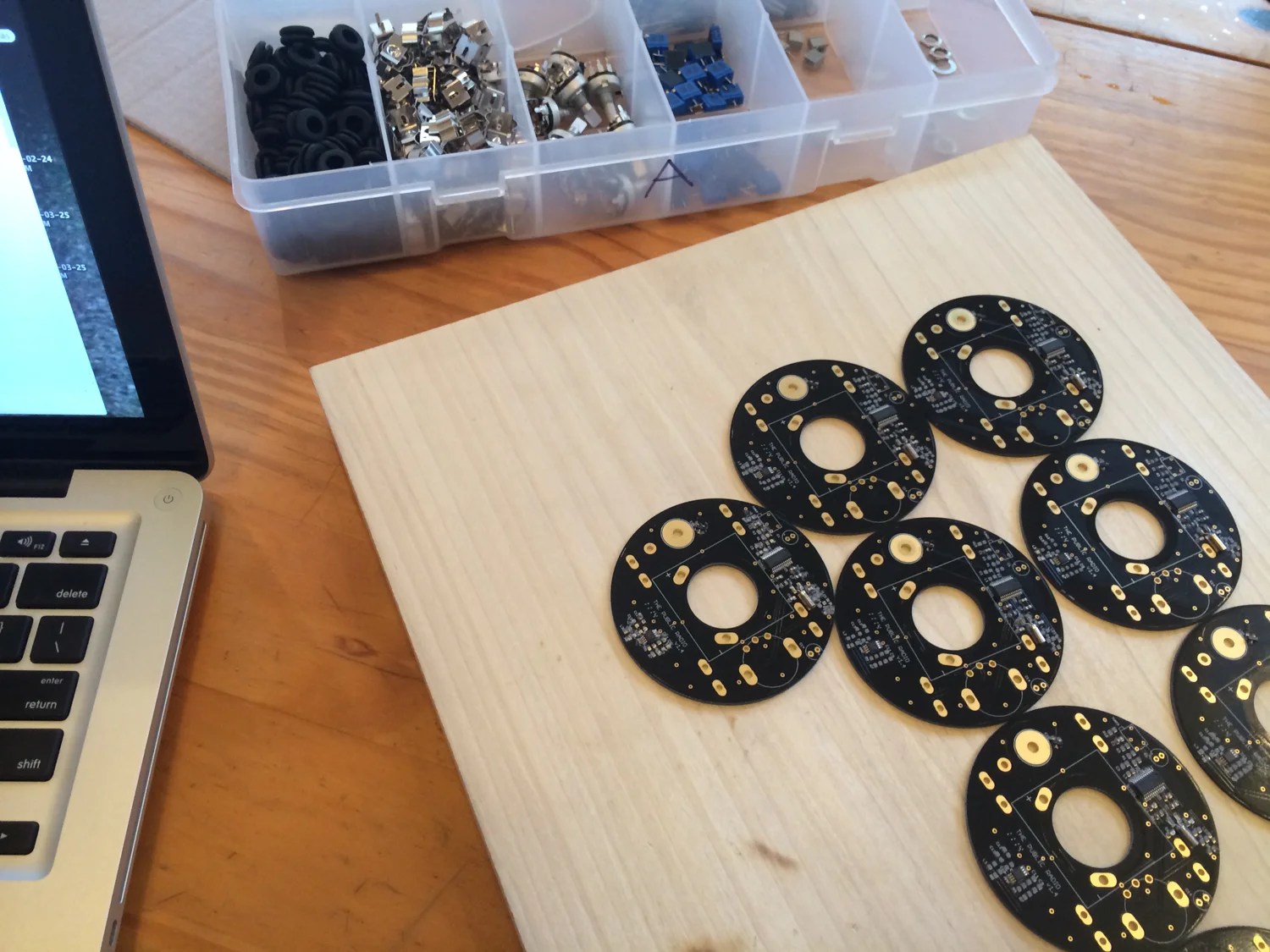
PCBA, recently @ The Public Radio:

We've got about a dozen beta radios out in the wild right now, and are working on an additional 10 or so. There are a few small hardware revisions that are yet to be made, but the overall design is about right, and we'll be rolling out a larger launch in the coming months. Stay tuned

Make. Equity. Deals.

Added on by Spencer Wright.

From a good article on Susan Kare, who (among other things) designed the great early GUI icons for Apple. 

In exchange for a pre-IPO purchase of Apple stock, Xerox allowed Jobs and his engineering team three days’ access to PARC to scope out the Alto and its development tools.

*So* good to deal in equity. 

Fertile Ground

Added on by Spencer Wright.

I relate to this very strongly. 

Whether in the context of building products or changing cultures, my own core interest is in seeing what drives human behavior and how people react to change. I am drawn back to the technology industry over and over not because I care about bits and bytes, but because it is the most fertile ground for behavior change that exists in our world today.

-Becky Bermont

cf. something I wrote like a year ago - whether or not it holds up :)

In order to find plot

Added on by Spencer Wright.

George Packer, writing in the New Yorker: 

Journalists and historians have to distort war: in order to find the plot—causation, sequence, meaning—they make war more intelligible than it really is. 

There's a nontrivial value to this kind of deception, but it's a tricky balance to strike. One presumes that there are lessons to learn from war, and it follows that someone should be empowered to tease those meanings from the (literal and figurative) rubble. At the same time, I have a strong aversion to making even subtle modifications to underlying truths, and it worries me to consider that what I read is distinctly different from facts.

This same dilemma extends to other realms, including my own (as it were). Business analysis (even that which I find most insightful) and the opinions of experts are subject to all manner of distortions, and I struggle to keep those out of my own work.

Albert Einstein

Added on by Spencer Wright.

If you can't explain it simply, you don't understand it well enough.

I can't find a good citation for this, but I like it. I do, however, think it's worth adding that good communication skills are also very, very important - and that "well enough" is relative.

Disfluency

Added on by Spencer Wright.

From a post titled "How Cognitive Fluency Affects Decision Making" on UXMatters. Emphasis mine.

In one study, researchers presented participants with the names of hypothetical food additives and asked them to judge how harmful they might be. People perceived additives with names that were hard to pronounce as being more harmful than those with names that were easier to pronounce. On a subconscious level, people were equating ease or difficulty of pronunciation with an assumption about familiarity. When the pronunciation seemed easy, people assumed it was because they’d previously encountered the additive and had already done the mental work of processing information about it. Since it seemed familiar, they assumed it was safe...

Researchers have found that, when a stimulus feels fluent, people are more likely to make judgments and decisions based on their first, Gut reaction. However, when a stimulus feels disfluent, people are more likely to reconsider their initial Gut reaction. Disfluency functions as a cognitive alarm that gets people to slow down and reassess a situation. From a UX-design standpoint, sometimes it’s good to get people to slow down and pay attention—and one way to do this is to deliberately make the information harder to process mentally by making its font harder to read or by using wording that is uncommon or unfamiliar.

On Set.

Added on by Spencer Wright.

Product photography is fun, and weird. 

Today I spent the majority of my day on-location shooting The Public Radio with Zach and Colin (and with help from Hannah, Lianna and Chris). It was good, and exhausting, and fun.

When I was building bikes, I self-consciously photographed a huge portion of my life. My aim was presumably to build a personal brand that would improve the appeal of my company, but looking back I wonder how much of it was pure narcissism. 

Now it's (ostensibly) different; I'm part of a larger team, and in many ways the aesthetic that we're selling is distinct from my own. Sure, I use Mason jars, and I truly enjoy FM from time to time - and when I do, I only listen to one station. But the challenges that interest me about The Public Radio are largely distinct from the reasons that (I believe) our customers would buy it, and that has a huge effect on the way I present it to the world. It frees me up, and removes self-consciousness from the equation. It makes it much easier.

Anyway. Consider The Public Radio's crowdfunding campaign begun. Stay in touch for updates.