Manufacturing guy-at-large.

Old & New

Added on by Spencer Wright.

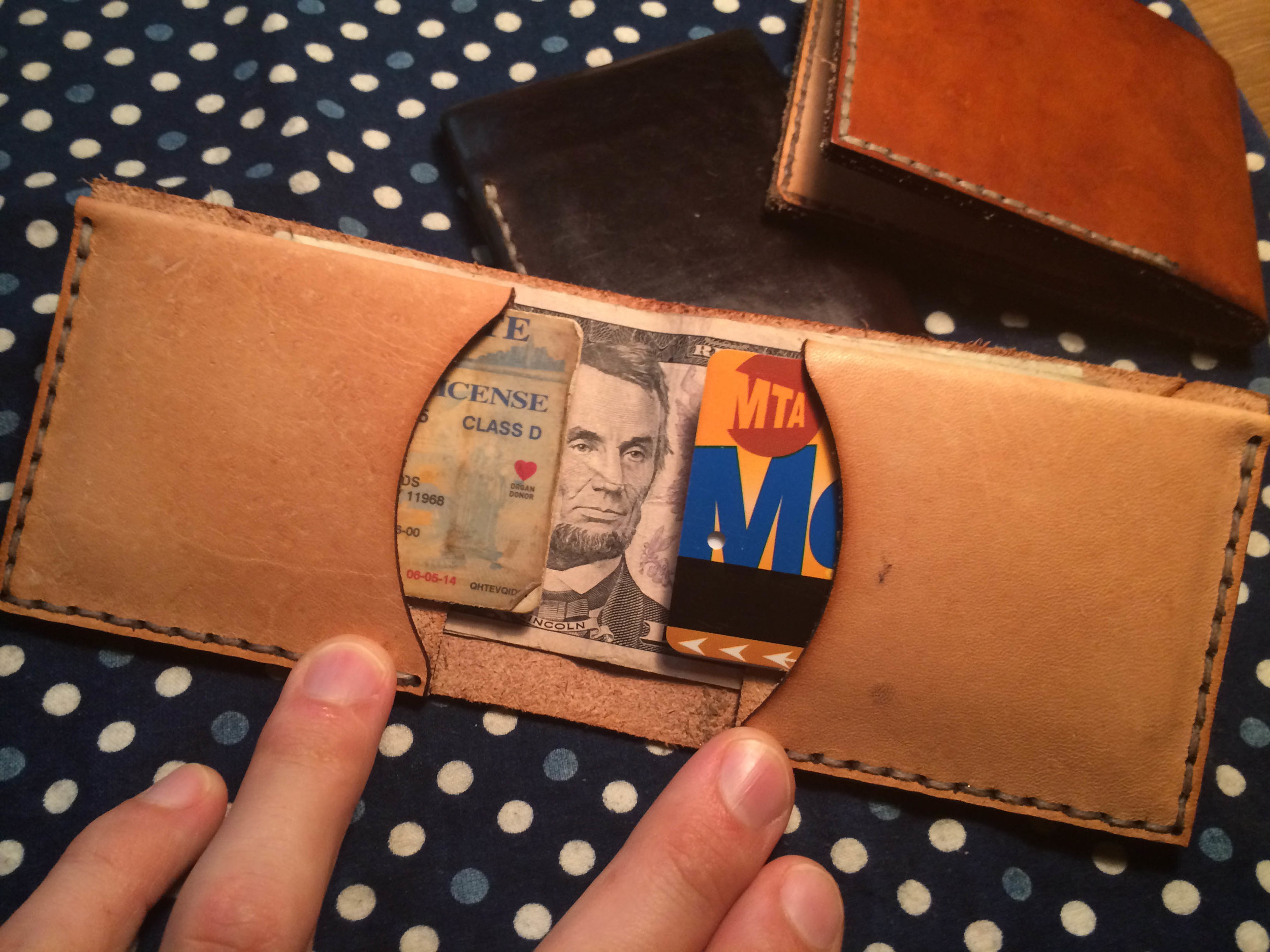
Christy and I have been making progress on the wallet :)

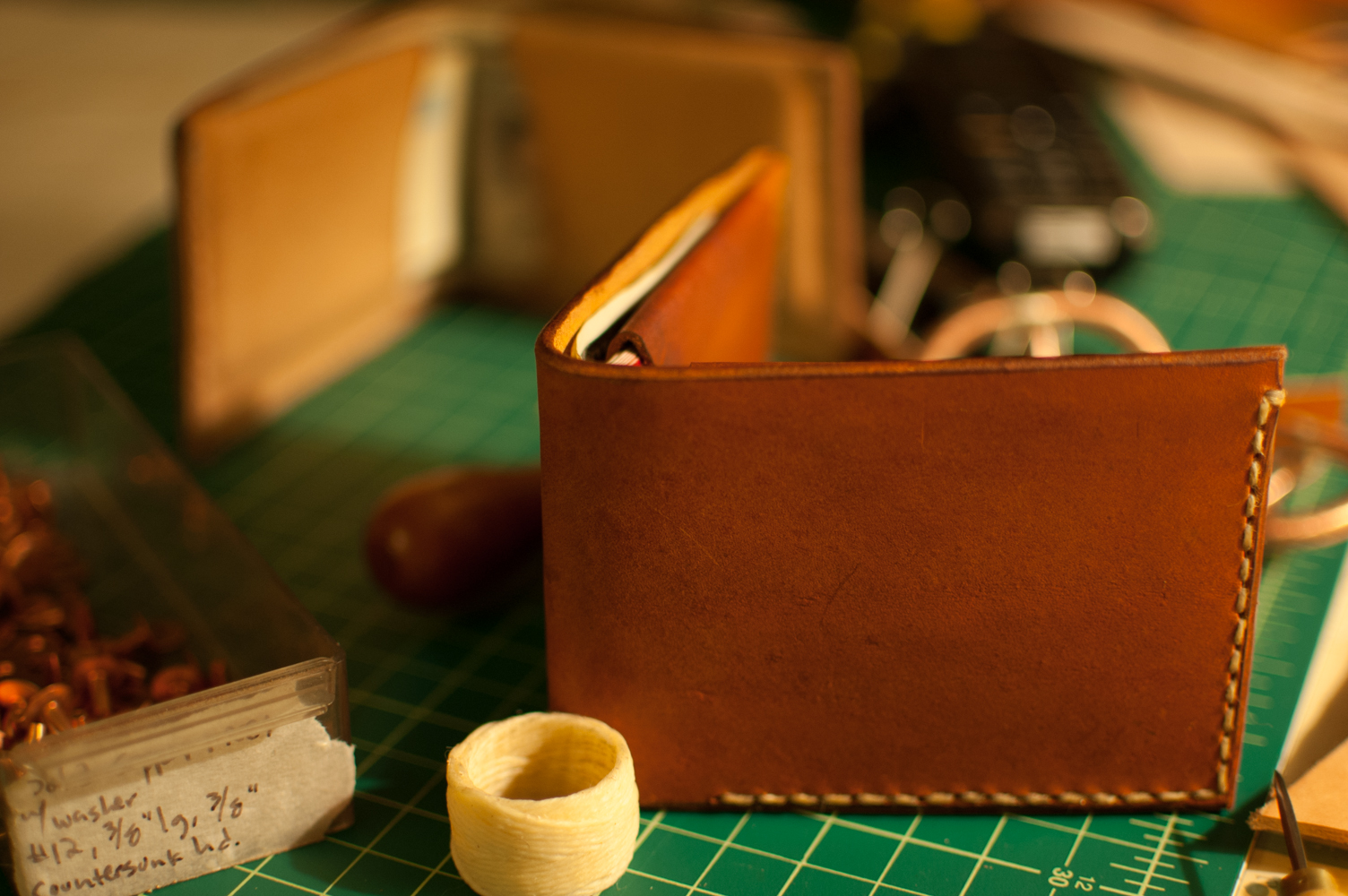
Center front is the latest version. On the right is one we made a few weeks back, but which needed a few modifications. In the back is the original version, which I made completely by hand in 2010 (it's been in my pocket for most of the time since then).

Throughout, the parts are vegetable tanned tooling leather. On the two new ones, we had the parts laser cut - but I'm not sure we'll be doing this for the production version.

We'll be finding suppliers of whole sides in the next few weeks, as well as looking into steel rule dies for making parts, etc. Expect updates.

SFO

Added on by Spencer Wright.

San Francisco: I will be in you 12.24-12.26. Holler at me.

This photograph, of the Golden Gate Bridge, was taken by my parents sometime in 1976-1977. 

Placebophiles

Added on by Spencer Wright.

This is definitely worth reading: Rob McGinley Myers on placebophilia. He takes his erstwhile obsession with audio equipment as an example - one in which he eventually concludes that "he was listening to his equipment rather than music."

It's easy to sneer at the placebo effect, or to feel ashamed of it when you're its victim. And that's precisely why I found Felix Salmon's piece revelatory, because instead of sneering at the placebo effect of fancy wine, its marketing, and its slightly higher prices, he thinks we should take advantage of it. If the placebo effect makes us happy, why not take advantage of that happiness? The more you spend on a wine, the more you like it. It really doesn’t matter what the wine is at all. But when you’re primed to taste a wine which you know a bit about, including the fact that you spent a significant amount of money on, then you’ll find things in that bottle which you love ... After all, what you see on the label, including what you see on the price tag, is important information which can tell you a lot about what you’re drinking. And the key to any kind of connoisseurship is informed appreciation of something beautiful.

...

Maybe each of these activities (listening to high end audio gear, drinking high end wine, having needles inserted into your chakras) is really about ritualizing a sensory experience. By putting on headphones you know are high quality, or drinking expensive wine, or entering the chiropractor's office, you are telling yourself, "I am going to focus on this moment. I am going to savor this." It's the act of savoring, rather than the savoring tool, that results in both happiness and a longer life.

Dog

Added on by Spencer Wright.

Yesterday, or something.

Dog is generally a lot of fun in the snow :)

I guess I'm naive, but I hadn't thought that the road salt would be as much of a hindrance as it has been the past few weeks. It only takes a block or two and I notice him limping around - something I rarely saw when we lived in the country. I even went so far as to buy him some booties, which has no joke increased the number of girls smiling at us/him by 5000%.

Short!

Added on by Spencer Wright.

The Public Radio is now shorter :)

We've been working on fitting everything into the next size down jar for a little while, and this afternoon we made a few steps in that direction. To celebrate, I spent a few hours modeling the target jar. 

The previous model was one of my first surface models, and I hacked it together *hard.* In the meantime I've gotten a lot more experience with NURBS, and it was great banging this out quickly. It's a lot more realistic in many ways, though I did half-ass the Ball logo a bit.

On the electronics front, Zach cranked out a new board design and we should be ordering a new PCB tomorrow. I also ordered new lids (one based on the new design, which is heading in the direction of sheet metal stamping). Meanwhile we've got a breadboarded version running, though it's a bit unwieldy. 

Expect more in the next week.

Public Radio Progress

Added on by Spencer Wright.

More on the electronics side soon (we had some good progress today), but for now just a few images.

I spent a bit of time today remodeling the lid to account for a few slight changes. The real rationale has to do with the potentiometer, which needed to be reoriented slightly. In the meantime I laid the speaker holes out a bit differently, and I'm pleased with the result.

I hope to have the whole thing together & in a jar by the middle of this coming week - finally! 

Diamonds are Bullshit

Added on by Spencer Wright.

From "Diamonds are Bullshit," 2013.05.19 by Rohin Dhar of Priceonomics.com. Emphasis mine.

And so, in 1938, De Beers turned to Madison Avenue for help. They hired Gerold Lauck and the N. W. Ayer advertising agency, who commissioned a study with some astute observations. Men were the key to the market:

Since “young men buy over 90% of all engagement rings” it would be crucial to inculcate in them the idea that diamonds were a gift of love: the larger and finer the diamond, the greater the expression of love. Similarly, young women had to be encouraged to view diamonds as an integral part of any romantic courtship...

...Lauck needed to sell a product that people either did not want or could not afford. His solution would haunt men for generations. He advised that De Beers market diamonds as a status symbol:

 ”The substantial diamond gift can be made a more widely sought symbol of personal and family success — an expression of socio-economic achievement.”

"Promote the diamond as one material object which can reflect, in a very personal way, a man’s … success in life."

This article also contains an interesting discussion of the price economics of diamonds, which due to their complicated and subjective valuations end up being remarkably poor investment vehicles. Interesting stuff.

The Reserve.

Added on by Spencer Wright.

From "Analysis of Reserve and Regular Bottlings: Why Pay for a Difference Only the Critics Claim to Notice?" Published by Roman Weil, Co-Chairman, Oenonomy Society of the US, 2013.05.16. Emphasis mine.

The wine maker harvests the grapes, sorting the best from the ordinary. At the end of the harvest, the pile of ordinary grapes exceeds the size of the pile of the best grapes, often by a factor of more than five. The wine maker takes special care in turning those best grapes into wine, bottles it separately, labels it differently, calls it the Reserve Bottling, to distinguish it from the bottling of wine made from the ordinary grapes, and offers it for sale at a price from as little as 40 percent higher to as much as three times the price of the regular bottlings. The process of sorting ordinary from best may involve the wine maker's selecting barrels of grape juice after the press or after some aging, or from sorting wines grown on one plot differently from another plot. One way or another, the wine maker distinguishes regular wine from similar, putatively great wine, with a reserve designation, perhaps using a different word, but the same concept.

Here, I report my tests of wine testers' ability to distinguish reserve bottlings from regular. My results show that:

  • just over 40 percent of my wine tester subjects can distinguish in blind tastings the regular from the reserve versions of a wine, whereas one-third could if the process was random, and
  • of those who can distinguish, half prefer the reserve and just under half prefer the regular.

Conclusion: Wine drinkers cannot distinguish much better than chance between regular and reserve versions of a wine. Those who can distinguish the difference do not prefer the more expensive reserve except at random. In only a fifth of the tests could the tester both distinguish the regular from the reserve and prefer to drink the more expensive reserve.

Later, on the experimental methods:

Most of the testers were either MBA students at the Graduate School of Business of the University of Chicago or its alumni, alumnae, and their companions. They are primarily upper middle-class, experienced and enthusiastic wine drinkers, but not experts. All testers paid an entry fee for the testing, which fee covered full costs of the testing, and in the case of some of the alumni, more.

And later still:

What to do with these results? ...If you serve the reserve wine, be sure to show your guests the label, because the chances are four to one against any one person's being impressed by the taste, so that any warm feelings the guest forms of your generosity will likely come from visual, not olfactory and taste, stimuli.

Currently

Added on by Spencer Wright.

I think this is technically workbench #4.

I spend quite a bit of time prototyping at my desk, and a lot of stuff ends up behind me, here. Could be worse.

Massive

Added on by Spencer Wright.

From "Google Puts Money on Robots, Using the Man Behind Android," The New York Times, 2013.12.04. Emphasis mine.

“The opportunity is massive,” said Andrew McAfee, a principal research scientist at the M.I.T. Center for Digital Business. “There are still people who walk around in factories and pick things up in distribution centers and work in the back rooms of grocery stores.

What McAfee is saying here is totally nontrivial. All around the world and across every sector of the economy there are human beings performing menial tasks.

Until I see evidence that menial work is useful for more than building character, I'm all for ending that.

Control

Added on by Spencer Wright.

From "Why Gamers Can't Stop Playing First-Person Shooters," by Maria Konnikova, New Yorker Online. Emphasis mine.

Control, compounded by a first-person perspective, may be the key to the first-person shooter’s enduring appeal. A fundamental component of our happiness is a sense of control over our lives. It is, in fact, “a biological imperative for survival,” according to a recent review of animal, clinical, and neuroimaging evidence. The more in control we think we are, the better we feel; the more that control is taken away, the emotionally worse off we become. In extreme cases, a loss of control can lead to a condition known as learned helplessness, in which a person becomes helpless to influence his own environment. And our sense of agency, it turns out, is often related quite closely to our motor actions: Do our movements cause a desired change in the environment? If they do, we feel quite satisfied with ourselves and with our personal effectiveness. First-person shooters put our ability to control the environment, and our perception of our effectiveness, at the forefront of play.

Saddle

Added on by Spencer Wright.

Quick afternoon project: make a quick saddle, plop it on the topper model. 

My workflow for the saddle: Started as a quadball T-spline body in Fusion 360. Played with it for maybe a half hour, then converted to a BRep and exported as a STEP file. Imported that into Inventor. Made two 2D sketches for the rail sweeps, then did a 3D intersection curve on them and swept a 7mm rail profile along the resulting path (I'm still using standard saddle rails here, I know...).

The workflow isn't that bad, and the whole process didn't take more than an hour and a half... but if I had a 3D scanner I probably would have used it, at least just to get the saddle top shape. 

Incidentally, I spent a little while looking around the fi'zi:k site (I fucking hate the punctuation in their name), and came across their new Volta saddle. I like the look of it, and would have copied it if I had seen it a little earlier.

Ultimately I'd like to get rid of the rails on the whole assembly and mount the saddle top directly to a redesigned topper. Stay tuned.

Potentiometers

Added on by Spencer Wright.

Today is potentiometerday.

The Public Radio has one knob on it: a switched single-gang potentiometer. The switch turns the entire device on, and the pot adjusts volume.

The plan originally was to get a PCB mount pot, and hang all of the electronics on it. That ended up causing troubles re: fitting everything into the jar, though, so we changed directions a bit. At the moment, the goal is to find a pot with solder lugs. It'll be panel-mounted to the lid of the radio, and will have five wires going from it down to the circuit board. My hope is that this isn't *too* labor intensive to assemble... we'll see soon. 

Ideally, we'd be using a 10k pot with a logarithmic (audio) taper. The theory goes that the human ear has a logarithmic response to sound pressure, and so audio should be controlled along a logarithmic curve. From a great article called "The Secret Life of Pots":

Volume controls are different. The human ear does not respond linearly to loudness. It responds to the logarithm of loudness. That means that for a sound to seem twice as loud, it has to be almost ten times the actual change in air pressure. For us to have a control pot that seems to make a linear change in loudness per unit of rotation, the control must compensate for the human ear's oddity and supply ever-increasing amounts of signal per unit rotation. This compensating resistance taper is accurately called a "left hand logarithmic taper" but for historical reasons has been called an audio or log pot. In these pots, the wiper traverses resistance very slowly at first, then faster as the rotation increases. The actual curve looks exponential if you plot resistance or voltage division ratios per unit of rotation.

As it turns out, finding a logarithmic pot in the configuration I want is rather difficult. I spent a while searching and ended up buying a little selection of pots - some linear and some logarithmic; some PC pin and some solder lugs; with various shaft conditions and body styles. I tried them all out, testing for knobfeel and comparing price, availability, and usability. The results were interesting, and to my delight the pot that I liked best ended up also being one of the least expensive and most readily available. It's a 10K linear taper with a 6mm flatted shaft and solder lugs.
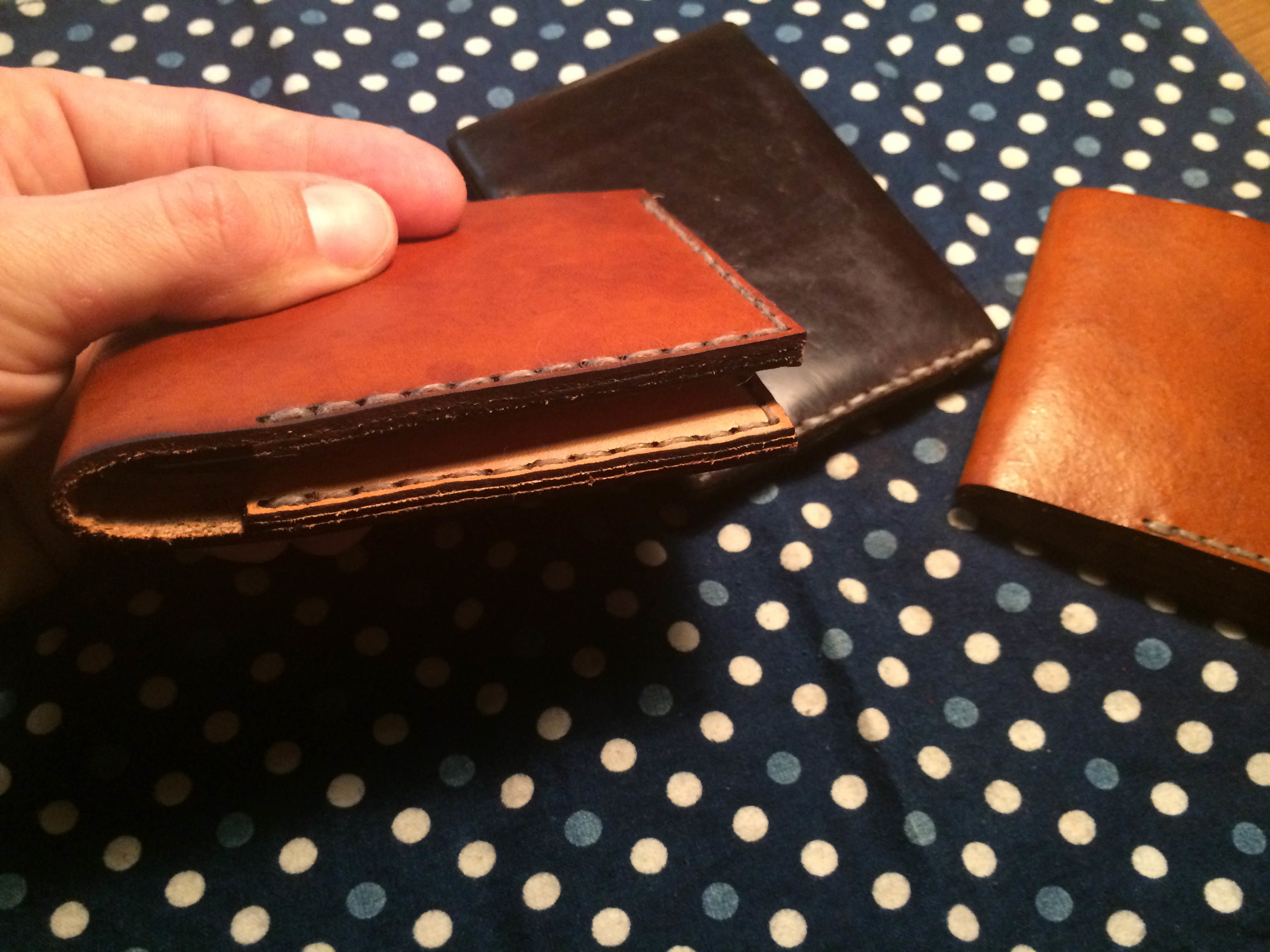
In the background you can see the knob that I'm planning on using. It attaches to the shaft of the pot with a little set screw; the result is quite pleasant.

A geeky note: I really like looking at switch designs, and this one is super simple and rather clever. On the backside of the pot there's a tiny cam which actuates a little spring-loaded contact. The whole operation is totally visible and rather mesmerizing. 

As I noted, this pot has a linear taper. It's likely that, after some testing, we'll add a resistor between the wiper and the counterclockwise lug, making the nearly logarithmic. This is done through a simple and really effective algebra trick, which is described really well at the same "The Secret Life of Pots" post. More on this as we get the rest of the radio together, likely in the middle of next week.

Wallet

Added on by Spencer Wright.

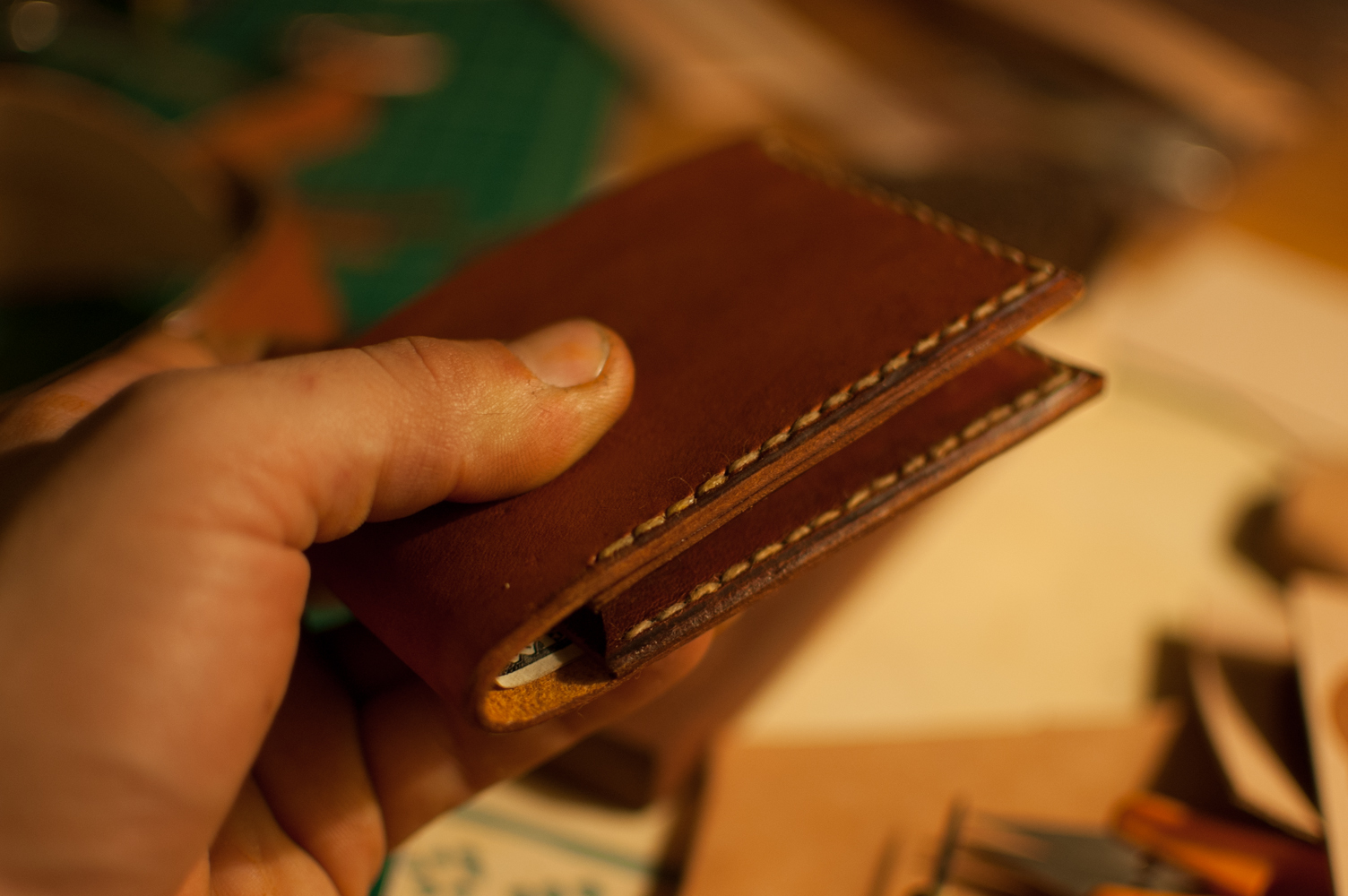
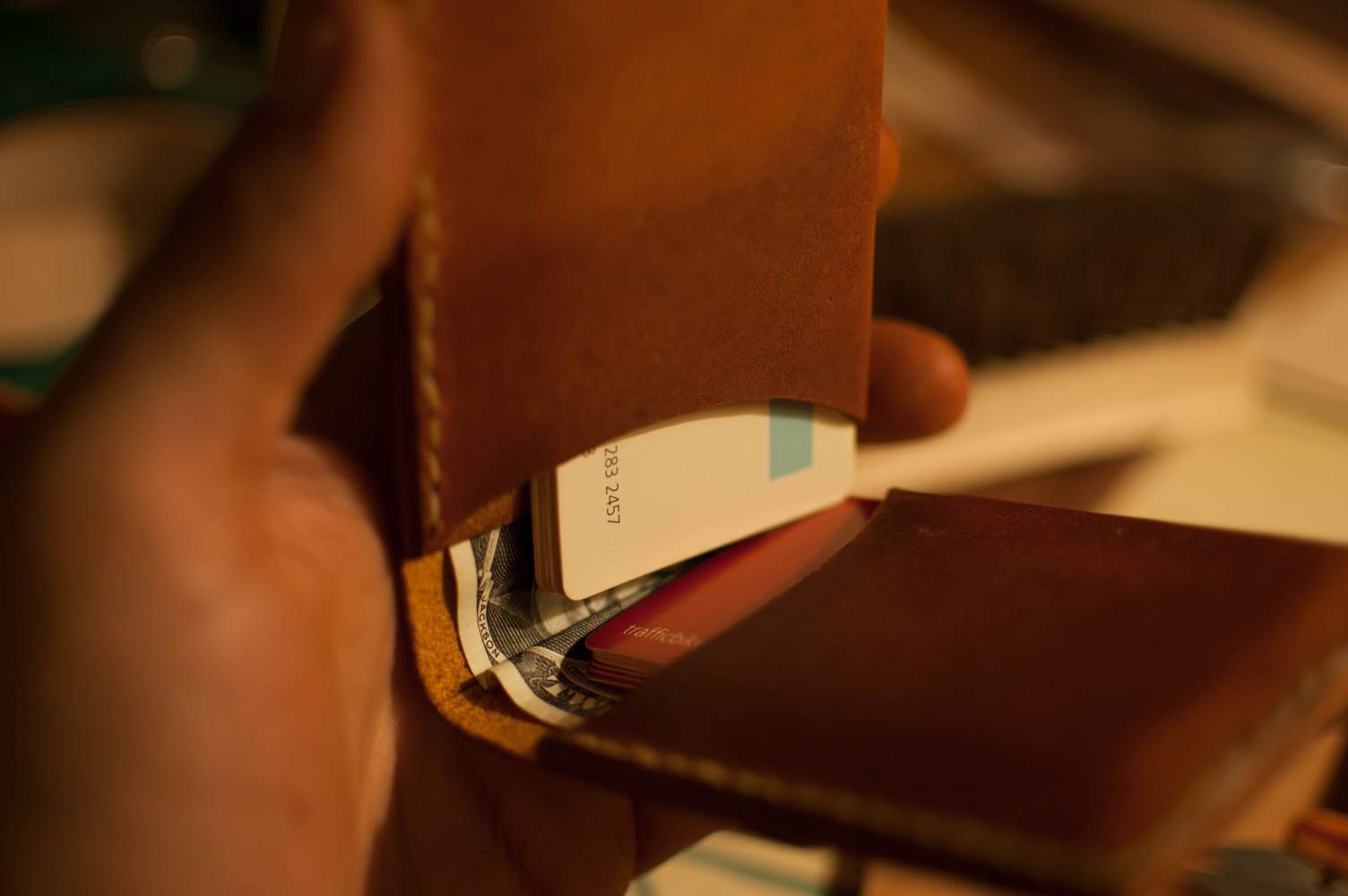
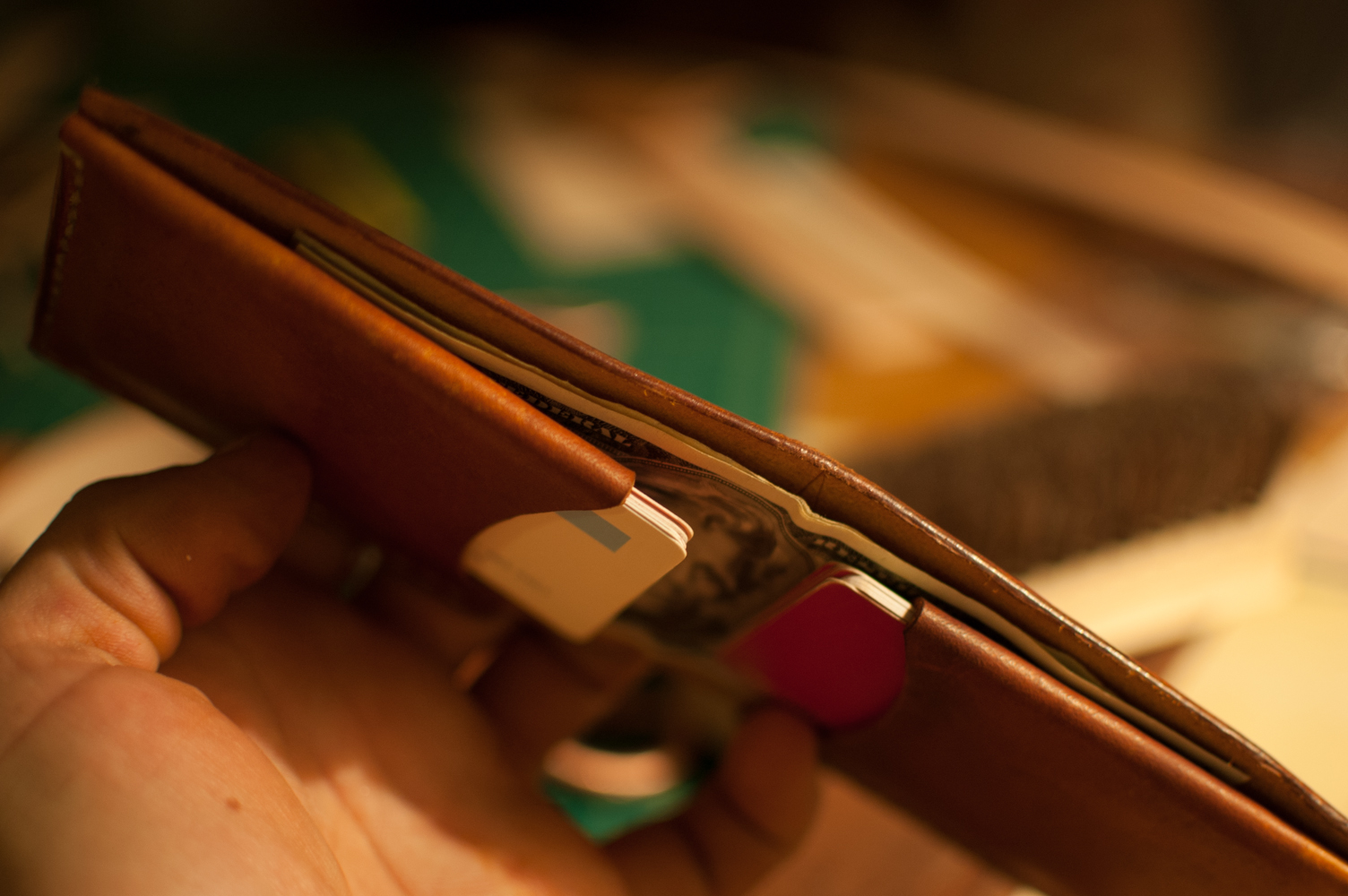
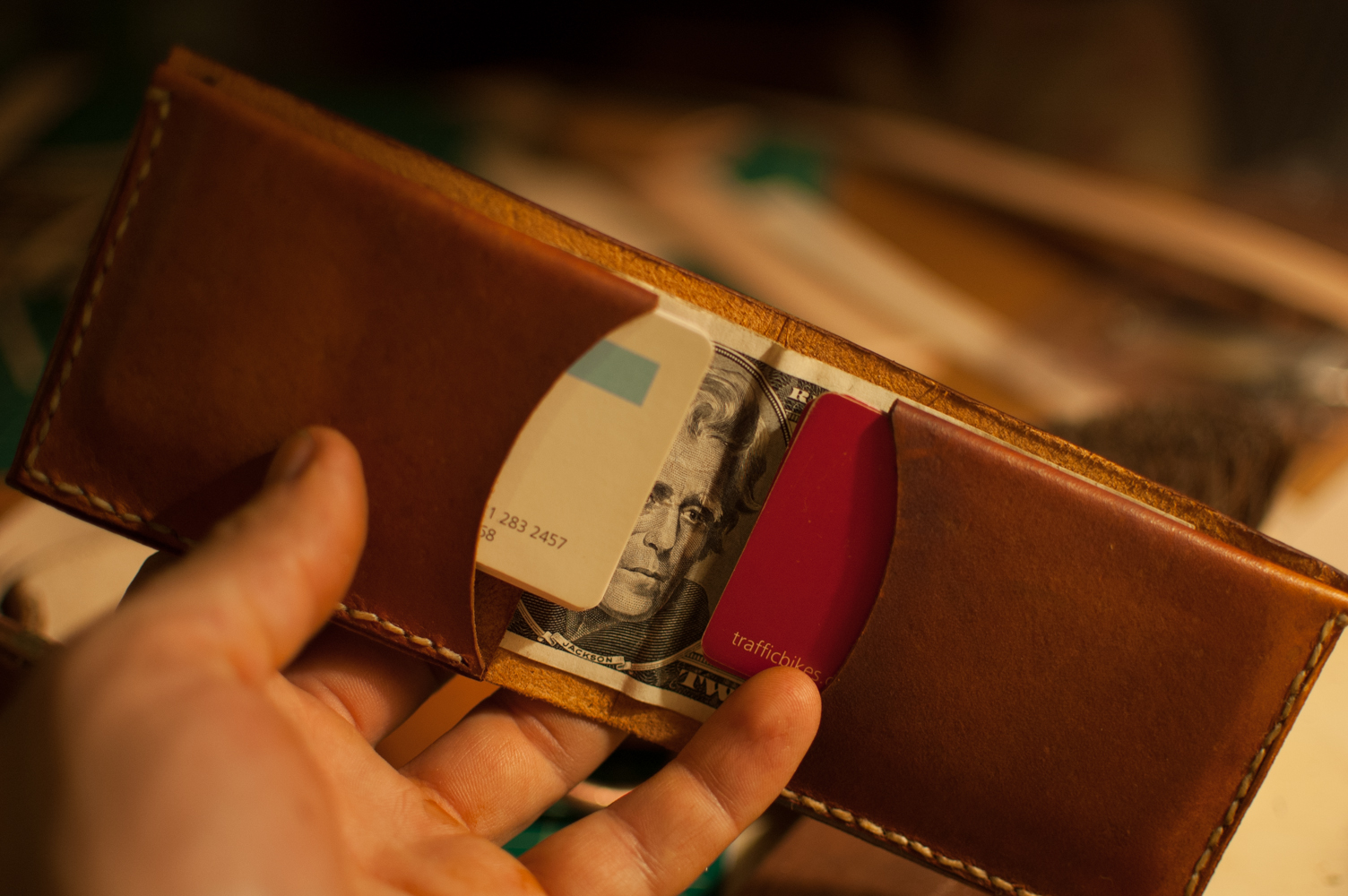
About three years ago, I made myself a wallet.

I drew inspiration from a number of makers, among them Billykirk, Makr, and Corter. Eric Heins @ Corter was also helpful in getting me oriented on a few of the details.

Recently I've been inspired by the idea of making a batch of similar pieces, and have been working with Christy Holzer on developing specs and finding suppliers of the necessary parts.

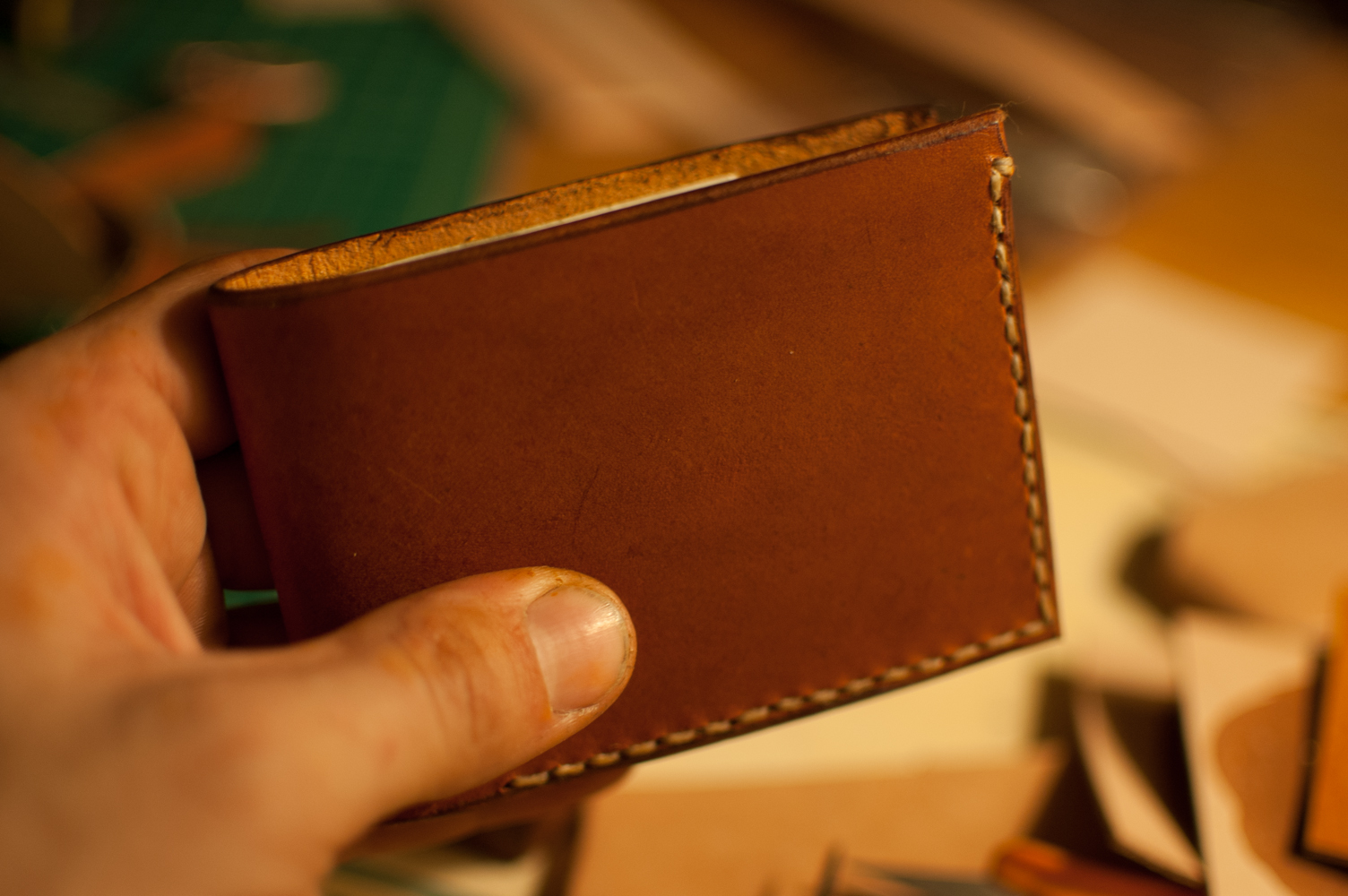
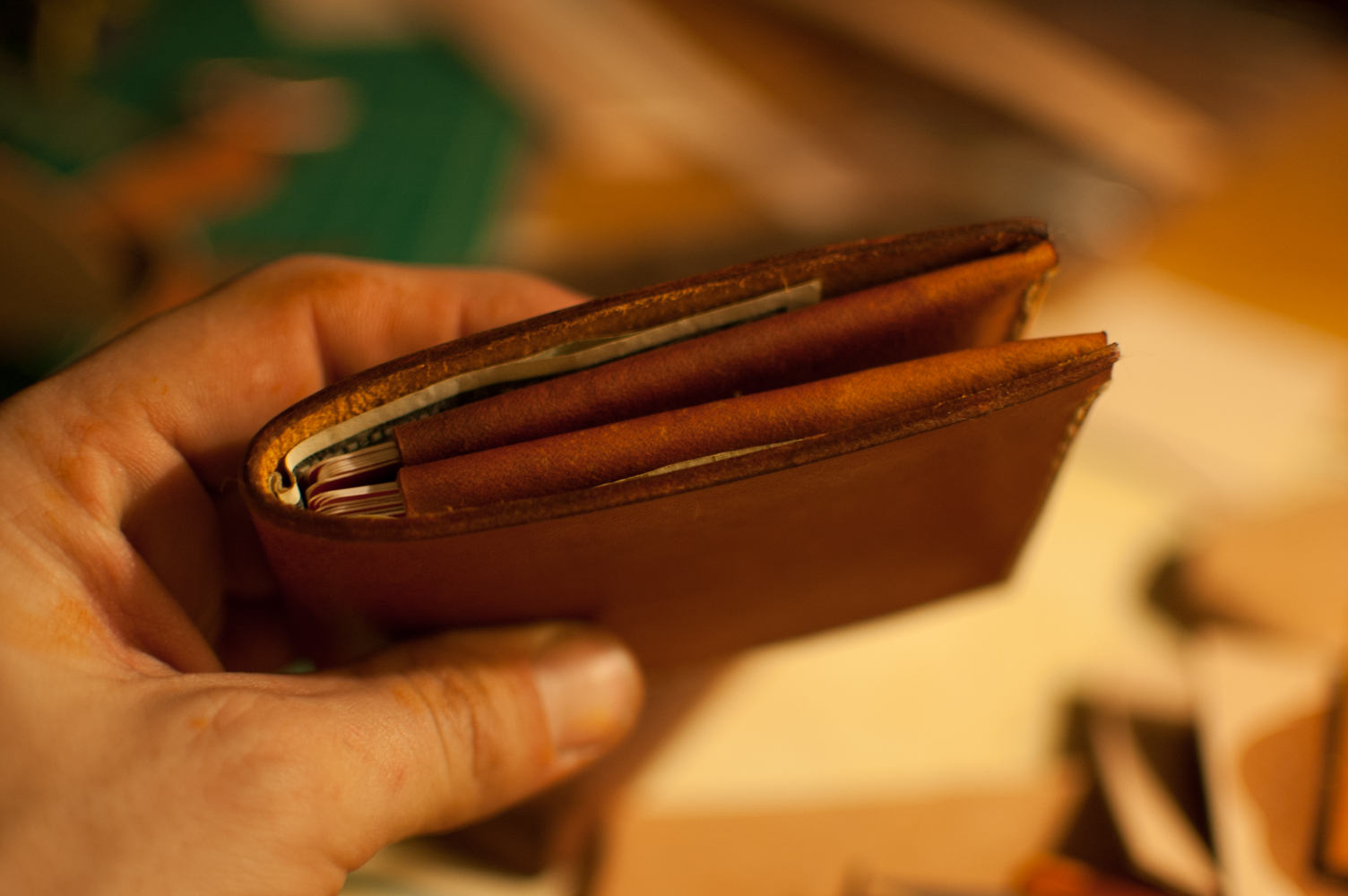
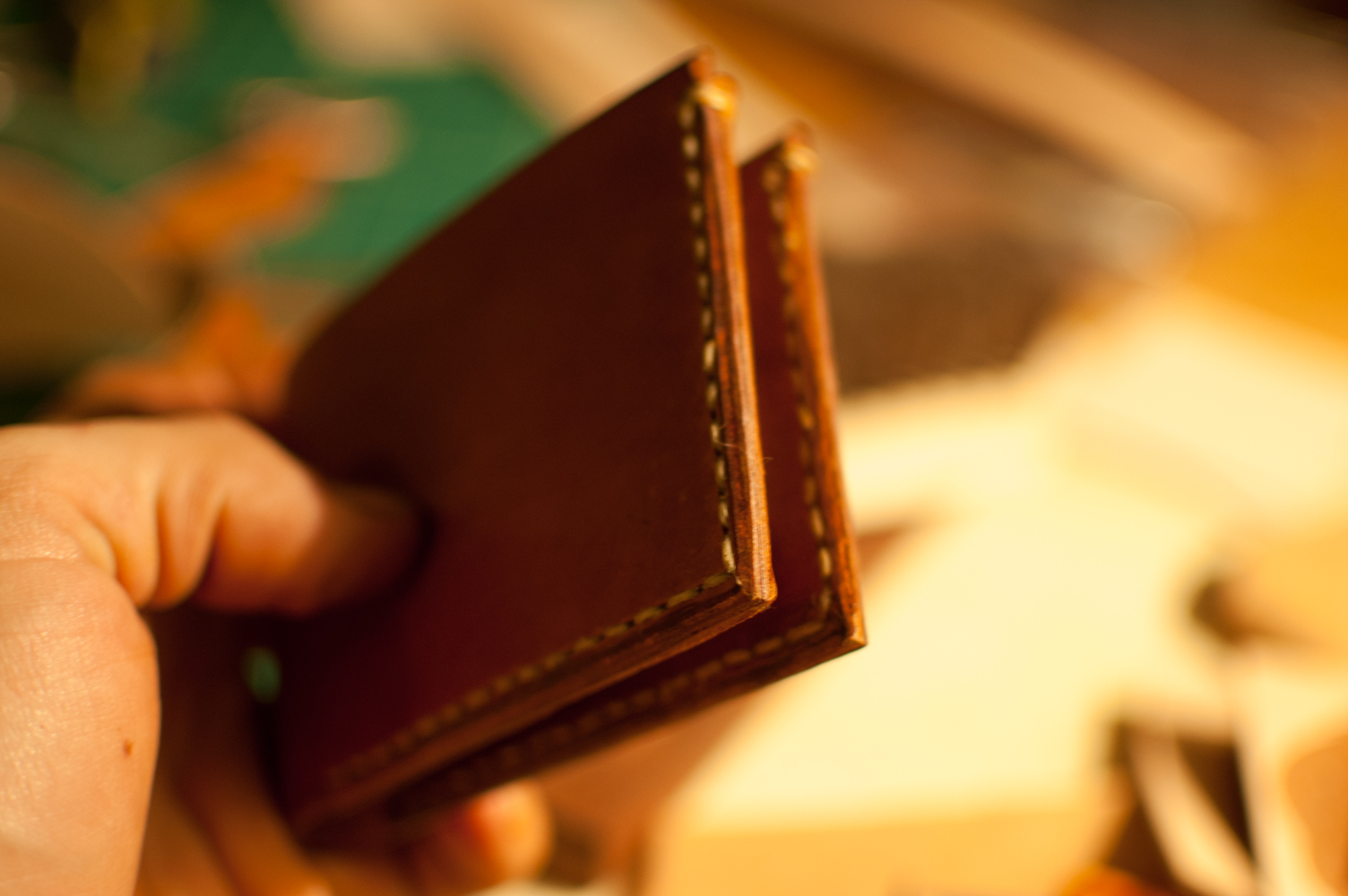
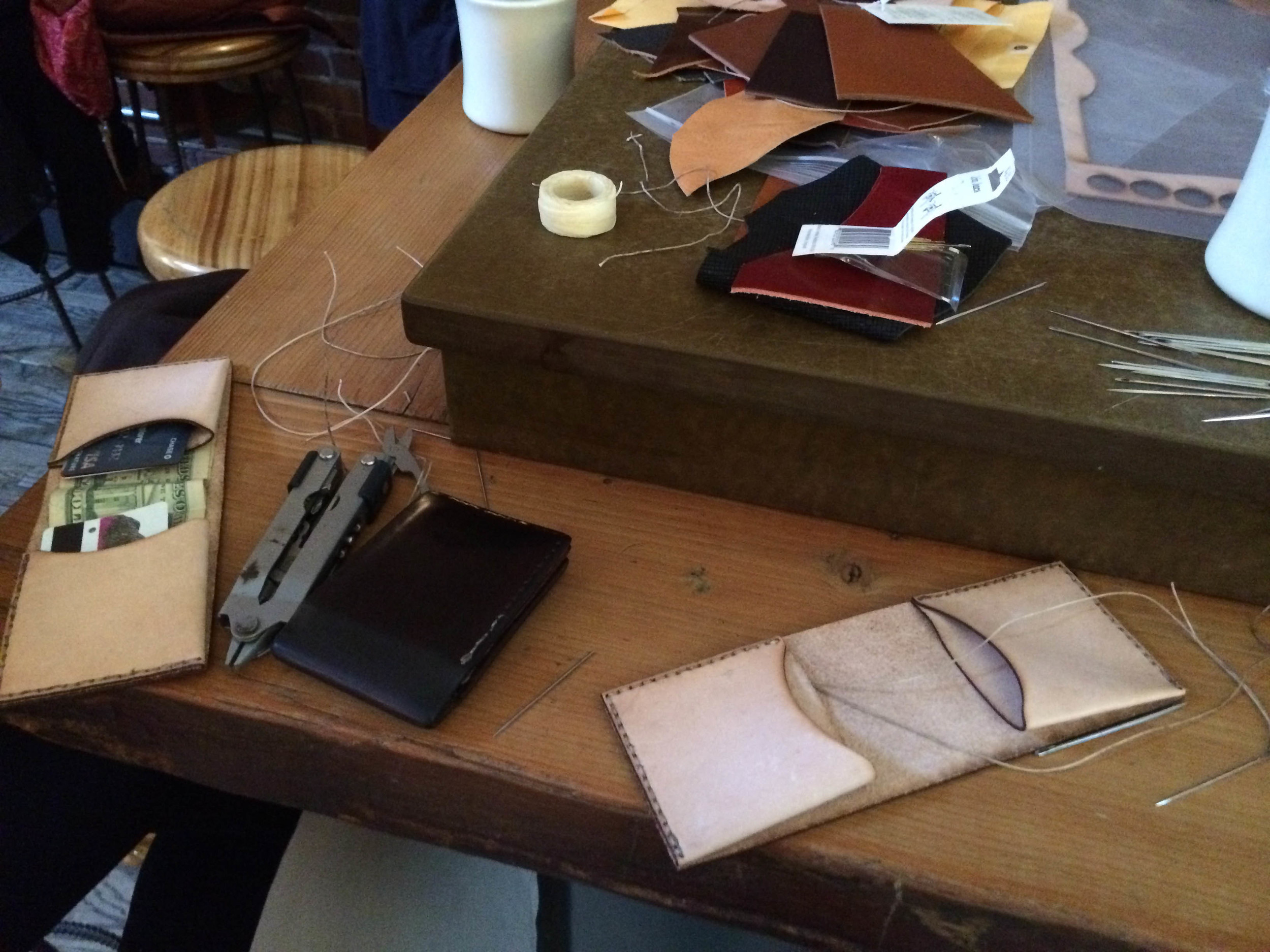
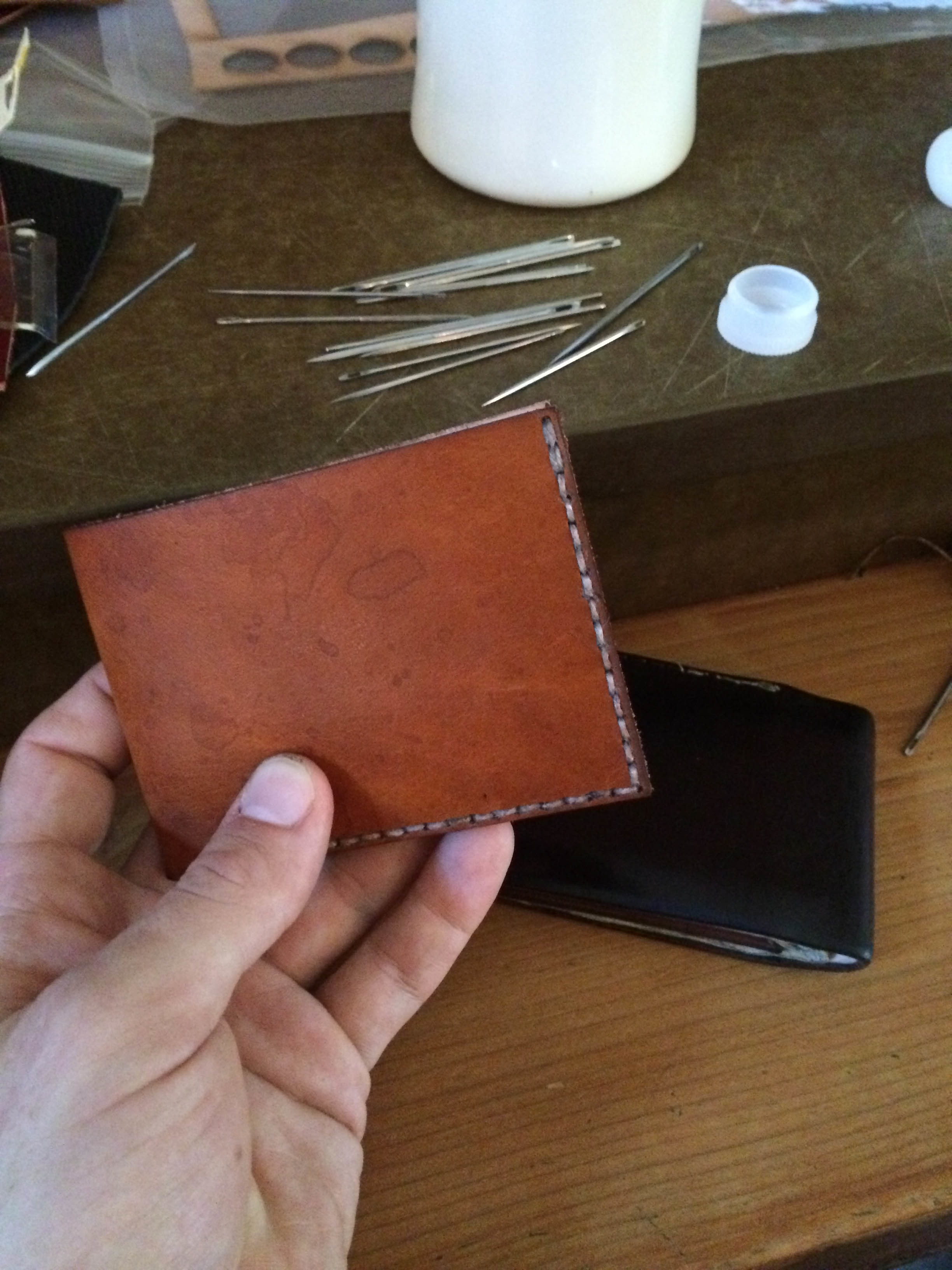
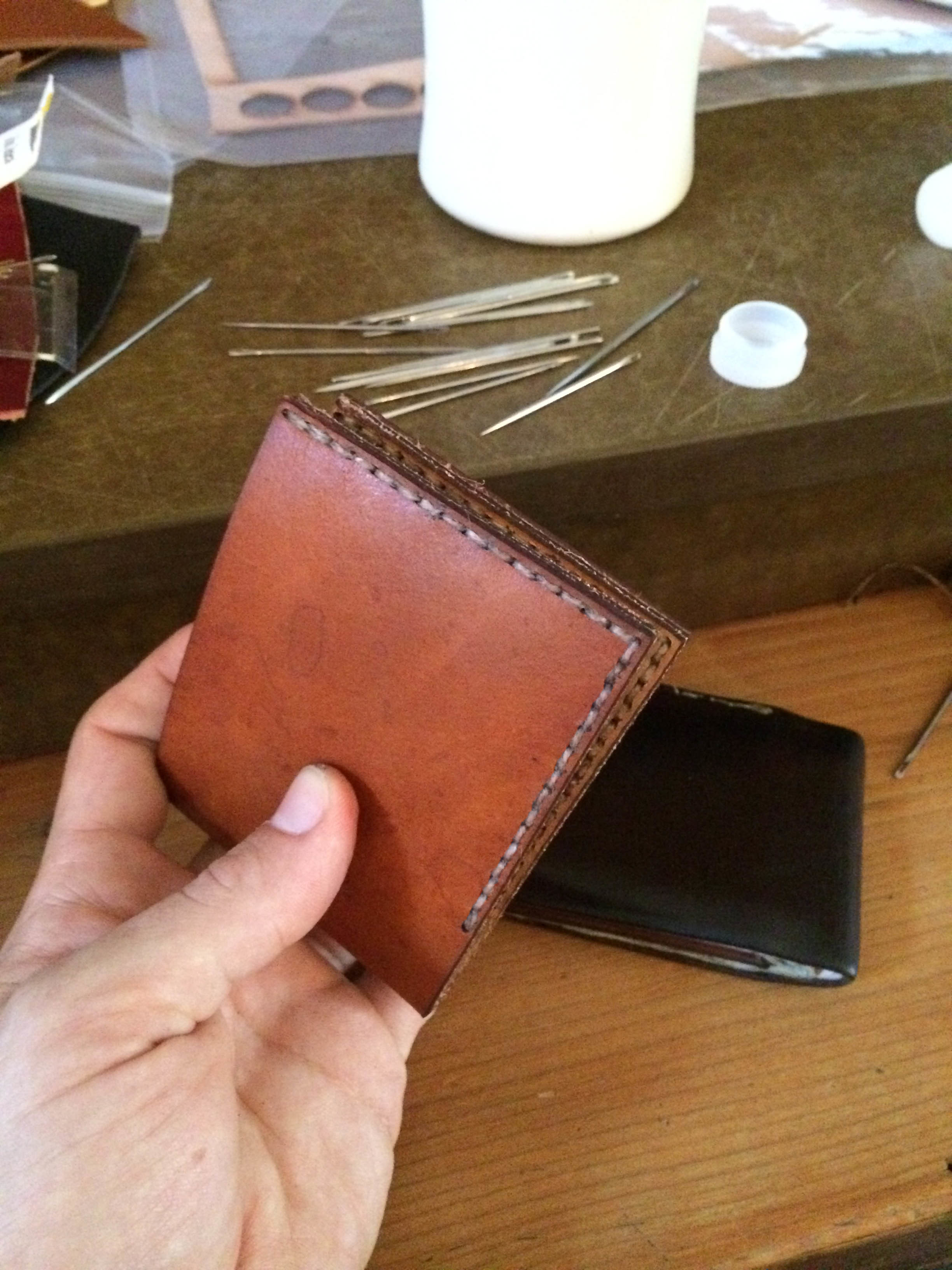
Last week, we got a few pieces cut and met to sew them up. The leather was all old scraps I had, and the fit & finish isn't exactly what it'll be in the end, but I like the result. We'll be refining it a bit over the next week or two, and hope to make plans for a small production run soon. 

It's a fun project, and I'm excited to see what the response is. Sign up below to get updates!