Manufacturing guy-at-large.

My Beef with iOS Newsstand

Added on by Spencer Wright.

I made a lame attempt to describe why I'm not a fan of the iOS Newsstand app last weekend, and thought a bit about it afterwards. Quickly, here are my thoughts:

The problem with Newsstand is that it begins with the base assumption that periodicals constitute a meaningful subcategory of content distribution media. 

Part of the lesson of the past few decades is [citation needed] that consumers don't care about distribution platforms. They're perfectly happy watching TV on their computers, reading newspapers on their iPads, and listening to talk "radio" shows as Podcasts. They'll happily trade their coffee table books for Tumblr blogs, and have little qualms skipping the bar and finding a date on a smartphone app.

Newsstand somehow misses this. It tries to package and export the entire magazine experience onto my phone, ignoring the myriad ways that I've found to consume content there and instead setting up a walled garden within which I'm allowed to view periodicals. 

In my perfect world, periodicals would integrate seamlessly into Pocket or Instapaper. My subscription to the New Yorker should automatically download new articles to those apps, where I can decide when and where to consume them. Pocket is where I do nearly all of my written media consumption, and I see no reason why periodicals should be any different.
T-Spline modeling

Added on by Spencer Wright.

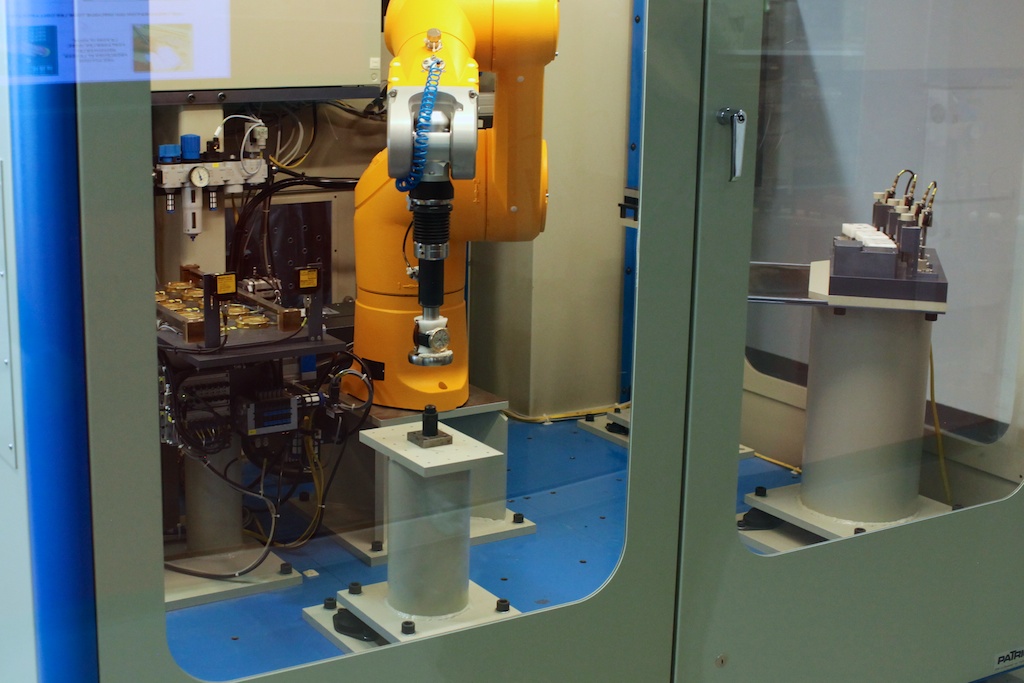
This model took me about 45 minutes. It's basically the first "organic" model I've ever created. 100% T-spline geometry, all on a piece of free software. 

I started with a single torus on the XY plane for one of the eyepieces. I applied a "Mirror-Duplicate" on the YZ plane, creating a second eyepiece that automatically mirrors whatever I did on the first. Then I created the only sketch in the entire model - a basic nose bridge, spanning from eyepiece to eyepiece. I created a "Bridge" feature between the two eyepieces, then began to sculpt. A bit into the process, I created the temples by extruding them from the faces closest to the top corners of the eyepieces.

At this point, I could export STLs and have this printed as a full scale, physical, part-in-hand mockup. The entire process - from sketching the torus to completing the print - would take about 4.5 hours. 

Note: I'm assuming you're using FDM (a process I'll begrudgingly accept for quick mockup purposes), e.g. MakerBot, and that your Lean, One-Piece-Flow Supply chain (as it were) is ready and running smoothly.

Update: Dropout protector

Added on by Spencer Wright.

Stopped by NYCVelo today to get design review on a few parts I've been playing with. While there, I tried out the dropout protector I designed on a fork they had laying around. It was the first chance I've had to do so.

The fit is snug, just like it should be - it took a mallet to get the protector in place. There's no chance it's going move around during shipping, but with a little careful prodding I was able to get it back out just fine.

I also left one of my dummy headsets there for them to use on frames around the shop. Brett was pretty excited about it, and it was great to get some feedback on the execution and pricing. I'll probably redesign the part soon and get an injection molded part quoted. In the meantime, the dropout protector is for sale at Shapeways if you want to grab one (or a dozen!) for yourself :)

Felix Salmon on Wine

Added on by Spencer Wright.

Felix Salmon has a bunch of great posts on the ups and downs of blind wine tasting on his Reuters blog. A few excerpts below, emphasis mine throughout.

From "The Negative Correlation Between Wine Price and Quality," 2008.14.26:

Eric Asimov thinks that wine is like film or literature: the good might not be popular, and the popular might not be good. Which may or may not be true – but no one tries to charge higher prices for better films or better books. He does however make another good point: that the real finds in the wine world aren’t the expensive famous wines or even the cheap famous wines but rather the tiny artisanal wines which have a personality and uniqueness which defies pricing. If you find a wine you really love, then it’s likely to be worth spending money on. But if you find a wine which everybody loves (Dom Perignon is the example in the book), then it’s almost certainly overpriced.

From "Tasting Wine Blind," 2009.09.12:

In any case, the various different factors which go into the enjoyment of a wine are so multitudinous that when you try to eradicate them all in order to allow different wines to compete on a level playing field, you at the same time eradicate much of what makes a wine so enjoyable in the first place. You might love your spouse’s [insert body part here], but it would be pointless and invidious for someone to test that love by presenting you with a series of carefully anonymized body parts and asking you which one you liked the most.

And:

What is blind tasting good for? Well, for one thing it’s very good at showing how important knowledge of price, as opposed to price itself, is as a contributing factor to a wine’s perceived quality. If you know that a wine you’re drinking is expensive, you’ll probably like it much more. If you’re deceived into thinking that a wine is expensive (if someone poured Yellowtail into a Lafite bottle, say) you’ll like that much more, too. And if someone poured Lafite into a colorful screw-top bottle, you’d like it less.
When I say, then, that in wine there’s no correlation between price and quality, what I mean is that there’s no correlation between price and quality except for in the 99% of cases where in fact the correlation is very strong — the cases when you know, more or less, how expensive the wine you’re drinking is.
I’m trying to train myself out of that ingrained mindset, by drinking quite a lot of cheap wine and buying large quantities of the good stuff. And there really is a lot of good cheap wine out there. But I know that I do still have the same prejudices as everybody else, no matter how much I write about negative price-quality correlations. If I open a cheap bottle and I don’t think much of it at first, I’ll assume it’s not very good. On the other hand, if I open an expensive bottle and I don’t think much of it at first, I’ll let it breathe, I’ll revisit it later, I’ll try to see if I can discern some subtlety and sophistication which might not have been immediately apparent. And if I look hard enough, I’ll probably find it.

Also of note: In 2010, Salmon wrote a great post on how he structures his at-home wine tasting events. I've been wanting to host something similar for a while, and will definitely be taking his format notes into consideration.

Subjective well-being

Added on by Spencer Wright.

From the wikipedia page for "Hedonic Treadmill," emphasis mine.

Headey (2008) concluded that an internal locus of control along with "positive" personality traits (notably low neuroticism) are the largest significant factors affecting one's subjective well-being (SWB). The author also found that adopting "non-zero sum" goals, that is those which enrich one's relationships with others and with society as a whole (family-oriented and altruistic goals), increase the level of SWB. Conversely, attaching importance to zero-sum life goals: career success, wealth, and social status, will have a small but nevertheless statistically significant negative impact on people's overall subjective well-being (even though the size of a household's disposable income does have a small, positive impact on SWB). Duration of one's education seems to have no direct bearing on life satisfaction. And contradicting set point theory, there is apparently no return to homeostasis after sustaining a disability or developing a chronic illness. These disabling events are permanent, and thus according to cognitive model of depression, may contribute to depressive thoughts and increase neuroticism (another factor found by Headey to diminish SWB). In fact disability appears to be the single most important factor affecting human subjective well being. The impact of disability on SWB is almost twice as large as that of the second strongest factor affecting life satisfaction—the personality trait of neuroticism.

Mailing list!

Added on by Spencer Wright.

I know you're out there: The RSS readers, the folks who drop by, the people who are at least *somewhat* interested in what I'm thinking about.

So here's your chance!

I'm setting up a mailing list. Nothing fancy, just links to things I read on the internet and think are good. I read a lot, and the topics are varied, so expect a wide range of compelling to mindblowing to kind of weird stuff. I'll try to keep it predictable, concise, and relevant.

And I won't, like, spam you.

Here's a taste of my first draft: 

So. Sign up below and I'll get in touch. It'll be fun. 

Really.

At the risk of sounding naive

Added on by Spencer Wright.

The act of putting yourself out there, of being outside of your abilities a bit. You take your experience, your expertise, and you venture a little bit beyond them. And some of what you know is applicable, but you've always got to keep in mind that whatever frameworks you're bringing to bear don't necessarily apply.

I like being this way - a bit over my head. But I'm at my best when I'm honest with that fact. 

At the risk of sounding naive is a fairly good way to communicate this, in certain contexts. 

Pretty lucky

Added on by Spencer Wright.

This is kinda obscure, but I've spent the past few days learning all the ways that you *can't* get vector text into Autodesk Fusion 360. Fusion doesn't support text input directly, so I've been creating vector text in Illustrator and then exporting/importing. That's all fine, but there are also some issues in Fusion with importing SVGs... it's a bit unclear. Anyway I'm getting closer:

I was shocked to learn that keeping all the original text vectors in there (as opposed to just exporting the stroke outline) ended up being the key. It was a PITA to extrude just what I wanted, but in the end it worked.

This T-spline model was extruded and then "patched"... Results were mixed. 

Management

Added on by Spencer Wright.

We believe great management is built on a few key capabilities: giving great, inspirational feedback; active improvement of colleagues’ skills over time; and constructing project rhythms that extract outsize value from each member on a team. It’s not about efficiency or Gantt charts, it’s about helping the people around you achieve more when you’re around than when you’re not.

-Clay Parker Jones, in Medium; emphasis mine.

Misplaced Optimism

Added on by Spencer Wright.

The following Q&A is excerpted from Makeway Magazine's interview with Jake Bronstein, of Flint & Tinder.

Through the journey so far, any particularly memorable stories that have helped you continue?


The first underwear factory featured in our video is particularly near and dear to my heart. It was in the foothills of PA and had been having a hard time for a VERY long time. We got them spun up making underwear (bought them a couple of pieces of equipment, learned to use it together etc) and in doing so kept nearly 100 people employed for 3 months. It wasn’t enough to keep the bank from foreclosing though. It was really hard watching, but it also crystalized the importance of what it is we’re going.

Here, a weird narrative. A "family owned and operated" factory in middle Pennsylvania is down on its luck. They're "ready for something better," so Bronstein - an entrepreneur and showman - makes them the lead role in his (highly successful) Kickstarter campaign. Here's the video:

I take Bronstein at his word that he worked intimately with his factory, and that if he could have had his way they would have remained open. But the portion of his $290K campaign that went to the factory apparently "wasn't enough to keep the bank from foreclosing," and the factory was shuttered.

The Flint & Tinder FAQ page claims that "for every 1,000 pair of underwear we sell per month, at least one sustainable job is added within our supply chain. " But what does "sustainable" mean, and why wasn't F&T able to keep the original factory open? What does a "sustainable" job look like once the bank forecloses?

I like American people as much as the next guy. But I'm highly skeptical of anyone who claims to be entering a business venture in order to lift American manufacturing out of its presumably sorry state. Poorly run operations will be shuttered, no matter where they're located. And procurement teams should choose suppliers based on whether they are able to fill orders.

I own F&T product, and I think it's totally fine. And I like a narrative as much as the next guy. But my experiences visiting factories in China were as compelling - if not more so - as my experiences visiting US facilities.  As a consumer, I appreciate $.35 worth of human toil that went into making my cheap nail clippers, no matter where they came from. And as a supply chain specialist, I appreciate the vendor that can deliver what I want, when I want it, at a price that my consumers will pay for. That's all. 


UPDATE: I posted this on 2013.11.11. On 2013.11.17, Flint & Tinder sent a sincere reply to me on twitter, saying they were confused by my post. I respect F&T's feelings, and will be writing up a clarification as soon as I'm able.

Working with a hardware product designer

Added on by Spencer Wright.

Adapted from my answer on Quora

Q: How do you find, hire, and work with a product designer?

As a hardware product designer myself, I can say that it's really important to be working with someone with whom you have a shared understanding of the product development process.

I've generally been lucky, but from time to time I have worked with clients who simply have a different idea about how hardware should/can/will be developed. While I tend to think that I'm right when it comes to these things, the bottom line is that it doesn't really matter: conflicts of this type are undesirable and difficult to resolve once you've entered into development.

Like with most things, it's up to the client to know what questions need to be asked. If it were me, I'd get smart in as many ways as you can. Start by going to hardware design/development/production meetups. Download a copy of Autodesk Fusion 360 and start modeling your ideas. Learn about as many manufacturing processes as you can, optimally visiting actual shops in person. The more you know, the better.

I would also recommend that you approach a designer with sketches and good specs for what you want to do and how you want it to look. In other words: if you have perspectives on these matters (some people don't, but more often they just don't communicate them effectively), you want to be clear on both design intent and aesthetics.

Something to keep in mind here: The more you bring to the table, the more clarity in your relationship with the rest of the development team, AND the less time & money you spend.

I would also, for what it's worth, take Tom Wolfe's "Man From Mars" stance, described here.