Manufacturing guy-at-large.

Water will find its level.

Added on by Spencer Wright.

This week's 99% Invisible  includes a short piece on the Strowger Switch, the 1878 invention that allowed telephone calls to be connected without a manual operator. Poignantly, Roman includes a bit about the inventor's reaction to the plight of those operators whose jobs would be eliminated due to his invention. His response, I think, is perfectly appropriate, and reminds me of this chart from McKinsey's report on disruptive technologies. From Roman's piece:

La Porte Indiana became the first place to have automatic operator-free telephone dialing. In a speech at the unveiling of the La Porte telephone exchange, the cantankerous Strowger addressed the issue of the 'hello girls' - the operators who would lose their jobs because of his automated switch. "I am often told that the the telephone girls would be angry with me for robbing them of their occupation. In reply, I would say that all things will adjust themselves to the new order. Water will find its level. The telephone replaced the messenger boy, as this machine now displaces the telephone girl. Improvements will continue to the end of time. Strike where they may."

Voyager

Added on by Spencer Wright.

The 116 images onboard Voyager 1 (the Golden Record) are absolutely fascinating. They tell a weird and compelling story about humanity and the way we understand and process the world. Below are a handful of them, found on Web Odysseum

I would love to write something more interesting here, but really you should just listen to this episode of Radiolab and read the excellent Wikipedia entry for the Golden Record.

Chuck Klosterman on agreeing with the Future

Added on by Spencer Wright.

 Chuck Klosterman from his 2013 book "I Wear the Black Hat: Grappling with Villains (Real and Imagined)." The key (to me) is the second paragraph; emphasis mine. (n.b., the text below is transcribed (carefully) from the audiobook. Punctuation may vary.)

And the worst part is that there is no other option. If a father stops his son from embracing the online universe, he is stopping him from becoming a competitive adult. It's like refusing to teach him how to drive a car, or boil water. You may worry about al the ancillary consequences, but you can't take away the experience. Avoiding the internet is akin to avoiding everything that matters. This is even true for adults. An author I know once explained why writing became so much more difficult in the 21st century: "The biggest problem in my life," he said, "is that my work machine is also my pornography delivery machine." The future makes the rules.
The future makes the rules, so there's no point in being mad when the future wins. In fact, the easiest way for any cutthroat person to succeed is to instinctively and relentlessly side with the technology of tomorrow - even if that technology is distasteful. Time will eventually validate that position. The only downside is that until that validation occurs, less competitive people will find you annoying and unlikeable. The future will retire undefeated, but it always makes a terrible argument for its own success.
The argument is inevitably some version of this: You might not like where we're going, and tomorrow may be worse than yesterday, but it's still going to happen whether you like it or not. It's inevitable. And this is what people hate. They hate being dragged into the future. And they hate that technocrats remind them that this is always, always, always happening. We tend to dislike cultural architects who seem excited that the world is changing, particularly when those architects don't seem particularly concerned whether those changes make things worse. They know they will end up on the right side of history, because the future always wins. These are people who have the clearest understanding of what technology can do, but no emotional stake in how its application will change the lives of people who aren't exactly like them. They know the most, and they care the least, and they kinda think that's funny. Certainly, this brand of technophobia has always existed. As early as 1899, people like H.G. Wells were expressing apprehension about a future "ruled by an aristocracy of organizers, men who manage railroads and similar vast enterprises." But this is different. This is about the kind of person who will decide what the future is.

Seth Bunsen's Coffee experiment

Added on by Spencer Wright.

OMFG this is great! 

Basically, this guy did an informal (but blind, controlled, and apparently statistically serious) experiment to determine which variables affected people's feelings about a cup of coffee. The short of it:

  • People slightly prefer spinning-blade grinders to burr grinders
  • People actually prefer Aeropress coffee to drip brew. 
  • Seth Bunsen is awesome. 

A few takeaways (emphasis mine):

My longest running experiment centers on coffee grinders. A common belief among coffee pundits is that good coffee depends on good grinding. Specifically, coffee ground with a burr grinder purportedly tastes better because it grinds the beans more uniformly and doesn’t over-heat the grounds like traditional blade grinders. The experiment I setup tested this claim by brewing coffee using a burr grinder or a blade grinder and scored which of the two cups subjects preferred...Based on this analysis, subjects did not show a statistically significant preference to coffee brewed from a blade grinder or burr grinder. Therefore, I opted to save a few hundred dollars and not invest in a burr grinder based on these experiments.

And: 

Another variable I was interested in understanding was the impact of different brewing methods on flavor preferences. I wanted to know if house guests preferred coffee brewed via drip-extraction versus coffee brewed with the Aeropress. I setup my experiment as previously described and scored the number of house guest who preferred each brewing method. The objective of this analysis was similar to the burr grinder experiment, but this time I wanted to compare preferences between two different brewing methods...I observed that 15/20 or 75% of subjects preferred coffee from the Aeropress...Thus, there is reason to believe that the Aeropress may, in fact, produce better tasting coffee than drip-extraction.

And: 

I’ve examined other coffee variables using a similar experimental approach and found only a few factors that had any measurable effect on coffee flavor in isolation. For example, variables like bean freshness or bean purveyor has little effect on flavor...Until I obtain convincing evidence that support investing additional money in brewing accouterments, I see little reason to deviate from this system. In the words of Carl Sagan, extra-ordinary claims require extra-ordinary evidence.

This is exactly the kind of study I want to do with wine. I'd also love to expand upon Bunsen's coffee experiments to include Moka pot, French Press, and - why not - Folgers. 

With thanks to Marco Arment for the link.


3D printing & Material specifications

Added on by Spencer Wright.

I've been working on a few product ideas that would be 3D printed from titanium or stainless steel, and the methods by which 3D printed parts are specified has been on my mind throughout the process. The following passage, taken from the IDA Science and Technology Policy Institute's 2012 report "Additive Manufacturing: Status and Opportunities" sums up my feelings quite nicely. Note: "AM" refers to "additive manufacturing, which is a slight superset to the processes casually described as "3D printing." Emphasis is mine.

AM technology has made significant strides over the past 25 years, but technical challenges related to materials, equipment, and applications remain. Many of the challenges described in this section, which have commonly been discussed in workshops or publications, are the focus of ongoing research in government agencies or industrial organizations. In some cases, the topics may be underfunded by the private sector and could benefit from new or additional Small Business Innovative Research funding. 
Information is needed on material properties for different processes, but who would maintain such a database and which data should be publicly available are unclear. Before the AM industry can fully transition to offering viable manufacturing solutions, specifications are needed that provide mechanical properties data for available materials, as well as more detail on how parts made from these materials perform (Campbell et al. 2011). Engineers and designers cannot design without fully understanding the properties of the materials used to manufacture the parts being designed. If the properties for AM materials are not available, designers will not consider additive manufacturing as a method of manufacturing. With so many AM processes and materials currently available, the creation of comprehensive specifications is a resource-intensive endeavor, requiring the involvement of research organizations and system and material manufacturers (Kinsella 2011). 

Worth noting: despite knowing the difference between yield strength and ultimate tensile strength, I am not an engineer. But having access to full material data - as well as data on how parts made of that material perform - would be incredibly useful, even to a dullard like me.

Zach Holman

Added on by Spencer Wright.

via Timoni. Original text on GitHub.

I’ve had a few really great ideas over the years of really awesome things I’ve wanted to work on, and sure, you get people saying “yeah that’d be awesome to have!” But then I couldn’t find anyone to work on it with me. That’s a huge indicator. It’s easy to get people to agree with you, but if you can’t convince them to donate their time to make the vision a reality, it’s a massive signal that what you’re doing isn’t great.

-Zach Holman

Hackweek Day 5

Added on by Spencer Wright.

Friday was Rubyday.  

On Thursday, Zach and I had banged out about a third of the Codecademy Ruby class. It was a good primer on Ruby syntax and basic usage, and I'll be completing it this week. But we wanted to get a little web dev practice in, and so on Friday we went through the "Getting Started with Rails" tutorial on RailsGuides.

The tutorial is great. My method is to hand-type (not copy/paste)  every section of code. I keep two BASH terminal windows open and got the Sublime Text command line tool running so I can quickly create files and edit them without touching my mouse.  There were a few anomalies in the tutorial that I had a little trouble with, but googling solved them in short order (It seems that the guide is written for Ruby 1.9.3, and the syntax for 2.0.0 requires a few changes).

By the end of the day, I had created a simple blog app and was hosting it locally. I should note that I don't totally understand the structure of all of what I did, but I got a bit of debugging in, and just typing the entire thing out really did help develop a basic feel for the framework.  I think it's also worthwhile to go through simple exercises like this, just to understand how little you know about the basic tools (e.g. blogs) that you get used to using on a daily basis. 

The net effect of the week: Every week should be like this. Which is to say, every week is hustle week.  

Of course, shit will get in the way. This week I need to be out of town for a couple days, and that'll inevitably throw me off a bit. But I will finish the Codecademy Ruby class. And I will make progress on my seatpost project, and I will move on to the Ruby On Rails Tutorial book. This last one is the most significant of the three, but I would hope to complete it in a matter of a week.

:Sigh: 

You know, for three years I worked alone building bikes. It was an incredibly lonely, frustrating time of my life, and in the end I allowed those factors to prevent me from learning all the relevant lessons that were available to me. I didn't hustle hard enough; I had a hard time learning things quickly enough. I'm learning more quickly now, and hustling harder. And though the burn will remain slow for a while, I'm betting that the blaze that results will be quite a bit more satisfying.

Hamish McKenzie on content providers

Added on by Spencer Wright.

Hamish McKenzie, writing on Pandodaily about Spotify and the future of content providers.

I’ve said it before, and I’ll keep saying it until the publishing world has fully adapted to this ongoing tectonic shift in media: In a world in which digital content is increasingly being distributed via all-you-can-eat platforms like Spotify, Netflix, and Oyster at the same time as social networks like Twitter, Facebook, Reddit, Digg, and email are pushing content to people rather than the other way around, and as we increasingly consume media on one-thing-at-a-time mobile devices, the “bundle” doesn’t matter nearly as much as it did in the print or Web 2.0 eras.
Homepages are becoming less relevant.
Stories have to stand on their own.
Content owners have to get used to the idea that their carefully curated packages are being blown to bits. 

Jeff Bezos on being misunderstood

Added on by Spencer Wright.

Amazon's Jeff Bezos at the Aspen Institute in 2009. Via The Motley Fool (emphasis mine).

If you look at where we are today, it's half luck, half good timing, and the rest has been brains. So in some ways, I think we have not been tested. You know, we were unprofitable for so long, and people predicted our demise for so long, that we did develop thick skins - which I think is very valuable for invention, because often times invention requires a long-term willingness to be misunderstood. You do something that you genuinely believe in, that you have conviction about, but for a long period of time, well-meaning people may criticize that effort. When you receive criticism from well-meaning people, it pays to ask, 'Are they right?' And if they are, you need to adapt what they're doing. If they're not right, if you really have conviction that they're not right, you need to have that long-term willingness to be misunderstood. It's a key part of invention.


Jeff Bezos on regrets

Added on by Spencer Wright.

Amazon's Jeff Bezos, quoted by The Academy of Achievement in 2008. via The Motley Fool (emphasis mine).

So, it really was a decision that I had to make for myself, and the framework I found which made the decision incredibly easy was what I called -- which only a nerd would call -- a "regret minimization framework." So, I wanted to project myself forward to age 80 and say, "Okay, now I'm looking back on my life. I want to have minimized the number of regrets I have." I knew that when I was 80 I was not going to regret having tried this. I was not going to regret trying to participate in this thing called the Internet that I thought was going to be a really big deal. I knew that if I failed I wouldn't regret that, but I knew the one thing I might regret is not ever having tried. I knew that that would haunt me every day, and so, when I thought about it that way it was an incredibly easy decision. And, I think that's very good. If you can project yourself out to age 80 and sort of think, "What will I think at that time?" it gets you away from some of the daily pieces of confusion. You know, I left this Wall Street firm in the middle of the year. When you do that, you walk away from your annual bonus. That's the kind of thing that in the short-term can confuse you, but if you think about the long-term then you can really make good life decisions that you won't regret later.

The best question

Added on by Spencer Wright.

The best question is the one that gets the most interesting response, whether it answers the question or not.

The best interviewer is the person who elicits the most interesting response - not the one who asks the most interesting question.

The best interviewee is the one who is able to both yes-and the interviewer (it's not about agreement, it's about agreeability) and provide the most interesting response to the question at hand.

A real wine test

Added on by Spencer Wright.

Hey, look: we're all intelligent people who make careful, considered decisions. And in the interest of maximizing our reward-to-cost ratio, I think that we should inform ourselves as to what really makes us happy.

It's been a number of years since I first heard the Freakonomics on whether expensive wines taste better, and it has informed the way I think about my own tastes in profound ways. But every time I bring it up with people who know wine, the conversation goes nowhere.

I'd like to hold an event. Call it an experiment, call it a party, call it interactive performance art.  We find a venue - probably not a wine bar, but an event space with a liquor license - and all chip in on a big double-blind test. We pre-sell tickets to fund the purchase of a variety of bottles, and have some knowledgeable - and some not-so-knowledgeable - people curate the tasting selection. Then, while most of the crowd mingles, small batches of participants are called forward to have their preferences tested. As the night goes on, we all get to taste, and by the end of the evening we're ready to release results and show what we, as a group, all really like. 

I think it might teach us all a lot about ourselves and the degree to which we really know what we like - and better yet, I think it'll be fun! 

If you agree and live in/can get to NY, fill in your info below and I'll be in touch. 
Chopshop

Added on by Spencer Wright.

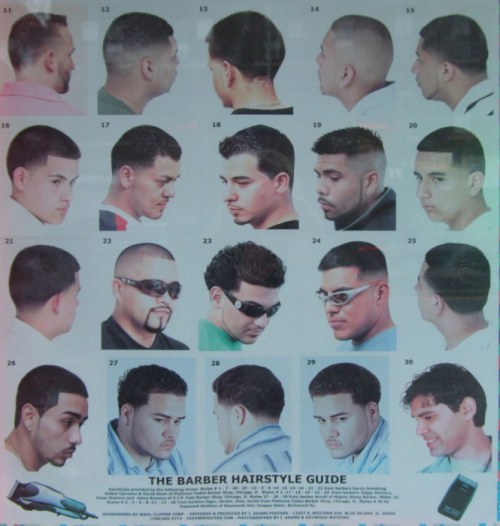
Why aren't barbershops tracking customer preferences?

haircut-chart.jpg

I have never, not once, felt confident enough to point at the barbershop haircut charts when sitting down to get a trim. I suspect I'm not alone. 

I've also never had a regular enough barber to develop any degree of aesthetic understanding and trust. This leaves me in a tricky position. I want to look good, and I want my barber to have some creative input. I want a stylist, really, but without a long-term relationship with my haircutter, that's difficult to establish.

It's only recently that I decided to load my phone with photos of haircuts I liked before getting a trim. It was somewhat effective, but it has this basic problem: those guys aren't me. And telling my barber that I want to look like him isn't really true. I want to look like the best version of myself.

So. An app that integrates with my barber's POS. When I'm done with my cut - right after they take the stupid mirror and show me my neck (in fact, the app should replace the mirror) - they take a quick GIF showing me from a bunch of angles. It's saved in my customer file, and accessible by my barber when I come in next month. It's something we can discuss and point at - a jumping off ground for experimentation. My haircut becomes a work in progress instead of a one-time gig. 

For the customer: Consistency. For the barber: The opportunity to develop a long term relationship that can transcend staffing changes.  The app becomes a whiteboard for discussing style.

Am I missing something? For the right kind of customer and shop, I think it'd be a killer match.  

Scott Belsky

Added on by Spencer Wright.

From "Finding Your Work Sweet Spot: Genuine Interest, Skills & Opportunity" by Scott Belsky (emphasis mine).

As you contemplate your next career move or a new project, you should take the intersection of your genuine interests, skills, and opportunities into consideration.
Contemplate the three circles of the Venn diagram above  –  one circle encompasses your genuine interests; one, your skills; and one, the stream of opportunities available to you. An intersection between just two of the circles doesn’t cut it. A love for basketball and a connection to an NBA scout won’t help you if you lack the skills to play ball. You need to find YOUR trifecta. When you engage with a project that finds this intersection, you’ve entered your zone of maximum impact. In such a state, you are a potent force of nature  –  your avocation becomes your vocation. You can work with full conviction, without ambiguity, and you can transcend your reliance on short-term rewards and societal approval.
As leaders, we must help our partners and employees find work at the ISO intersection. Legendary managers seek to understand the genuine interests and skills of their employees, and are constantly trying to create opportunities within the intersection. Want to change the world? Push everyone you know to work within their intersection. Mentor people to realize their genuine interests, skills, and to capitalize on even the smallest opportunities that surround them. When it comes to your own career, make every decision with a constant eye for work in the intersection.