Manufacturing guy-at-large.
Kevin Shea Adams
From Kevin Shea Adams.
Ben Horowitz
Ben Horowitz, in an old blog post titled "Why We Prefer Founding CEOs." Emphasis mine.
The music business has been continuously disrupted and revolutionized by the underlying technology since the outset. In fact, it’s still widely referred to as the “record industry,” because the entire business was created by the invention of the vinyl record. For the first few decades of the industry, songs were never longer than 3 minutes due to a technological limitation (the record would skip if the grooves were too thin). The album itself is a construct that originated with the total number of songs one could fit on a 33 1/3 Revolutions Per Minute (RPM) vinyl record. In the 80s, the invention of the CD completely revitalized the industry and led to (literally) record-breaking sales.
Despite this dynamic history, modern record company executives badly missed the most sweeping technical innovation—the Internet. How was that possible? By the time the Internet arrived, all of the original founders of the record companies had been bought out, retired, or died. The new, professional CEOs were unwilling to let go of the most basic assumptions driving the cost structure of their businesses. Specifically, they wouldn’t give up their stranglehold on distribution and the value they placed on owning the recording.
They were proficient at running the current business, but lacked both the courage and the moral authority to jeopardize the old business model by embracing the new technology. The transition would have been far easier if these executives running the companies had invented the old models. The founders of the music industry likely would have ditched old assumptions, because they would have been nuts to do continue believing an assumption that no longer makes sense.
Conversely, Netflix, run by cofounder Reed Hastings, provides an excellent counter-example. Faced with a similar transition (from distribution of the physical recording to electronic distribution of the bits), Netflix let go of its old assumption that customers wanted DVDs mailed to them, invested in innovation and produced a series of brilliant new offerings (streaming video to Xbox 360, Sony Playstation 3, Tivo, Wii, connected DVD players, and a host of devices) that are enabling them to transition smoothly. Hastings wasn’t married to the old distribution model precisely because he invented it.
Equity
From Yiren Lu's very good opinion piece in this week's NYTimes Magazine, "Silicon Valley's Youth Problem." Emphasis mine.
These are places where the C.E.O. often sits alongside the engineers, where recruiters talk about a “flat” hierarchy as a perk on par with paternity leave, where regular engineers get equity. Some of these changes have occurred out of necessity. “In the ‘80s, it was not uncommon to pay people salaries and give them few if any stock options,” Biswas said. “Now, you can’t have a company like Facebook and attract that kind of talent without offering equity.”
Ownership is *really* powerful.
Make sure it tastes good
David C. Novak, former COO of Pepsi, talking about Pepsi Crystal in an interview with Fast Company:
It was a tremendous learning experience. I still think it's the best idea I ever had, and the worst executed. A lot of times as a leader you think, "They don't get it; they don't see my vision." People were saying we should stop and address some issues along the way, and they were right. It would have been nice if I'd made sure the product tasted good. Once you have a great idea and you blow it, you don't get a chance to resurrect it.
Not engineering exercises
From a post on Medium by the very smart team at Bolt.io:
Conduct prototype builds as science experiments not engineering exercises. Have a hypothesis about one specific thing, build something to test that hypothesis, test it, and then analyze your results. Too often startups build a full functional prototype before testing basic assumptions they’re making about their users. Reduce your prototype iteration time as much as possible, and then a bit more.
Unsolved problems
Kegan Schouwenburg's advice to entrepreneurs working in 3D printing, from an interview with Ideas Lab:
Do something that isn’t being done currently. There are so many unsolved problems in 3D printing, and it seems like everybody is focusing on the same one right now, which is basically: Let’s make a cheaper 3D printer. But that problem has been solved. We have that. I think the question now becomes, How do we create products that people want? How do we develop the infrastructure to support that?
Something unexpected
Gui Cavalcanti, writing in Make about the difference between various types of hardware coworking spaces:
To me, ‘hacking’ and ‘hacker’ are fundamentally exclusionary; whether they refer to the traditional act of programming to defeat or circumvent existing systems, or the act of working with physical parts, there’s a basic understanding that ‘hacking’ refers to a specific subset of activities that involve making existing objects do something unexpected.
I'm not sure I would have put this just so, but I think there's something interesting here.
The bloggy way of doing it
Felix Salmon, writing about Newsweek's handling of the Satoshi Nakamoto case:
The bitcoin community is just that — a community — and while there have been many theories as to the identity of Satoshi Nakamoto, those theories have always been tested in the first instance within the community. Bitcoin, as a population, includes a lot of highly-intelligent folks with extremely impressive resources, who can be extremely helpful in terms of testing out theories and either bolstering them or knocking them down. If Newsweek wanted the greatest chance of arriving at the truth, it would have conducted its investigation openly, with the help of many others. That would be the bloggy way of doing it, and I’m pretty sure that Goodman would have generated a lot of goodwill and credit for being transparent about her process and for being receptive to the help of others.
Premortem
More from Daniel Kahneman's Thinking, Fast and Slow. Emphasis mine.
Organizations may be better able to tame optimism and individuals than individuals are. The best idea for doing so was contributed by Gary Klein, my "adversarial collaborator" who generally defends intuitive decision making against claims of bias and is typically hostile to algorithms. He labels his proposal the premortem. The procedure is simple: when the organization has almost come to an important decision but has not formally committed itself, Klein proposes gathering for a brief session a group of individuals who are knowledgeable about the decision. The premise of the session is a short speech: "Imagine that we are a year into the future. We implemented the plan as it now exists. The outcome was a disaster. Please take 5 to 10 minutes to write a brief history of that disaster."
...The premortem has two main advantages: it overcomes the groupthink that affects many teams once a decision appears to have been made, and it unleashes the imagination of knowledgeable individuals in a much-needed direction.
As a team converges on a decision - and especially when the leader tips her hand - public doubts about the wisdom of the planned move are gradually suppressed and eventually come to be treated as evidence of flawed loyalty to the team and its leaders. The suppression of doubt contributes to overconfidence in a group where only supporters of the decision have a voice. The main virtue of the premortem is that it legitimizes doubts. Furthermore, it encourages even supporters of the decision to search for possible threats that they had not considered earlier.
This is a brilliant idea.
Relative Position
Nick Denton, talking about Uber in a great interview on Playboy (SFW). Emphasis mine.
Markets are more efficient mechanisms for the distribution of services. The only thing that happens if you don't have surge pricing in a city like New York is that the limos and the cars dry up at certain times. Then nobody gets anything. And maybe that's the point. Maybe the point is that human beings are not so much concerned with their well-being as with their relative position. If they can't have access to this thing that's in short supply, then they don't want anybody else to either.
ST Clamp
An alumide Shapeways model I had made a month or so ago:

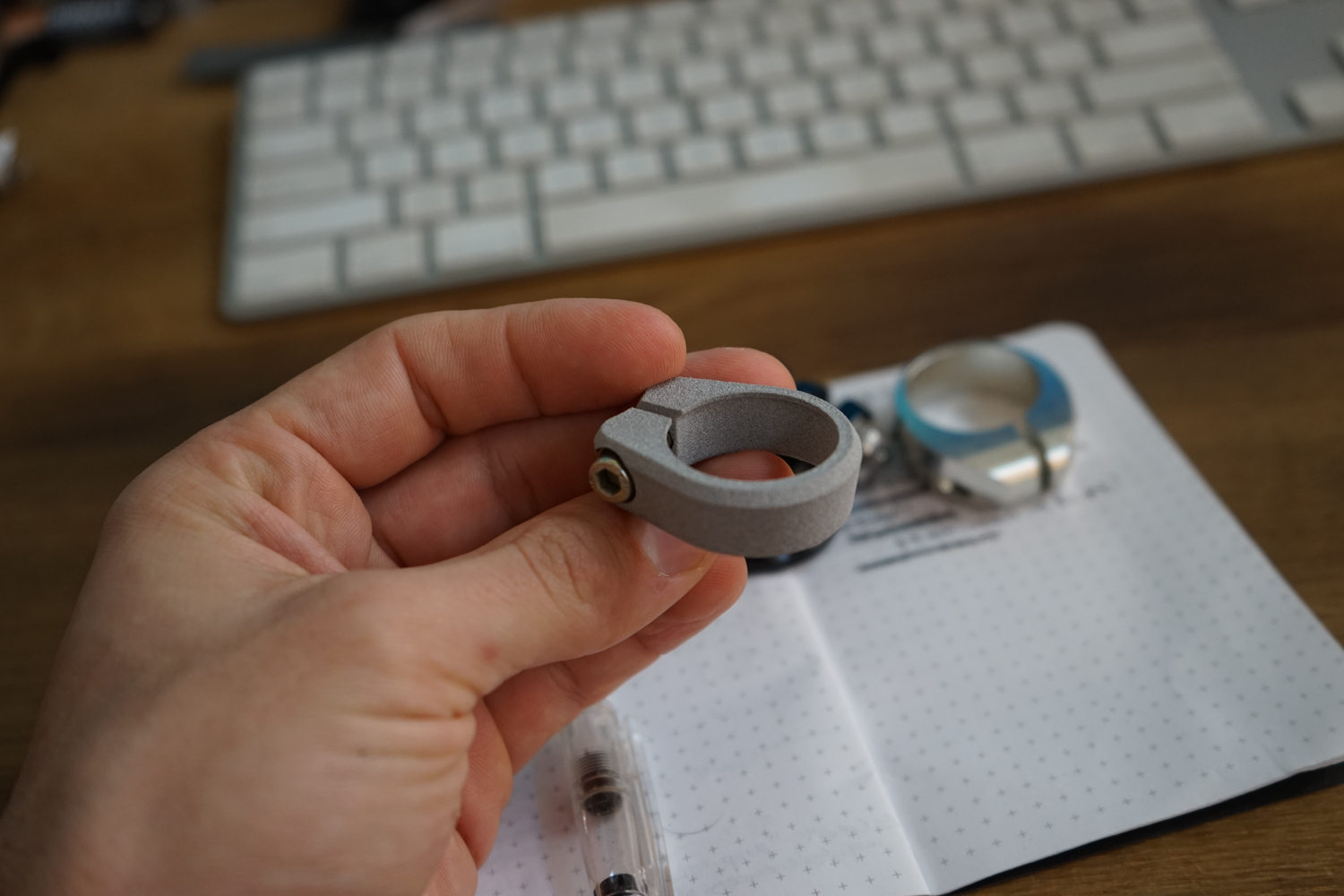
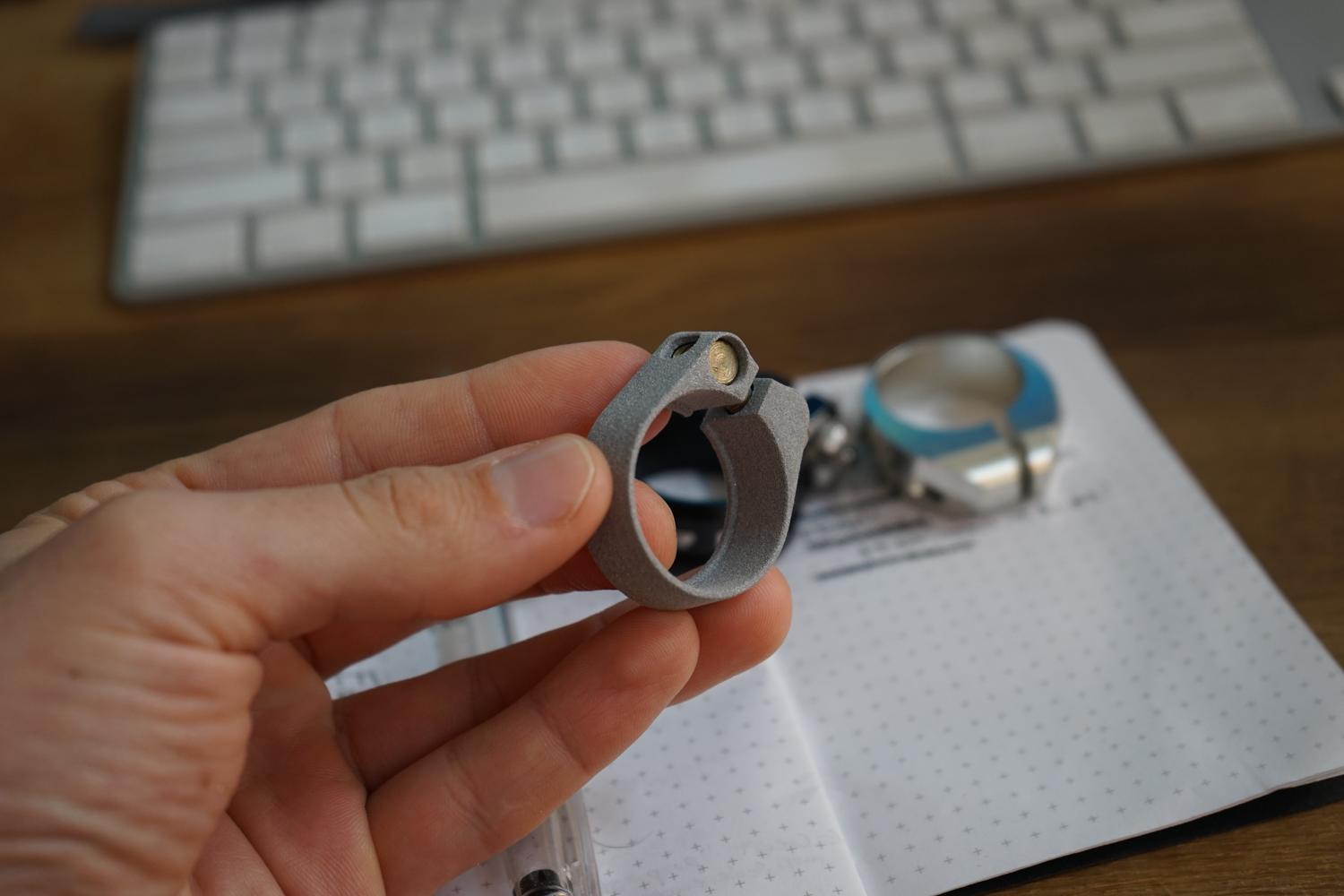
This is an alumide model of a part that I've gotten quoted in DMLS a few times recently. This part probably wouldn't be printed in its current design - at least as anything other than an exercise in showing that it's possible. The shape simply isn't optimized for additive manufacturing, and it would take a lot of re-imagination in order to change that.
Still, it's a start - and because of its volume/mass ratio, it would be an interesting part to explore deeper.
Old
This is me, working on this bike, a long time ago.
A quick thought: Angle of Organizational Repose
Thinking about the [citation needed] trend of traditionally hierarchical organizations going flat. Remembering how much I like the term "angle of repose."
Think there's something here.
It seems likely that there is some angle of repose for hierarchy in an organization. I hesitate, though, to suggest (literally or figuratively) that highly hierarchical organizations can't support themselves/will tend to collapse under their own weight. That seems a bit too on-the-nose, and anyway the analogy gets really complicated really quickly. There are too many factors to consider in an organization's structure, and each must be considered against an arbitrarily large set of organizational purposes & principles.
Still, it's a fun comparison to consider.
Questions
John Hagel, writing about the act of publicly expressing vulnerability as a tool for building influence (emphasis is original):
In the old days, it was simple and straightforward. We built influence by having answers...In an exponential world, answers have rapidly diminishing value. The greatest value in this kind of environment comes from questions, questions that no one had even thought to ask but that help to focus attention and effort on promising but previously ignored areas. Questions invite a different and more powerful form of participation. It’s no longer just about spreading the word and persuading others. It’s about inviting others to explore a new domain and help to generate new ideas and insights...
But questions do something else that’s absolutely vital for influence – they rapidly build trust with the person posing the questions. The person posing these kinds of questions has just done something very important – s/he has expressed vulnerability. S/he has acknowledged there’s something really important that s/he doesn’t know and needs help to solve...
But what about the influence that comes from having privileged access to knowledge flows? Won’t we undermine that by moving away from hub and spoke networks to mesh networks? Not to worry, by posing the questions that excite and motivate everyone to embark on their exploration, we’ll still have privileged access to the knowledge flows occurring within the network. Whenever someone comes up with an insight that they think is important, they’ll want to reach out and vet it with us. And if we continue to refine and evolve the questions as new insights become available, participants will continue to connect with us to get the most up to date framing of the questions that matter.
I agree with all of this.
Hat tip to Clay Parker Jones for the link.
I am happy about this
New PCBs for The Public Radio should arrive in ~2 weeks. Only a few changes, but will be much easier to assemble + will have pretty graphics on the bottom.
Thanks again to Jonathan Bobrow for everything that's cool about our current logo :)
Smart Factories & Design Intent
Robert Schouwenburg, writing on Medium about a utopian idea of manufacturing automation.
To be clear humans are still needed. Certain steps are better handled by a human (refill / maintenance of machines or specific process steps like assembly or packing of parts – all depending on the factory setup and supported production steps), but the human is just a resource in the factory. A resource which can be planned and directed by a computer. It is not about fully automating the factory but about the creating a smart factory.
So how does this work? A product production request comes in. Based on the product production requirements a production plan is generated. The production plan contains each step necessary to produce each part and – if applicable – how the product is put together. The production of the product is scheduled based on capacity and necessary process steps. Not only the machine are planned but also human operators where needed. In the end the factory runs itself in the most optimal way based on the incoming production requests.
Today, we miss a significant piece in this puzzle. The current standards for design files (Autodesk's .ipt, Solidworks' .sdlprt, the ISO .step format, and of course the now-ubiquitous .stl) are agnostic regarding manufacturing processes. They simply convey geometry, and don't communicate anything about how that geometry is to be created.
I suppose that an ideal manufacturing environment would be clever enough to analyze part geometries and produce a manufacturing plan that was highly optimized for efficiency, but that reality is still far away. It's also worth noting that such a world would never produce another Eames Lounge Chair Wood - an artifact which was designed specifically as a use case for a new material and manufacturing process. When computers control the manufacturing method, the only control a human has is to tell it what shape to make.
I should be clear that I don't fight that future's development; nor do I have enough foresight to find it either delightful or troubling. But it's worthwhile to consider the implications of a world in which the nature of design is so radically reimagined - and it's good to consider what it'll take to get there from where we are now.
Satya Nadella
Microsoft CEO Satya Nadella, quoted in the NYTimes about an interview he had with Steve Ballmer.
I went on to ask him, “How do I compare to the people who had my role before me?” And Steve said: “Who cares? The context is so different. The only thing that matters to me is what you do with the cards you’ve been dealt now. I want you to stay focused on that, versus trying to do this comparative benchmark.”
Preproduction.
The past few days
Have been a little hectic.
In addition to trying to make some long overdue progress on my DMLS work, The Public Radio is kind of heating up right now. We received a new batch of PCBs, and got a few of them built up quickly.
To our astonishment, the first board we built worked immediately. This was actually kind of weird - we were expecting at least a bridge or two would need to be fixed, and there was always the chance that we had made a design error. Having our first board turn right on, and then quickly tune to WBGO 88.3, was a real kick.
Things won't always go so well, though, and so the following day we spent a bit of time straightening the workshop and setting up a bit of new tooling. The Public Radio HQ is now the home to a brand-old 1984 Tektronix 2465, a 4-channel 300MHz analog scope. We also picked up an inexpensive hot air rework station, and I dumped some bike parts out of one of my small parts cabinets and dragged it in to the city as well.
We don't have stencils for these boards (aligning circular stencils requires a bit more foresight than we could muster when we made the purchase) so we're laying out solder paste by hand with a syringe and toothpicks. Then we laid out a big piece of card stock and placed SMT components out part by part and set out with tweezers and loupes to place them on boards.
Our boards have two fine-pitch parts on them (the FM IC and the amplifier), and then they're almost all 0603 packages. These are manageable once you get going, but initially they're just fucking small. Anything smaller and we'd have a really hard time hand assembling these boards.
There are a few small modifications that we'll make before we go into production. Our thru hole trimpot's package needs to be changed, and we need to do a little tweaking on the gain setting resistors going into the amplifier, and I want to spend a little while getting graphics on the silkscreen layers. But these are minor changes; overall, the boards are 95% there.
On Monday we'll be receiving a batch of lasercut stainless steel lids, and we'll finally see how our whole assembly fits together IRL.