Manufacturing guy-at-large.

Premortem

Added on by Spencer Wright.

More from Daniel Kahneman's Thinking, Fast and Slow. Emphasis mine.

Organizations may be better able to tame optimism and individuals than individuals are. The best idea for doing so was contributed by Gary Klein, my "adversarial collaborator" who generally defends intuitive decision making against claims of bias and is typically hostile to algorithms. He labels his proposal the premortem. The procedure is simple: when the organization has almost come to an important decision but has not formally committed itself, Klein proposes gathering for a brief session a group of individuals who are knowledgeable about the decision. The premise of the session is a short speech: "Imagine that we are a year into the future. We implemented the plan as it now exists. The outcome was a disaster. Please take 5 to 10 minutes to write a brief history of that disaster."

...The premortem has two main advantages: it overcomes the groupthink that affects many teams once a decision appears to have been made, and it unleashes the imagination of knowledgeable individuals in a much-needed direction. 

As a team converges on a decision - and especially when the leader tips her hand - public doubts about the wisdom of the planned move are gradually suppressed and eventually come to be treated as evidence of flawed loyalty to the team and its leaders. The suppression of doubt contributes to overconfidence in a group where only supporters of the decision have a voice. The main virtue of the premortem is that it legitimizes doubts. Furthermore, it encourages even supporters of the decision to search for possible threats that they had not considered earlier. 

This is a brilliant idea. 

Relative Position

Added on by Spencer Wright.

Nick Denton, talking about Uber in a great interview on Playboy (SFW). Emphasis mine.

Markets are more efficient mechanisms for the distribution of services. The only thing that happens if you don't have surge pricing in a city like New York is that the limos and the cars dry up at certain times. Then nobody gets anything. And maybe that's the point. Maybe the point is that human beings are not so much concerned with their well-being as with their relative position. If they can't have access to this thing that's in short supply, then they don't want anybody else to either.

ST Clamp

Added on by Spencer Wright.

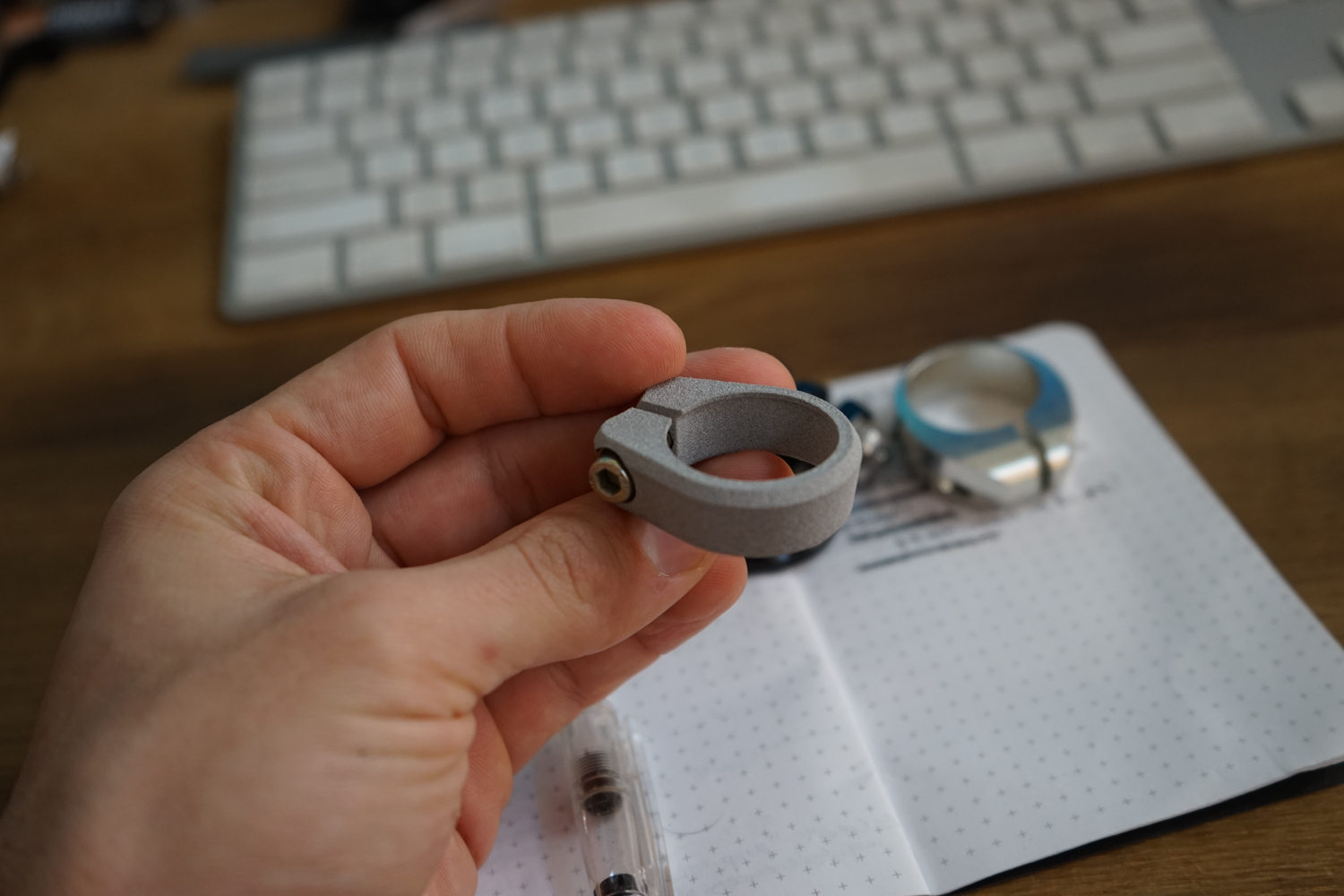
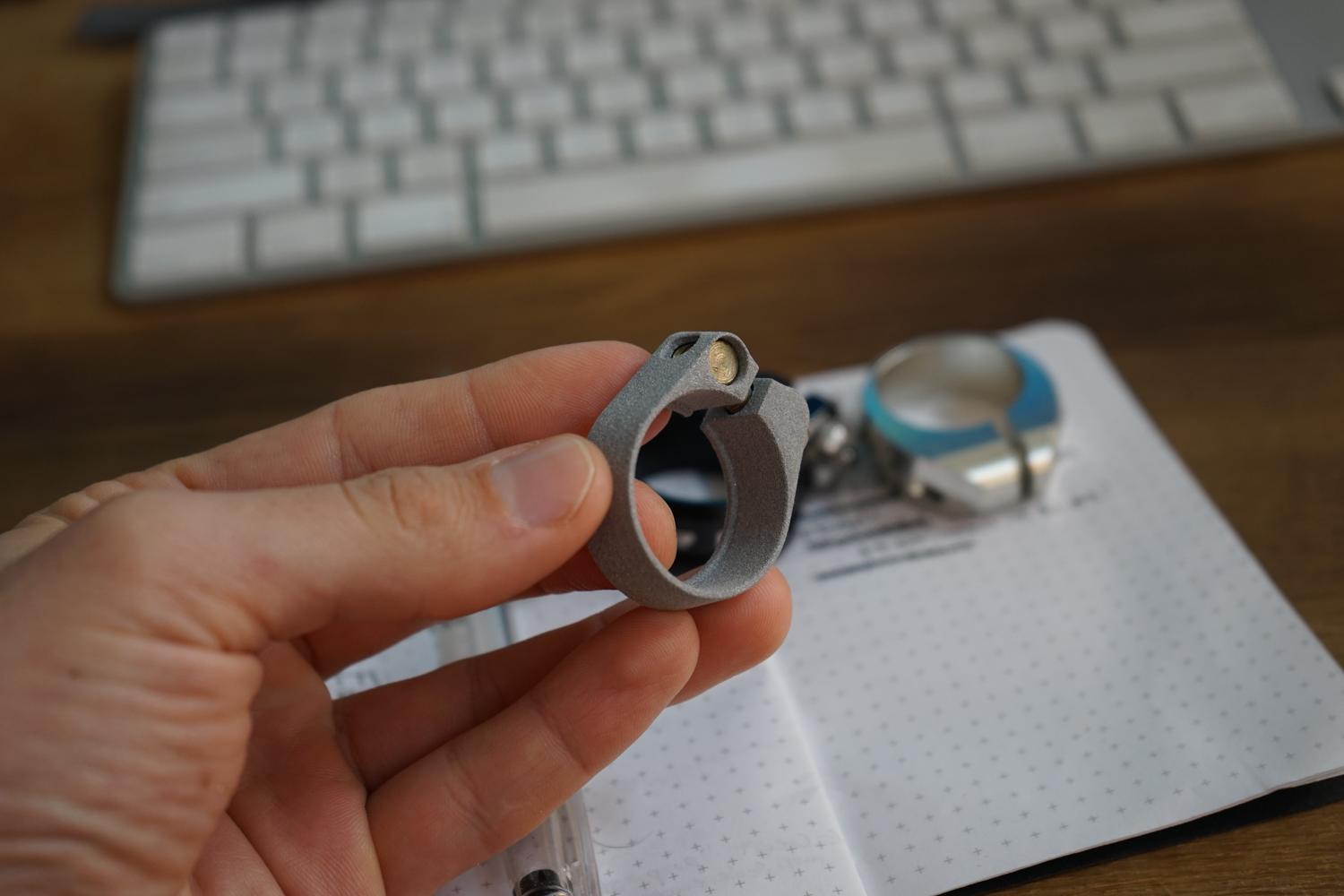
An alumide Shapeways model I had made a month or so ago:

This is an alumide model of a part that I've gotten quoted in DMLS a few times recently. This part probably wouldn't be printed in its current design - at least as anything other than an exercise in showing that it's possible. The shape simply isn't optimized for additive manufacturing, and it would take a lot of re-imagination in order to change that.

Still, it's a start - and because of its volume/mass ratio, it would be an interesting part to explore deeper.

Stay tuned.

A quick thought: Angle of Organizational Repose

Added on by Spencer Wright.

Thinking about the [citation needed] trend of traditionally hierarchical organizations going flat. Remembering how much I like the term "angle of repose."

Think there's something here.

It seems likely that there is some angle of repose for hierarchy in an organization. I hesitate, though, to suggest (literally or figuratively) that highly hierarchical organizations can't support themselves/will tend to collapse under their own weight. That seems a bit too on-the-nose, and anyway the analogy gets really complicated really quickly. There are too many factors to consider in an organization's structure, and each must be considered against an arbitrarily large set of organizational purposes & principles. 

Still, it's a fun comparison to consider.

Questions

Added on by Spencer Wright.

John Hagel, writing about the act of publicly expressing vulnerability as a tool for building influence (emphasis is original):

In the old days, it was simple and straightforward.  We built influence by having answers...In an exponential world, answers have rapidly diminishing value. The greatest value in this kind of environment comes from questions, questions that no one had even thought to ask but that help to focus attention and effort on promising but previously ignored areas. Questions invite a different and more powerful form of participation. It’s no longer just about spreading the word and persuading others.  It’s about inviting others to explore a new domain and help to generate new ideas and insights...

But questions do something else that’s absolutely vital for influence – they rapidly build trust with the person posing the questions. The person posing these kinds of questions has just done something very important – s/he has expressed vulnerability.  S/he has acknowledged there’s something really important that s/he doesn’t know and needs help to solve...

But what about the influence that comes from having privileged access to knowledge flows? Won’t we undermine that by moving away from hub and spoke networks to mesh networks? Not to worry, by posing the questions that excite and motivate everyone to embark on their exploration, we’ll still have privileged access to the knowledge flows occurring within the network.  Whenever someone comes up with an insight that they think is important, they’ll want to reach out and vet it with us. And if we continue to refine and evolve the questions as new insights become available, participants will continue to connect with us to get the most up to date framing of the questions that matter.

I agree with all of this.

Hat tip to Clay Parker Jones for the link.

Smart Factories & Design Intent

Added on by Spencer Wright.

Robert Schouwenburg, writing on Medium about a utopian idea of manufacturing automation.

To be clear humans are still needed. Certain steps are better handled by a human (refill / maintenance of machines or specific process steps like assembly or packing of parts – all depending on the factory setup and supported production steps), but the human is just a resource in the factory. A resource which can be planned and directed by a computer. It is not about fully automating the factory but about the creating a smart factory.

So how does this work? A product production request comes in. Based on the product production requirements a production plan is generated. The production plan contains each step necessary to produce each part and – if applicable – how the product is put together. The production of the product is scheduled based on capacity and necessary process steps. Not only the machine are planned but also human operators where needed. In the end the factory runs itself in the most optimal way based on the incoming production requests.

Today, we miss a significant piece in this puzzle. The current standards for design files (Autodesk's .ipt, Solidworks' .sdlprt, the ISO .step format, and of course the now-ubiquitous .stl) are agnostic regarding manufacturing processes. They simply convey geometry, and don't communicate anything about how that geometry is to be created.

I suppose that an ideal manufacturing environment would be clever enough to analyze part geometries and produce a manufacturing plan that was highly optimized for efficiency, but that reality is still far away. It's also worth noting that such a world would never produce another Eames Lounge Chair Wood - an artifact which was designed specifically as a use case for a new material and manufacturing process. When computers control the manufacturing method, the only control a human has is to tell it what shape to make.

I should be clear that I don't fight that future's development; nor do I have enough foresight to find it either delightful or troubling. But it's worthwhile to consider the implications of a world in which the nature of design is so radically reimagined - and it's good to consider what it'll take to get there from where we are now.

Satya Nadella

Added on by Spencer Wright.

Microsoft CEO Satya Nadella, quoted in the NYTimes about an interview he had with Steve Ballmer.

I went on to ask him, “How do I compare to the people who had my role before me?” And Steve said: “Who cares? The context is so different. The only thing that matters to me is what you do with the cards you’ve been dealt now. I want you to stay focused on that, versus trying to do this comparative benchmark.”

The past few days

Added on by Spencer Wright.

Have been a little hectic. 

In addition to trying to make some long overdue progress on my DMLS work, The Public Radio is kind of heating up right now. We received a new batch of PCBs, and got a few of them built up quickly.

Verifying fine-pitch connections on the FM IC.

Zach adjusting station tune on the first assembled board.

To our astonishment, the first board we built worked immediately. This was actually kind of weird - we were expecting at least a bridge or two would need to be fixed, and there was always the chance that we had made a design error. Having our first board turn right on, and then quickly tune to WBGO 88.3, was a real kick.

Things won't always go so well, though, and so the following day we spent a bit of time straightening the workshop and setting up a bit of new tooling. The Public Radio HQ is now the home to a brand-old 1984 Tektronix 2465, a 4-channel 300MHz analog scope. We also picked up an inexpensive hot air rework station, and I dumped some bike parts out of one of my small parts cabinets and dragged it in to the city as well.

The. Shop.

We don't have stencils for these boards (aligning circular stencils requires a bit more foresight than we could muster when we made the purchase) so we're laying out solder paste by hand with a syringe and toothpicks. Then we laid out a big piece of card stock and placed SMT components out part by part and set out with tweezers and loupes to place them on boards.

Zach placing parts.

Our boards have two fine-pitch parts on them (the FM IC and the amplifier), and then they're almost all 0603 packages. These are manageable once you get going, but initially they're just fucking small. Anything smaller and we'd have a really hard time hand assembling these boards.

Soldered & partially assembled (but not reflowed) PCBs.

Our fine pitch parts. 

Partially assembled boards. Our knobs showed up too; they're looking really pretty :)

Fully assembled boards, ready to be tuned and tested. There are a couple of 0603 parts in the far right corner.

There are a few small modifications that we'll make before we go into production. Our thru hole trimpot's package needs to be changed, and we need to do a little tweaking on the gain setting resistors going into the amplifier, and I want to spend a little while getting graphics on the silkscreen layers. But these are minor changes; overall, the boards are 95% there.

On Monday we'll be receiving a batch of lasercut stainless steel lids, and we'll finally see how our whole assembly fits together IRL.

Availability Heuristic

Added on by Spencer Wright.

Also (again) from Thinking, Fast and Slow.

A major advance in the understanding of the availability heuristic occurred in the early 1990s, when a group of German psychologists led by Norbert Schwarz raised an intriguing question: How will people's impressions of the frequency of a category be affected by a requirement to list a specified number of instances? Imagine yourself a subject in that experiment:

First, list six instances in which you behaved assertively.

Next, evaluate how assertive you are.

Imagine that you had been asked for twelve instances of assertive behavior (a number most people find difficult). Would your view of your own assertiveness be different?...

The contest yielded a clear-cut winner: people who had just listed twelve instances rated themselves as less assertive than people who had listed only six. Furthermore, participants who had been asked to list twelve cases in which they had not behaved assertively ended up thinking of themselves as quite assertive! If you cannot easily come up with instances of meek behavior, you are likely to conclude that you are not meek at all. Self-ratings were dominated by the ease with which examples came to mind...

Psychologists enjoy experiments that yield paradoxical results, and they have applied Schwarz's discover with gusto. For example, people:

  • believe that they use their bicycles less often after recalling many rather than few instances
  • are less confident in a choice when they are asked to produce more arguments to support it
  • are less confident that an event was avoidable after listing more ways it could have been avoided
  • are less impressed by a car after listing many of its advantages

Editor's note: PEOPLE ARE SO WEIRD!!!!!

Kahneman

Added on by Spencer Wright.

From Thinking, Fast and Slow. Emphasis mine.

A very generous estimate of the correlation between the success of the firm and the quality of its CEO might be as high as .30, indicating 30% overlap. To appreciate the significance of this number, consider the following question:

Suppose you consider many pairs of firms. The two firms in each pair are generally similar, but the CEO of one of them is better than the other. How often will you find that the firm with the stronger CEO is the more successful of the two?

In a well-ordered and predictable world, the correlation would be perfect (1) and the stronger CEO would be found to lead the more successful firm in 100% of the pairs. If the relative success of similar firms was determined entirely by factors that the CEO does not control (call them luck, if you wish), you would find the more successful firm led by the weaker CEO 50% of the time. A correlation of .30 implies that you would find the stronger CEO leading the stronger firm in about 60% of the pairs - an improvement of a mere 10 percentage points over random guessing, hardly grist for the hero worship of CEOs we so often witness. 

If you expected this value to be higher - and most of us do - then you should take that as an indication that you are prone to overestimate the predictability of the world you live in. Make no mistake: improving the odds of success from 1:1 to 3:2 is a very significant advantage, both at the racetrack and in business. From a perspective of most business writers, however, a CEO who has so little control over performance would not be particularly impressive even if her firm did well. It is difficult to imagine people lining up at airport bookstores to buy a book that enthusiastically describes the practices of business leaders who, on average, do somewhat better than chance. 

Daryl Davis

Added on by Spencer Wright.

Daryl Davis, talking with Nick Van Der Kolk about his work combating racism by befriending KKK members. Emphasis mine.

Q: What about well-meaning white liberals?

A: There are a lot of those... and there are a lot of well-meaning black liberals. But you know what? Again - when all they do is sit around and preach to the choir, it does absolutely no good. If you're not a racist, it doesn't do any good for me to meet with you and sit around and talk about how bad racism is. 

If you don't listen to Love + Radio... ugh.

Random thoughts on Net Neutrality

Added on by Spencer Wright.

This was written in a draft email that I eventually didn't send. It was in response to a discussion about this article.

A few notes: I'm bullshitting like 65% of this, and look forward to being called out where I haven't covered my tracks. Also, I know next to nothing about how the internet and/or public utilities are regulated now.

I totally agree that the effects of the (probable?) demise of net neutrality are *really* scary. I definitely don't want anyone controlling my access to information. 

However: I worry that treating the internet like water (or heath care, or clean air, etc etc) will lead to the equivalent of golf courses in Las Vegas, which are built & maintained at the expense of basically everyone who lives in the Colorado River Basin - 12 million people and a quarter million square miles of land.

In other words - until we figure out some crazy new way of transmitting data, global bandwidth (and global bandwidth infrastructure development) is still a finite resource. And I worry that while no-holds-barred net neutrality is great for all of us (privileged, educated, live in metropolitan areas, etc), it's at the cost of... well, those same people in the Southwest.

It's possible that that's a tradeoff that's ultimately good for society (which would be fucking crazy - this is *not* a claim that I endorse), but either way that conversation needs to take place independent of any gripes I have about how long it takes me to bittorrent new episodes of True Detective. And I'm just not sure that I'd defend my right to free, ultra-fast access to internet porn when some kid in North Dakota is just trying to get off of dialup. 

I don't at all mean this to be a defense of the telecom industry, and I'm not particularly excited about subsidizing high speed internet all across rural areas either. But I recognize that the world would probably be a better place if a 20 minute shower cost me significantly more than a 5 minute shower. And if society doesn't have any mechanism to make me feel that effect, then we're probably all worse off as a result.


Editor's note: Sometimes the best email is the one you drafted, deleted, and posted on your blog instead ;) Hat tip to everyone at Gin Lane for the inspiration.

Iterating

Added on by Spencer Wright.

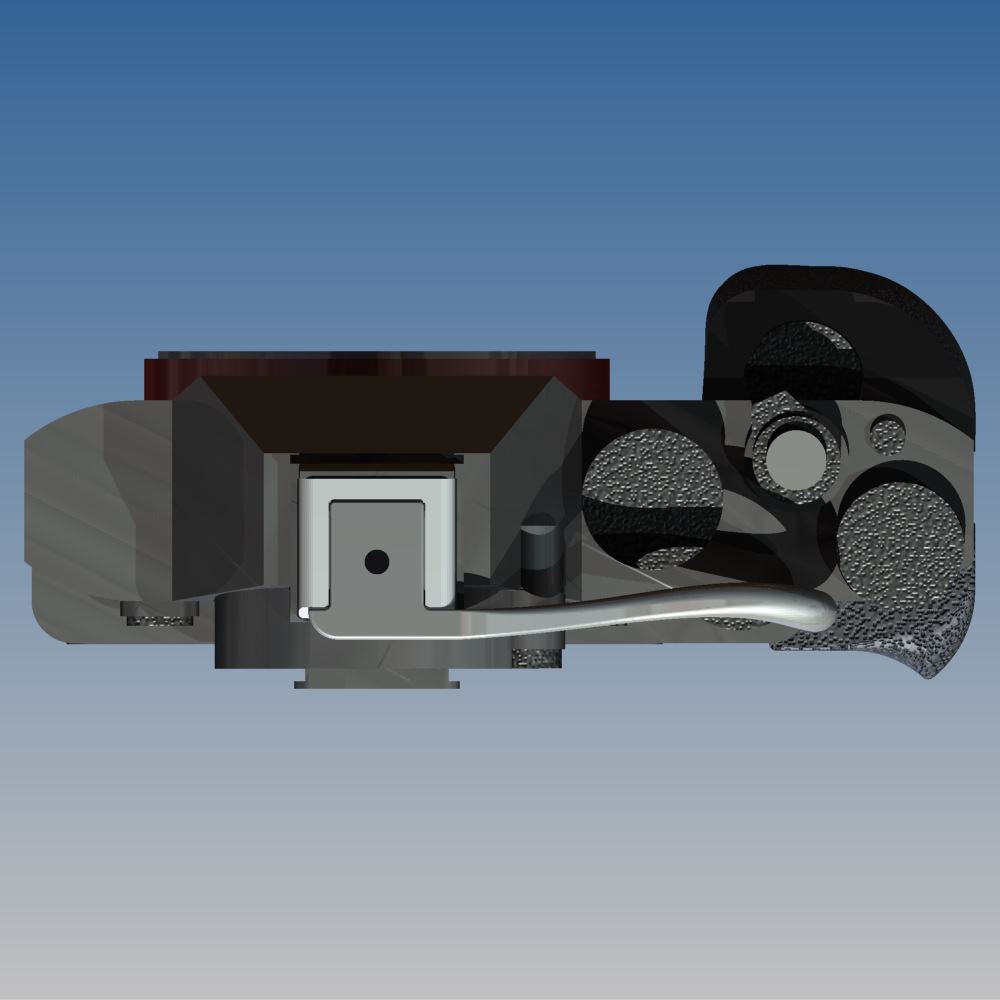
Rebuilt most of this A7 thumbgrip model today. 

Incidentally, Shapeways is complaining about the wall thicknesses on the hotshoe insert and a small area on the top of the cutout. I suspect this won't be much of an issue, but it could be.

Screen Shot 2014-02-24 at 1.06.21 AM.png

Old

Added on by Spencer Wright.

This is maybe the second or third 3D model I ever created. I was attaching a glass handrail to an existing deck, and needed a way of documenting the irregularities of the support members. My steel guy didn't respond all that well to my screenshots, but it came together quite nicely. 

Stewart Butterfield

Added on by Spencer Wright.

From "We Don't Sell Saddles Here," the title given to a memo sent to the team of Slack by the CEO of Tiny Speck, Stewart Butterfield.

The best — maybe the only? — real, direct measure of “innovation” is change in human behaviour. In fact, it is useful to take this way of thinking as definitional: innovation is the sum of change across the whole system, not a thing which causes a change in how people behave. No small innovation ever caused a large shift in how people spend their time and no large one has ever failed to do so.

and:

...all products are asking things of their customers: to do things in a certain way, to think of themselves in a certain way — and usually that means changing what one does or how one does it; it often means changing how one thinks of oneself. We are asking a lot from our customers...

To get people to say yes to a request that large, we need to (1) offer them a reward big enough to justify their effort and (2) do an exceptional, near-perfect job of execution...

The reason for saying we need to do ‘an exceptional, near-perfect job of execution’ is this: When you want something really bad, you will put up with a lot of flaws. But if you do not yet know you want something, your tolerance will be much lower. That’s why it is especially important for us to build a beautiful, elegant and considerate piece of software. Every bit of grace, refinement, and thoughtfulness on our part will pull people along. Every petty irritation will stop them and give the impression that it is not worth it.