Manufacturing guy-at-large.

Public Radio Progress

Added on by Spencer Wright.

The last few days have been a bit of a whirlwind. 

First, we visited Todd to discuss some circuit layout concerns. On the way over we nabbed a cheap radio at RadioShack, and took it apart with Todd.. 

narrat1ve-1.jpg

What we found was really interesting. The device uses a different chip than we had been prototyping with, and as a result their circuit is *much* simpler. Our chip (Silicon Labs' Si4703) requires digital tuning, which we were accomplishing with a microcontroller. But RadioShack was using the Si4822, which is mechanically tuned. The result is drastic from a circuit standpoint - they no longer need a voltage regulator, or a microcontroller, or a bunch of additional passive components on the board. They're also in a better position re: noise on the board: an MCU (and a voltage regulator too) will produce a bunch of noise that might get on the antenna, affecting reception. RadioShack doesn't need to worry about this at all.

Over the past few weeks, we've been looking for just a breakthrough like this - a way of rethinking the problems we were dealing with. Our issue was that we were stuck conceiving this as an Arduino-descended product, which it doesn't need to be. 

public radio hammer nail-1.jpg

We also made a bit of progress reengineering the hardware layout of the board. Our new design (this is just the board layout, not the circuit schematic) will be significantly easier to assemble, program & service.

public radio hammer nail-2.jpg

We're also pretty sure we can shorten the antenna *significantly.* The mockup here shows a custom solid stainless steel antenna, 50mm long. I rather like it, and it's designed such that a longer telescopic antenna can be swapped in easily. 

short antenna round pcb full assy.jpg

Our PCB will now be circular, and we're soldering the potentiometer and speaker directly to the board. There will be a bunch of SMT stuff on the top (same side as the speaker & pot) and a battery back and trimpot (not shown) on the bottom.

I *really* like where this is headed. More updates soon. 

Radio Monogamy

Added on by Spencer Wright.

"Radio monogamy" was suggested by a few friends during discussions on The Public Radio. I'm mulling a storyboard for a short video, and jotted this down last night :)

Every once in a while, paper prototyping is really effective.

McKinsey

Added on by Spencer Wright.

Two excerpts from a short piece on 3D printing by McKinsey. Emphasis mine:

As of 2011, only about 25 percent of the additive-manufacturing market involved the direct manufacture of end products. With a 60 percent annual growth rate, however, that is the industry’s fastest-growing segment. As costs continue to fall and the capabilities of 3-D printers increase, the range of parts that can be economically manufactured using additive techniques will broaden dramatically. Boeing, for example, already uses printers to make some 200 part numbers for ten different types of aircraft, and medical-products companies are using them to create offerings such as hip replacements.

And:

Design is inherently linked to methods of fabrication. Architects can’t design houses without considering construction techniques, and engineers can’t design machines without considering the benefits and limitations of casting, forging, milling, turning, and welding. While there is a wealth of knowledge around design for manufacturing, much less is available on design for printing. Our conversations with executives at manufacturing companies suggest that many are aware of this gap and scrambling to catalog their design know-how.

Incidentally, I'm not sure that the premise of that second quote is necessarily true, regardless of what I believe *should* be the case.

Junk Science

Added on by Spencer Wright.

Two bits from a good article from The Guardian on wine tasting:

More evidence that wine-tasting is influenced by context was provided by a 2008 study from Heriot-Watt University in Edinburgh. The team found that different music could boost tasters’ wine scores by 60%. Researchers discovered that a blast of Jimi Hendrix enhanced cabernet sauvignon while Kylie Minogue went well with chardonnay.

and:

Colour affects our perceptions too. In 2001 Frédérick Brochet of the University of Bordeaux asked 54 wine experts to test two glasses of wine– one red, one white. Using the typical language of tasters, the panel described the red as "jammy' and commented on its crushed red fruit.

The critics failed to spot that both wines were from the same bottle. The only difference was that one had been coloured red with a flavourless dye.

Notes on Powersaving modes

Added on by Spencer Wright.

Today Zach and I are playing with powersaving modes on The Public Radio. This was all done with this commit; cases were tested by commenting out lines 42, 45 and 46 and varying volume via our potentiometer. Current is being measured on Vout of the VREG on hardware v1.1. 

  1. MCU ON (sleep disabled)
    1. Amp OFF (shutdown enabled)
      1. Si4703 ON
        • .019A
      2. Si4703 OFF
        • .004A
    2. Amp ON (shutdown disabled)
      1. Volume @ 100%
        1. Si4703 ON
          • .050-.100A
        2. Si4703 OFF
          • .004A
      2. Volume @ 0%
        1. Si4703 ON
          • .026A
        2. Si4703 OFF
          • .004A
  2. MCU OFF (sleep enabled)
    1. Amp OFF (shutdown enabled)
      1. Si4703 ON
        • .016A
      2. Si4703 OFF
        • .004A
    2. Amp ON
      1. Volume @ 100%
        1. Si4703 ON
          • .030A-.090A
        2. Si4703 OFF
          • .004A
      2. Volume  @ 0%
        1. Si4703 ON
          • .023A
        2. SI4703 OFF
          • .004A

There are some weird things going on here. Our powersaving mode isn't having quite the effect we're looking for, either.

More work to come.

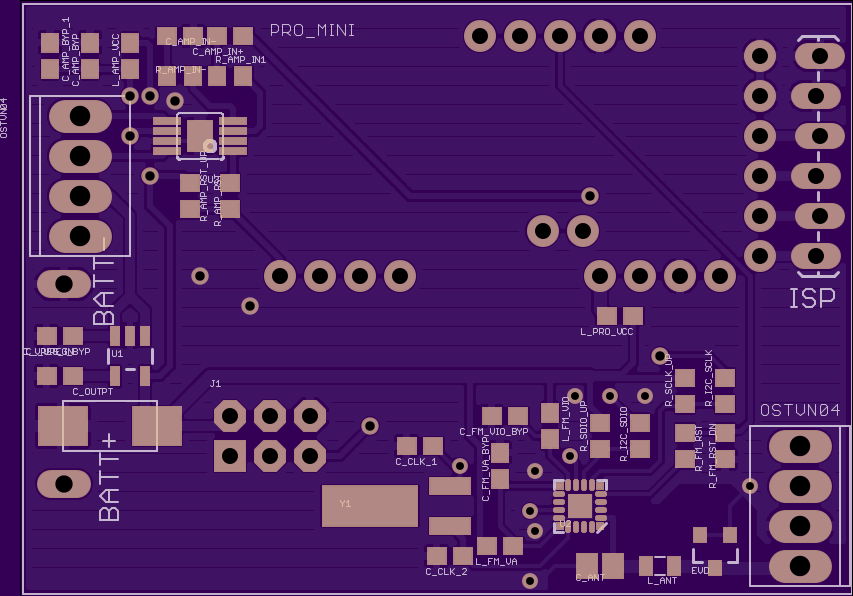
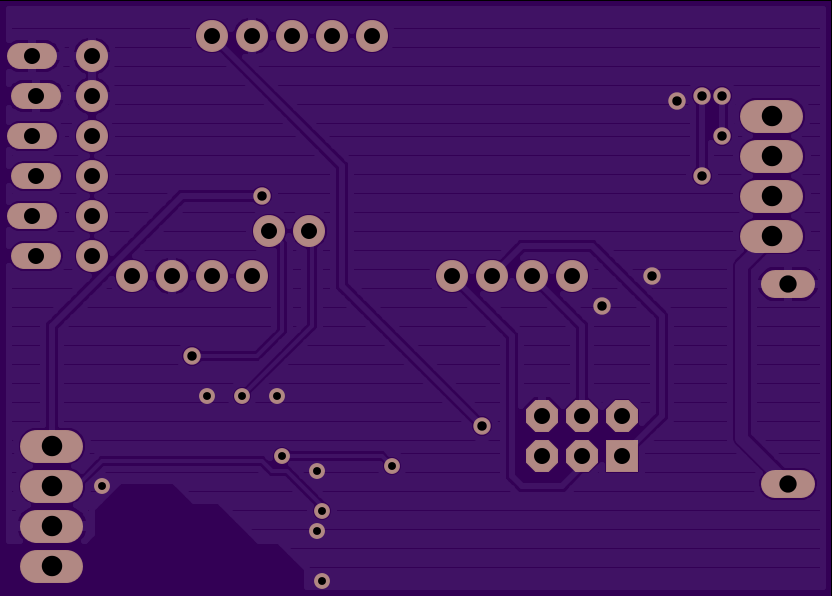
The Public Radio v1.2

Added on by Spencer Wright.

Ordered yesterday from OSHPark. 

This board uses an Arduino Pro Mini, which can be programmed from either an FTDI cable or via an AVRISP (which we'll do to shorten powerup time). The rest of the circuit is all discrete components, mostly SMT. The whole thing mounts on the backside of a 3xAAA battery pack.

We should receive these boards around Valentine's day, and will be testing and iterating on them shortly afterwards.

Elasticity

Added on by Spencer Wright.

From an interesting piece on open-electronics.org titled "The Truth About Open Source Hardware Business Models." Emphasis mine.

A successful hardware design – being it closed or open doesn’t matter – will be copied once successful and – as Nathan Seidle often pointed out in interviews – market advantage resides in company elasticity and in the capability to innovate rapidly a product portfolio.

Rewarding Failure

Added on by Spencer Wright.

From a BBC article on Google X's policy of rewarding failure:

You must reward people for failing, he says. If not, they won't take risks and make breakthroughs. If you don't reward failure, people will hang on to a doomed idea for fear of the consequences. That wastes time and saps an organisation's spirit.

Quick Scheme - Top Rack mount

Added on by Spencer Wright.

Just had a quick brainstorm re: rack mounting. My 4-A rack ends address the bottom of the rack, but the top of the rack is equally challenging. One common way to attach a rack is through the brake hole on the frame/fork. I would always turn down the head of a M6 SHCS so that it could be inserted into the rack tubing; I'd then use a standard recessed brake nut on the backside. I made a quick & dirty sketch:

It might be useful to have these parts pre-made, so that rack builders don't need to turn their own on a lathe. If you'd be interested in a part like this, holler at me!

DMLS Site Visits

Added on by Spencer Wright.

Last week, I had the pleasure of visiting two excellent resources in the world of additive manufacturing. What follows is all in relation to my titanium 3D printed bike seatmast topper project.

Within Lab

On Wednesday I sat down in the Brooklyn Navy Yard with Kaveh and Siavash of Within Lab. Within's software takes solid models as input and allows the engineer to convert them to 3D lattice structures in order to reduce mass and build time - and maintain structural integrity. Their software is no joke; it's clear that for engineered mechanical products, Within Enhance is going to be key to making 3D printing a viable manufacturing method.

There were a few key takeaways:

  • The base portion of my topper is a thin walled sleeve. I suspect it could be latticed (instead of having a consistent wall), but I don't believe Within's software will generate curved lattice segments. The demos they ran all assumed a thin skin on the ID of the cylinder, but I suspect there's a better way - which would likely require a curved lattice.
  • It's possible that many of the theoretical benefits of Within's process will be somewhat tempered by the nature of my relationship (as a designer) with the job shops that will eventually produce the parts. Optimally, the job shop has an intimate understanding of the design intent of the part - both its function *and* the assumed build characteristics. In other words, I would hate to optimize my part for a vertical build orientation, and then find later that my supplier was building horizontally. Big things like that should be easy to avoid, but it'll require a bunch of management and communication on my part.
  • I'm unsure whether Within Enhance will be able to find an elegant design for the pinch bolt on the front of the Topper. I'd prefer to eliminate the bolt altogether, but I'm trying to redesign as little of the wheel as possible here. This isn't a criticism of the software itself - just an anomaly of my particular design (and the design of bike parts in general).
  • Within's software deals entirely with STLs, which are limited in their portability. I don't think this will be a serious issue, but I was a bit surprised about it.

It's also worth noting that I really need to redesign the saddle clamp if I'm going to take full advantage of the manufacturing process. Again, though, I'll probably hold off for now and just focus on getting one of these made - and on a bike - ASAP.

Incodema

On Thursday, I got a facility tour of Incodema (warning: autoplaying audio on their site!), a job shop in Ithaca NY with DMLS, CNC, stamping, wire EDM, and welding capabilities. I also got a chance to talk in depth with Scott about their DMLS capabilities and the idiosyncrasies of my project.

Some of the parts that Incodema commonly makes.

Some of the parts that Incodema commonly makes.

A few interesting things that I learned here:

  • Incodema uses wire EDM extensively for post processing. I had just assumed that part cleanup was either manual or machining, but EDM makes a lot more sense for lots of parts. Incodema keeps a bank of EDM machines, as uses them both for DMLS cleanup and for toolmaking for their stamping shop.
  • Incodema is developing a proprietary surface finishing treatment for DMLS parts. I'm aware that this is a hot topic (another supplier bragged of their ultra secretive process), and grumblings continue in the traditional manufacturing world re: DMLS's low (Ra ~400) surface finish. It's unclear where Incodema is with their process, but the first articles I saw were quite pretty.
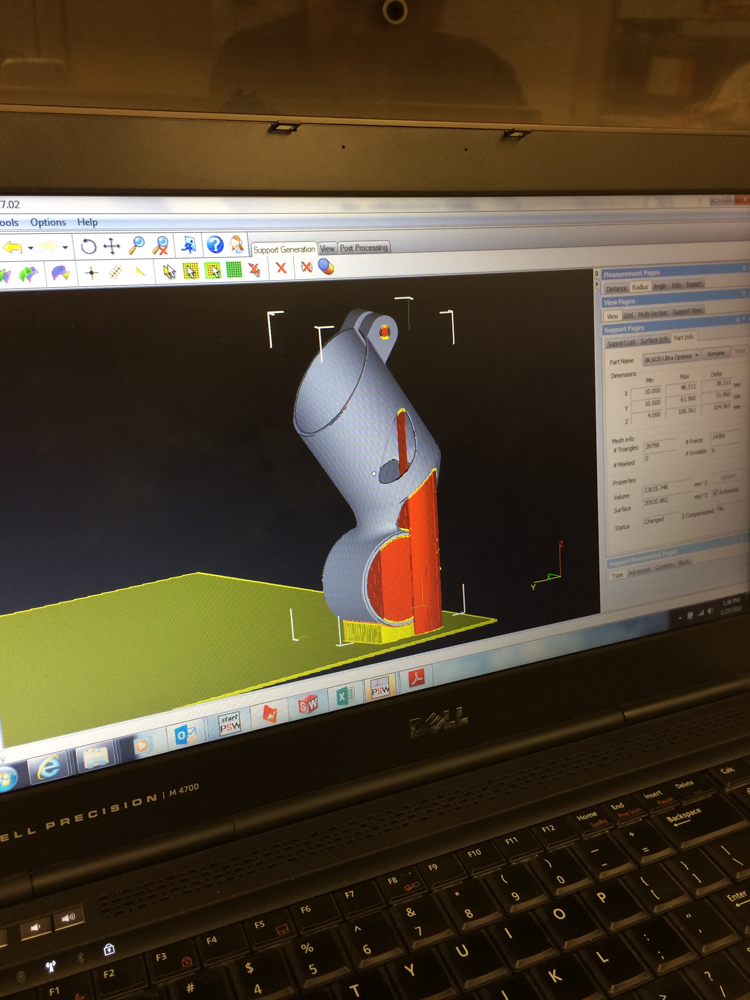
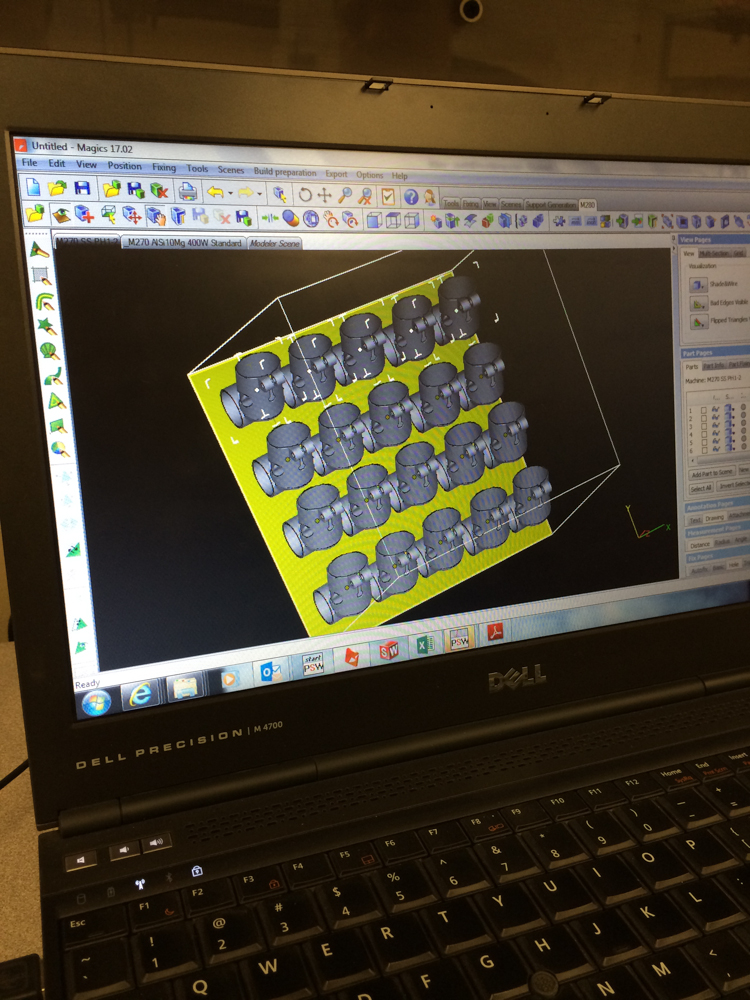
  • After hearing Within's off-the-cuff recommendations about build orientation, Scott and I spent a little while setting up a build platform and support structures for my part. It appears that we could build 20 parts per build with the part oriented roughly upside-down, and we were able to reduce support structures a bit too. We did, however, increase build height significantly, and it's unclear what effect that'll have on the per-part price. (I should have more info on this soon.)

I also got a chance to see a bunch of other DMLS parts in their shop. Most were NDA and couldn't be photographed, but this demo knife blade was pretty cool :)

It's a little hard to see, but almost everything on the top left side of this image is support structures (the part is built with the blade edge up), which can be snapped off manually. Support structures on parts like this are built with perforations in a couple different dimensions, including along the part edge, so removal isn't too hard. The resulting blank still needs to be post processed pretty heavily, though - this knife will require polishing, probably some tapping, and the blade will need to be sharpened as well. My part had an estimated 1 hour of post processing, which seems really reasonable to me.

Next Up

I need to spend some time reconfiguring my design. It's likely that I strip away a few more features, and possibly redesign the bolt boss as well. I then need to think a bit on how I can prep for support structures, and whether I can remove areas of the part (especially around the saddle clamp tube) in order to reduce build time and mass. It's possible that I'll reduce the offset of the topper as well, as it both increases mass and also requires a lot more support in order to build the part.

I'll be putting a bit more time into this project over the coming week; expect updates.

My Realster

Added on by Spencer Wright.

In 2010 I built a short production run of singlespeed bikes, dubbed The Realster. They were intended to be a practical take on the urban fixed gear. From the original product copy:

I believe in minimizing the degree to which my customers need to reorganize their lives in order to ride their bikes. On this project - a short production run of five framesets - I wanted to design a fixed gear bike that would be easy to use on a daily basis. The bike needed fenders, a rack, a comfortable riding position and a bell. It also needed good brakes, generous tire clearance and a reasonable pricetag. It should reward, not punish, you for riding it.

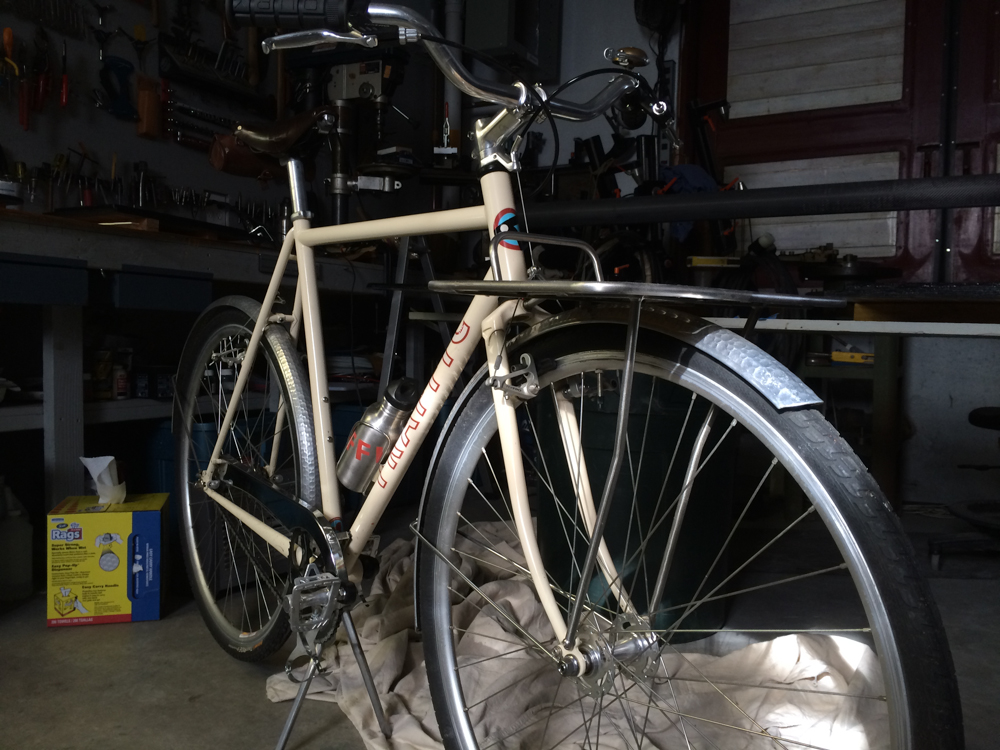
Enter the Realster. It's an upright, practical fixed gear for urban use. The stock version, shown below, sports swept-back handlebars, natural contact points (cork grips and a leather saddle) and a custom made porteur rack with salvaged cross-sawn hard maple slats.

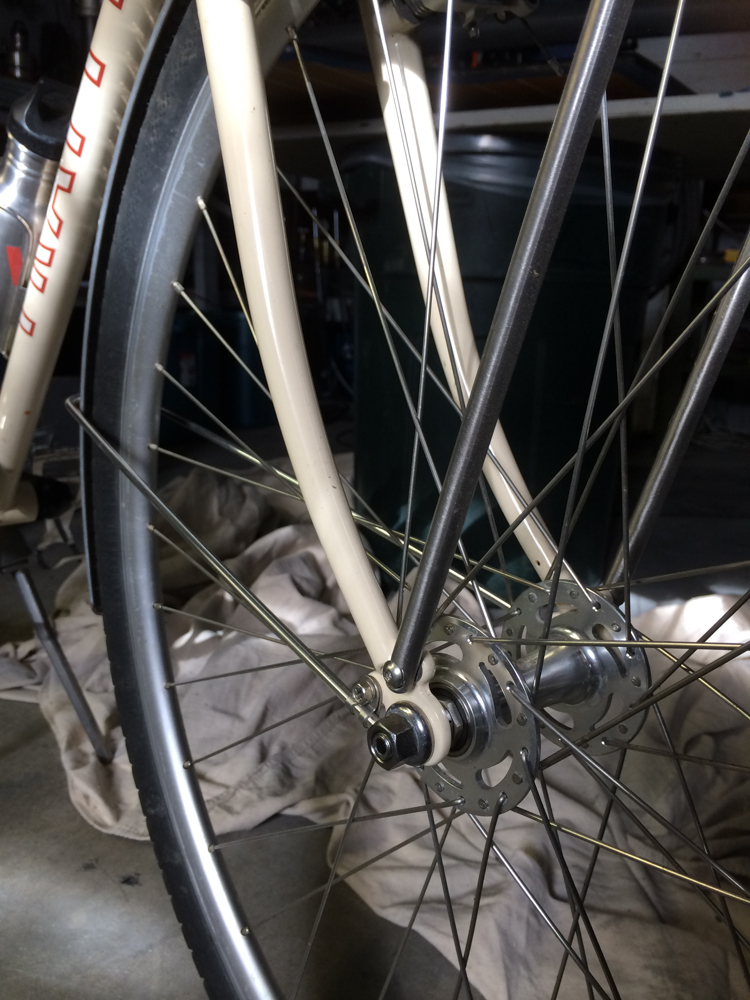
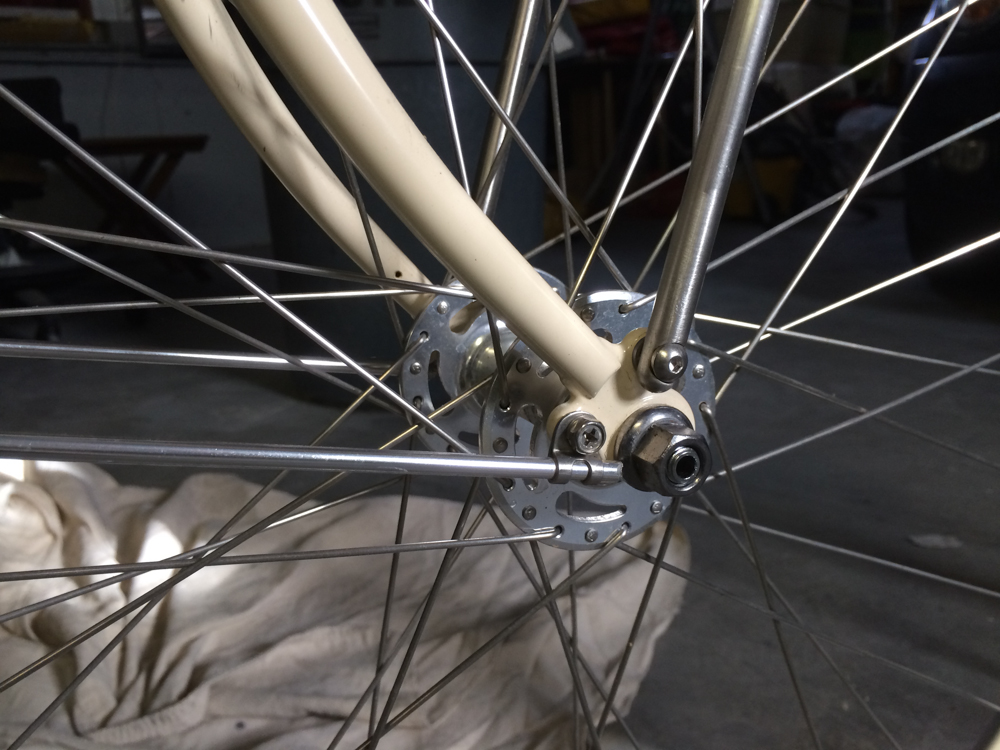
I was in my old shop the other day and snapped a few quick photos of the stock Realster, which I kept for myself. The build is really casual, which is rare for me - but I really like it. I'm particularly fond of its rack, which was an early project that used my rack ends.

There's one of these framesets that never got built up; I recently put it on Etsy.