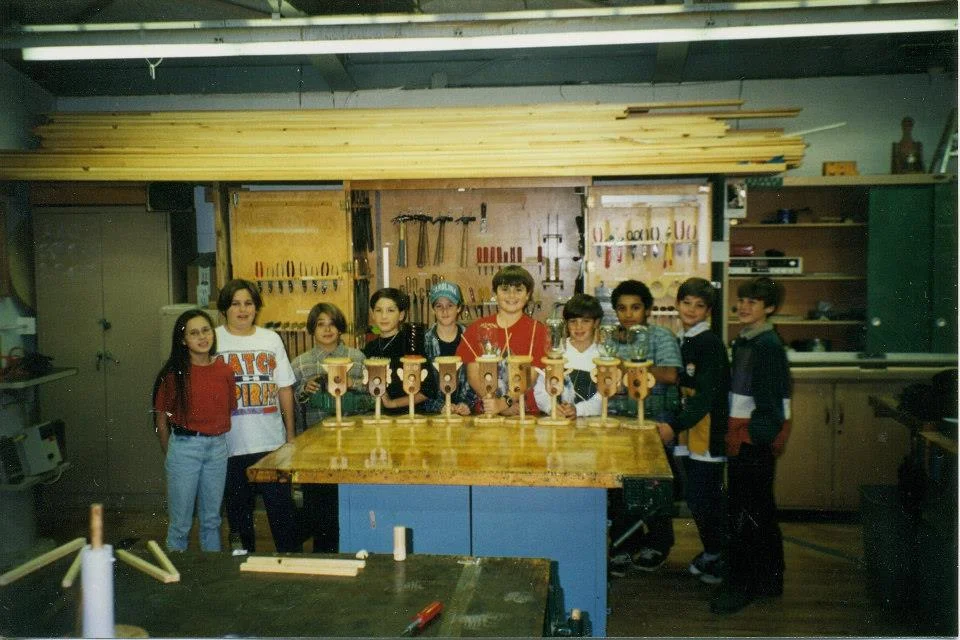
Summer shop camp. This would be like 1994 ish, 6th grade or so. I'm fourth from the left with the weird combover :)
Manufacturing guy-at-large.
Reading
My mailing list is live! And you, dear reader, should subscribe to it.
Pathing.
- Brad Luyster/Meat and Networking: Cheap Prototype PCB Comparison. This is a great article on the cost structures of various prototype PCB fab houses. Great graphics, great analysis, great explanation.
- Marcus Wohlsen/Wired: What Uber Will Do With All That Money From Google. Good profile of Travis Kalanick.
- Andy Dunn: Get One Thing Right. This is one of those "what I learned building" essays about the Bonobos product.
Developing.
- Bunnie Huang: Article on Novena. Bunnie built a totally open-source laptop. It's super geeky and super cool.
- Bunnie Huang: On Hacking MicroSD cards. Bunnie tears down SD cards and figures out how to use them as a cheap microcontrollers.
- ship-technology.com: FLIP - Research Vessel. This boat is insane!
- EOS: Press release for the new EOS M400. I'm looking forward to 4-laser machines.
Evaluating.
- Fred Benenson/Kickstarter: Kickstarter Fulfillment and Product Development: A Story of Dogfood and Data Validation. Kickstarter's data scientist runs a campaign & adapts the Kickstarter product according to what he learns.
- Apple: Mac Pro ME253/MD878 Environmental Report. This is the environmental report for the new "trash can" Mac Pro. It's totally interesting.
- Ryan Hoover/Pandodaily: What Philz Coffee can teach us about product design. This is less silly than it sounds.
Reflecting.
- Rakesh Sharma/Forbes: An Interesting and Frightening Situation: Terry Wohlers' Assessment of the Year in 3D Printing. Good overview of additive manufacturing. Wohlers' feelings on printing-as-a-service are totally keen.
- Peter Richardson: The Lay of the Land. A really thoughtful exploration of cartography and the way we experience terrain.
Eagle, etc.
Today Zach and I spent most of the day laying out a new PCB for The Public Radio.

I'm trying to implement pair programming on the project, and so far that's been really helpful for me - especially right now. To date, I've only designed one PCB in Eagle, and The Public Radio is quite a bit more complicated. Zach's no expert either, but he's got a bit more experience than I do. Regardless, working together on it feels a bit slow, but I'm confident that we'll make fewer mistakes and will eventually move a lot faster as a result.
One thing we're revising is the battery setup on the PCB. On the last board we just used screw terminals and plugged old 9V batteries into them. It worked, but it's an inefficient use of space and energy. On this version we're probably putting a 3-pack of AAA batteries (hence the photo above) right on the board, and are getting a little cute with the layout.
More details to follow; we'll be working on this most of the day on Sunday, and hope to get designs out to a PCB shop on Monday.
The Lady's Harp progress
Spent a little while with Daniel this AM and got some of The Lady's Harp rails built.
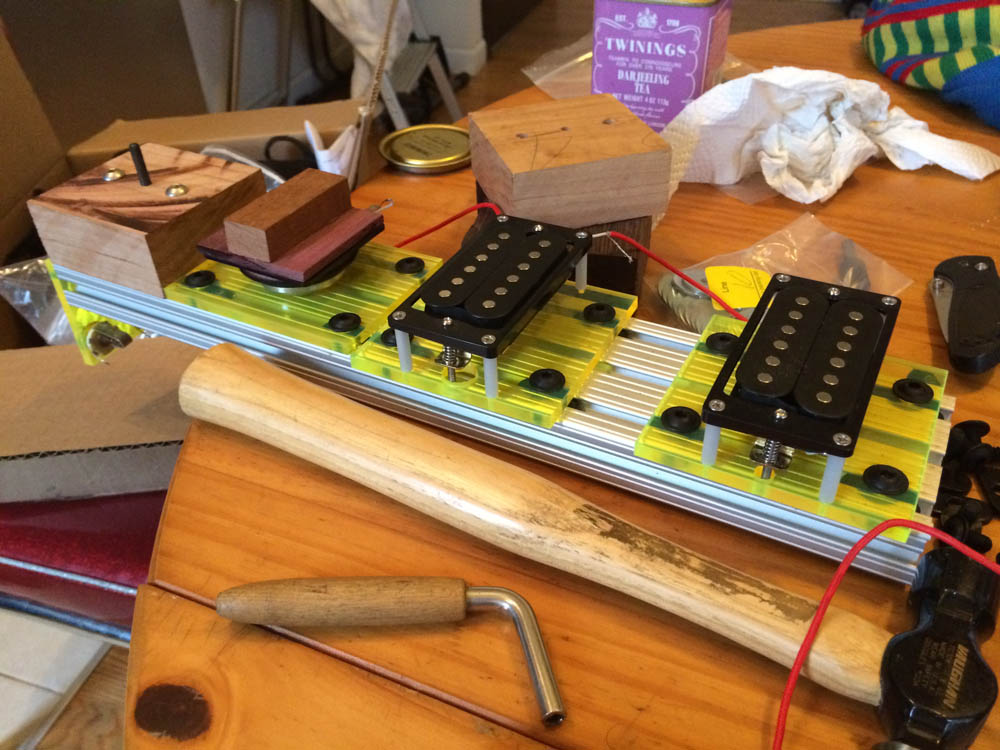
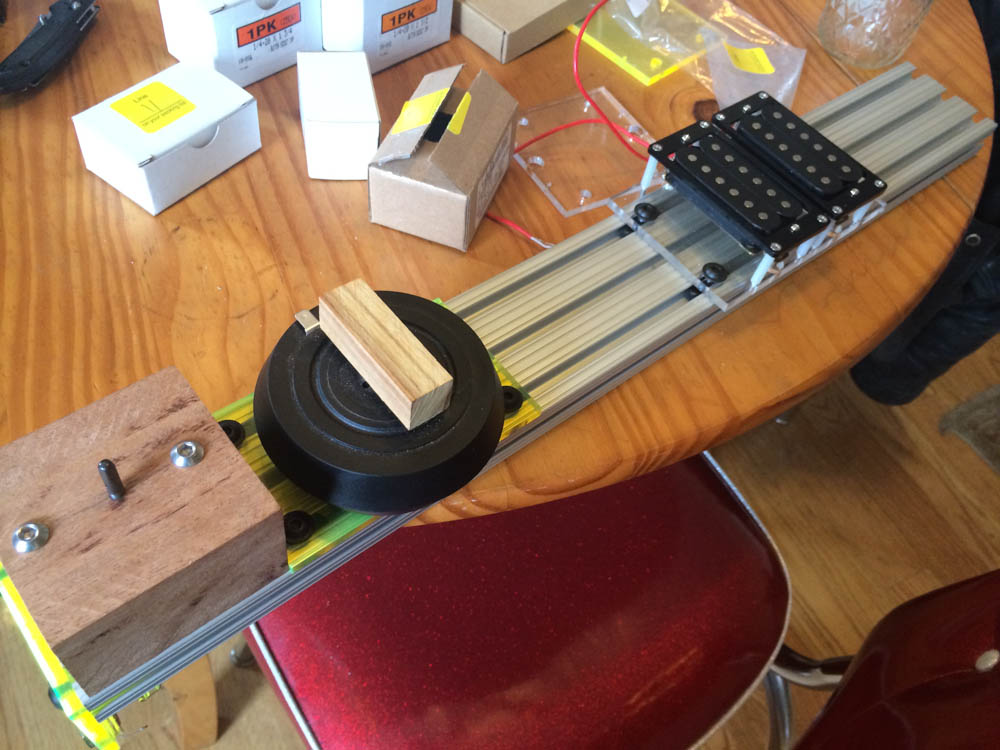
The two rails here are configured differently along a few dimensions. The top one uses the smaller Dayton DAEX58FP transducer, which has a fairly low profile and puts out a maximum of 40W. The lower rail uses the much heftier HDN-8, which is weatherproof and *bumps* a full 100W. Daniel wanted to try both transducers out, and so the tuning blocks (the wood parts, which have piano tuning screws in them) needed to be built at different heights.
Incidentally, these transducers are intended to be mounted to walls, floors or furniture to provide a more tactile audio experience. Imagine 100W of bone-shaking bass when you're watching a movie - I'm not sure it would be enjoyable, but I sure would like to try it out.


I also built the pickup platforms so that they can be gang-mounted (two pickups on one plate) or separated (one pickup per plate). It's possible that the pickups will want to be located at a particular node of the string, and these two configurations will allow all sorts of adjustability.
We should get the whole instrument together next week; expect updates.
A very free interpretation
In a long blog post titled "The Lay of the Land," Peter Richardson discusses the way that humans experience landscape and how to best represent that in a relief map. It's a fantastic read. Below, emphasis mine.
Every representation, in every medium, is subject to procedural artifacts and the judgements of its creators. Some artifacts are more obvious, and some judgements less expressly intentional, but all of our attempts to process and describe our surroundings must contend with these forces.
This fact echoes life in a body made of sensors, all wired to a brain – our experience is the sum of heavily-processed and filtered inputs. There are no guarantees of absolutes in the information we are exploring, and every sensor is a filter. And the more we learn about physics, the more we understand that we are afloat in a sea of statistical likelihoods, and that our ability to group sensations into a world of coherent, individual objects is a very free interpretation of the available data.
So it makes sense that we gravitate toward models. Unless you believe you have direct access to the world of pure being, models are all we’ve got. I’d like to get better at working within these constraints, and in understanding and manipulating them to our advantage.
Via Alexis Madrigal.
Radiodifuziunea Romina
Via Gary Stevens/Flickr and Alexis Madrigal.

It's worth reading the wikipedia entry on QSL cards - it's an interesting and bizarre idea.
Ceiling
A while back.

Yes.
I love working on projects where it’s not a given that the idea is even possible.
— Jonnie Hallman (@destroytoday) January 8, 2014My steez.
Public Radio progress
The latest rev (v1.1) of The Public Radio:

The current state is:
- Arduino Pro Mini
- Si4703 breakout
- Mono audio amp breakout
- VREG
- A bunch of screw terminals
The next rev will be a little PCB that the Pro Mini can mount to, and on the back will be all discrete components comprising our own FM tuner & amplifier. This will reduce the cost of the assembly by a *lot* (these Sparkfun boards are easy to work with but silly expensive), and will allow us to play with the circuits a bit.
The incredible thing is really how cheap the Pro Mini is. These things cost under $9 (cheaper on eBay) and have a lot more features than we'd ever need. Eventually we'll strip that off too and run the whole thing off of an ATTiny (or similar) but for now there's no point in getting ahead of ourselves - the Pro Mini is cheap enough and requires very little work on our part to get our MVP out quickly.
We should have the updated circuit done tomorrow and will be working on board layouts over the weekend :)
Dance dance

Burritos
Craig Cannon, from his poignant 2013 recap:
I’ve found it dangerously easy to mistake industry-defined success with what I actually want, which is, as always, more burritos.
True.
The Lady's Harp
I've been working with Daniel Fishkin on a electronic sound art project called The Lady's Harp. It's a large scale installation that uses acoustic feedback (from guitar pickups) looped back through contact transducers, which induce vibration on piano strings. Daniel has installed this instrument in a few other settings, but needs it to be easier to set up & tear down, so I'm helping with some basic mechanical design. We're using mostly off-the-shelf components - primarily 8020 extrusion - and a few laser cut acrylic parts.
We're mocking the components up in the next few days, and Daniel will be installing the Lady's Harp in Nothing Space later this month. I'll have more updates soon, but Daniel's description of the project is much more elegant and informative :)
Writer's Block
From Jerry Seinfeld's recent AMA:
Q: How do you deal with writers block?
A: Writer's block is a phony, made up, BS excuse for not doing your work.
:)
Schematic & Plans
One more report from our Hacknight: The Public Radio's schematic.

We'll use a Pro Mini for this next rev (the one after that will likely get an ATTiny), but will be using discrete ICs for both the FM receiver chip (Si4703 for this rev, though we'll eventually transition to Si4702 as we're not using the RDS features the 4703 offers) and the amplifier.
This schematic got a little sloppy at the end (after all, I was drawing it :/). I'll probably redraw it once more on paper just to make it pretty, and then we'll punch it down into Eagle and build a board file off of it.
There are probably a few mistakes here so if anyone's got a sharp eye, let me know :)
And lastly, our tasklist for the next few days:

Most of this doesn't bear much comment... The next rev will likely get laser cut acrylic lids, which I kind of hate but which should be significantly more economical (and quicker to procure). Eventually we'll do stamped stainless steel lids, but that's a ways off. We also need to do a bit more digging on active antennas, as the telescoping RC antennas we're using here leave much to be desired. We've also got to look into other wire-to-board connection options; the screw terminals we're using (.1 spaced) are still a bit bulky, and we'd really like to avoid soldering wire directly to the PCB...
More soon.
Symbols
This is a poorly formatted quote.
A week or two ago I posted a really great quote that I received on MFG. This one is on the opposite end of the spectrum.

Note that although I specified DDP terms, the supplier (a middleman for overseas outsourcing) has quoted FOB China.
The price is also totally noncompetitive. I hope to purchase these parts from a US supplier for under $3 apiece at this quantity - and I don't want to be waiting 6 weeks for a boat to show up, either. At larger quantities (1000s) I'd hope to be paying more like $1.75 to my door.
MFG RFQ View rates
For traditionally manufactured parts, MFG has a large enough supplier network that you almost always get a handful of good quotes. My rack end, for instance, went out to over a thousand suppliers. About 75 viewed the RFQ, and to date I've received 7 bids. Another dozen or so suppliers are apparently "preparing quotes."
When you shrink the pool down, though, the rates matter a lot more. There are a *lot* of swiss turning shops in the US, but very few that can produce DMLS titanium parts. So when I posted my seatmast topper, I tracked the results with a lot more interest.
The RFQ went out to 110 suppliers. 8 viewed it, and I have yet to receive a single quote.

Incidentally, there is at least one supplier on this list who did *not* view the RFQ but whom I found separately via Google.
The thing that really strikes me here is MFG's total incapacity to move my project forward - quotes or not. In optimal situations, MFG is an effective marketplace to compare quotes for manufactured parts. What it's not good at, however, is the broader function of connecting designers with manufacturers. Anything I want to learn about the DMLS process - information that inevitably is going to come directly from the engineers and operations managers that are quoting and building my parts - is totally missing from the MFG experience. Instead, I'm left to do leather-to-the-ground work the same way I always have: an afternoon spent with Google + a phone line.
There's definitely a place in the world for a manufacturing marketplace, but I'm pretty sure this could be better.
Regardless, I'm beginning to develop a few old-fashioned leads on good DMLS job shops, and I hope to have some real - and reasonable - pricing in the next few days.
Documentation
Note: This is old, and too complicated/obscure to explain here. I still like it tho :)

Snowdog
A couple days ago.

A good idea that we're not ready for
A vending machine in Bushwick, via Ana Andjelic:
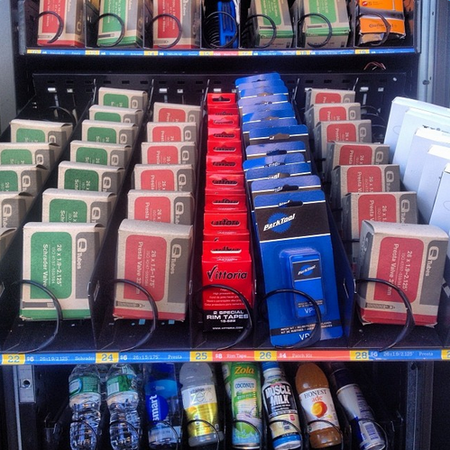
I think this is a great, great idea. But I suspect that for most cyclists, it doesn't actually eliminate a pain point - which presumably, in this case, is having a flat tire and not being able to fix it.
That's because access to supplies isn't really the issue with that pain point. For the vast majority of cyclists, the issue is not knowing how or not wanting to fix it yourself.
Take the issue of knowing which tube to buy. QBP (the most ubiquitous of all bicycle parts distributors, and the manufacturer of most of the tubes shown in this photo) sells literally dozens of SKUs of just inner tubes. Knowing which one to use requires a bit of knowledge, especially when you consider that many cyclists (a disproportionate number of whom probably live in Bushwick) are riding mostly obsolete tire sizes, e.g. 26x1-3/8" (an old Raleigh variant), which can easily be confused with incompatible alternatives (e.g. 26"x1.375").
But there are other possible issues here - being late for work and needing the service to be done as quickly as possible. Wearing clothing that isn't conducive to kneeling on the sidewalk. Maybe the issue isn't in the tube but in the tire itself - a blown sidewall, say.
Now, I'm *not* a booster of bike shops - I think that they provide pretty poor value to the vast majority of customers. But the way to fix that isn't through direct-to-consumer sales, whether online or via unmanned kiosks. Instead, we need a new way to provide customers with the information and service they need. We need to empower cyclists to choose between a variety of good options, for example:
- Affordable repair parts + clear & detailed education on how to perform basic services
- A basic way to store, access & understand information about your bike and its specs/requirements (e.g. tire size, brake pad style, etc)
- On-demand Uber-style repair service, anywhere/anytime
- The ability to lock your bike up wherever you are, and queue a mechanic to come by, unlock it, perform the service and drop the bike off at your home/work
Without a complete transformation of the way we think of bicycle repairs, I worry that services like the one in the photo will be wasting sidewalk space. I like the idea, but I need more execution to get behind it.
Also: Rim strips? Really? No regular consumer is buying those.