Manufacturing guy-at-large.

File conversion woes

Added on by Spencer Wright.

This is why dimensioned PDF drawings are so extensively used in procurement. The top photo is from a supplier from MFG.com; the bottom one is the STEP that I originally uploaded to MFG.

Screen Shot 2014-01-04 at 9.27.05 AM.png

This supplier has obviously downloaded my STEP and performed some translation or conversion on it, and in the process has deleted a few faces (you can see the difference in the foreground of the part, and in the areas he's highlighted in red). This is clearly an inexperienced supplier, and one that I would ultimately have a *really* hard time choosing. I'm not sure what he did or how he did it, but the fact that he made this mistake is an indicator that we'd have issues down the road.

(To his credit: the photo came from a message he wrote me saying that he "noticed some missing surfaces on the part file," and asking me to fix them. So he knew that there was a problem, but didn't understand what it was and wasn't able to troubleshoot it himself.)

In traditional manufacturing, 3D part files are created and edited in a program like Inventor or SolidWorks. The parts are then brought into a separate environment in the same application and drawn and annotated in multiple 2D views on a "paperspace." The resulting drawing file (.IDW for Inventor) is a dynamic representation of the original part; if you modify the part file, the drawing will update automatically. 

You *never* submit drawing files directly to a manufacturer. Instead, you export PDFs of the dimensioned drawings, and *optionally* include STEP files (which are essentially cross-platform 3D files) as a courtesy. The STEPs can be used to help the manufacturer set up their CNC machines, but they're for reference only; the PDFs (with all their dimensions and annotations) are what you're buying.

"Organic" shapes - like those that 3D printing is so well equipped to make - don't fit into this process well. Complex surfaces are *really* difficult to define clearly and completely in two dimensions, and so most 3D printed parts are built from solid files. In this case I submitted a STEP, which manufacturers will convert to an STL and then run through a slicer and feed into their machines.

The problem is that STEP files aren't immutable, and the supplier in this case has apparently deleted a feature from the part. In this case the result was obvious, but there are a lot of features that he could modify or delete that would be a lot more difficult for him to detect, and my QC job would be accordingly tricky.

This process should be better. The PDF workflow is inconvenient, but at least it's an effective barrier to issues like this one. 

Also, we need more, and more *good*, DMLS suppliers. 

Kevin Lynch

Added on by Spencer Wright.

From The Perceptual Form of the City, Lynch's classic text on urban planning and "imageability." Via Bostonography; emphasis mine.

A highly imageable city… would seem well formed, distinct, remarkable, it would invite the eye and the ear to greater attention and participation. The sensuous grasp upon such surroundings would not merely be simplified, but also extended and deepened. Such a city would be one that could be apprehended over time as a pattern of high continuity with many distinctive parts clearly interconnected. The perceptive and familiar observer could absorb new sensuous impacts without disruption of his basic image, and each new impact would touch upon many previous elements. He would be well oriented, and he could move easily. He would be highly aware of his environment.

The Public Radio assembly

Added on by Spencer Wright.

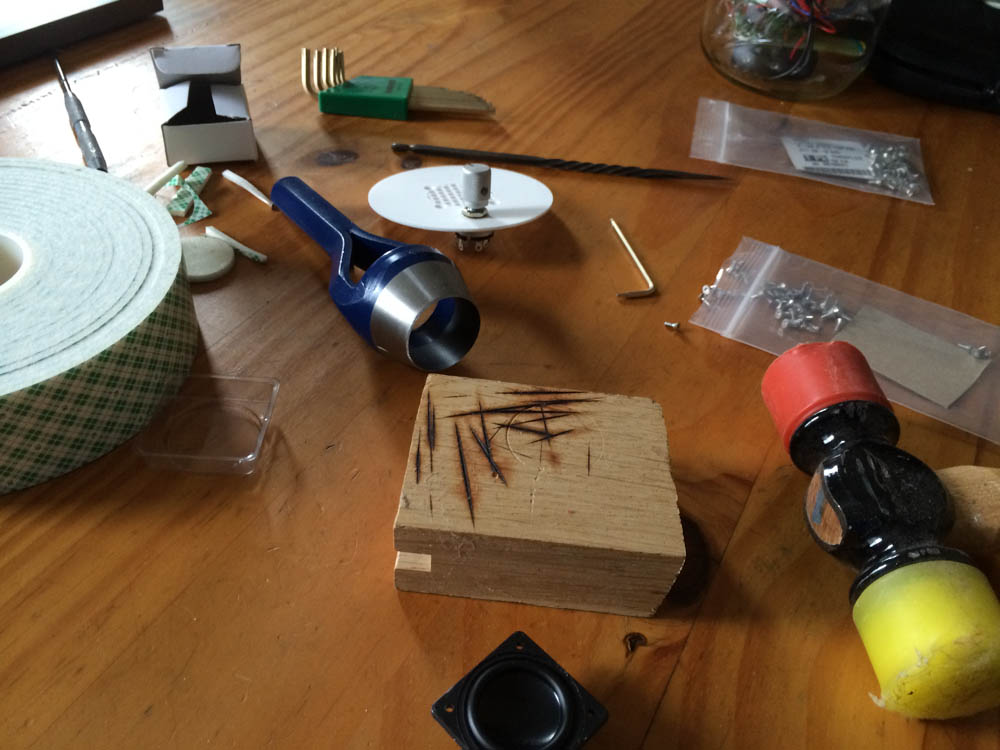
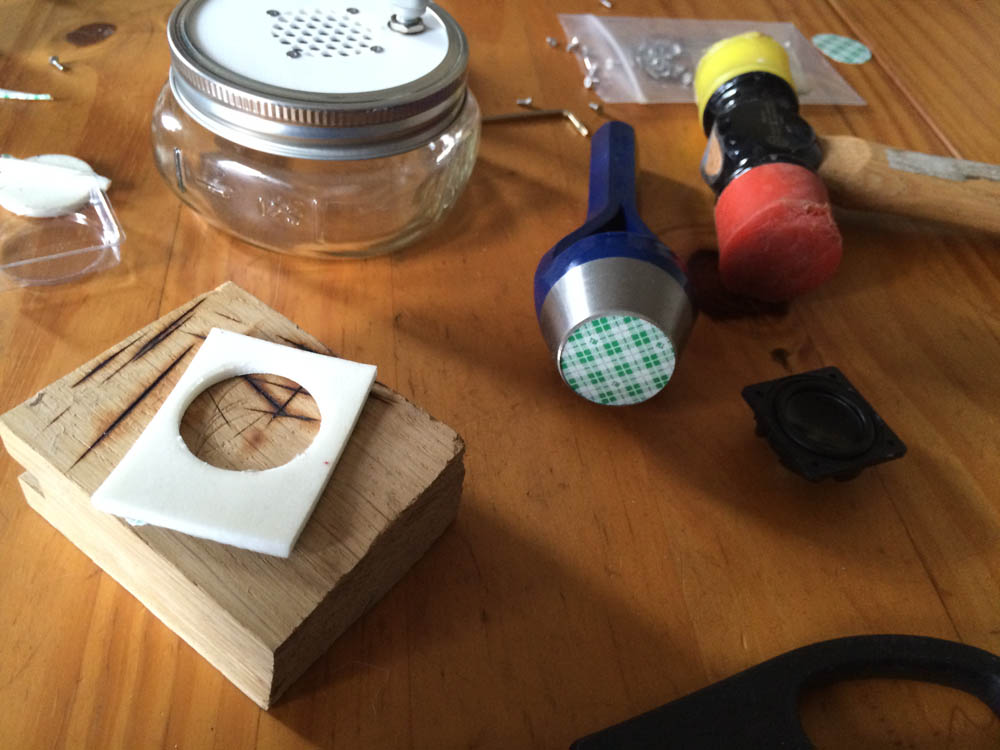
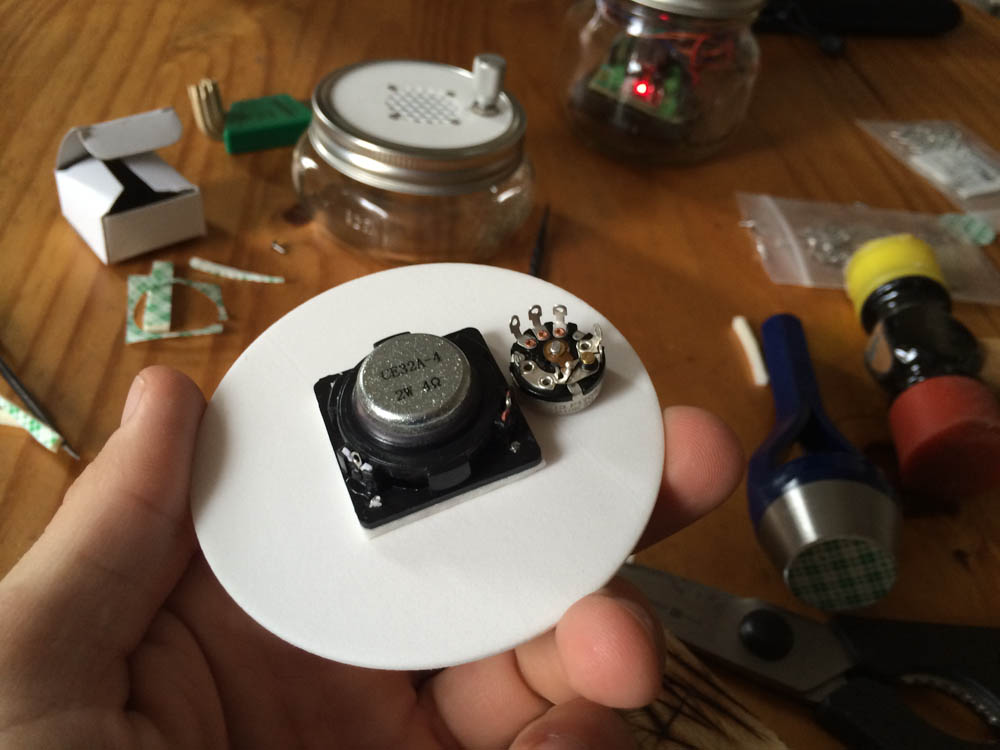
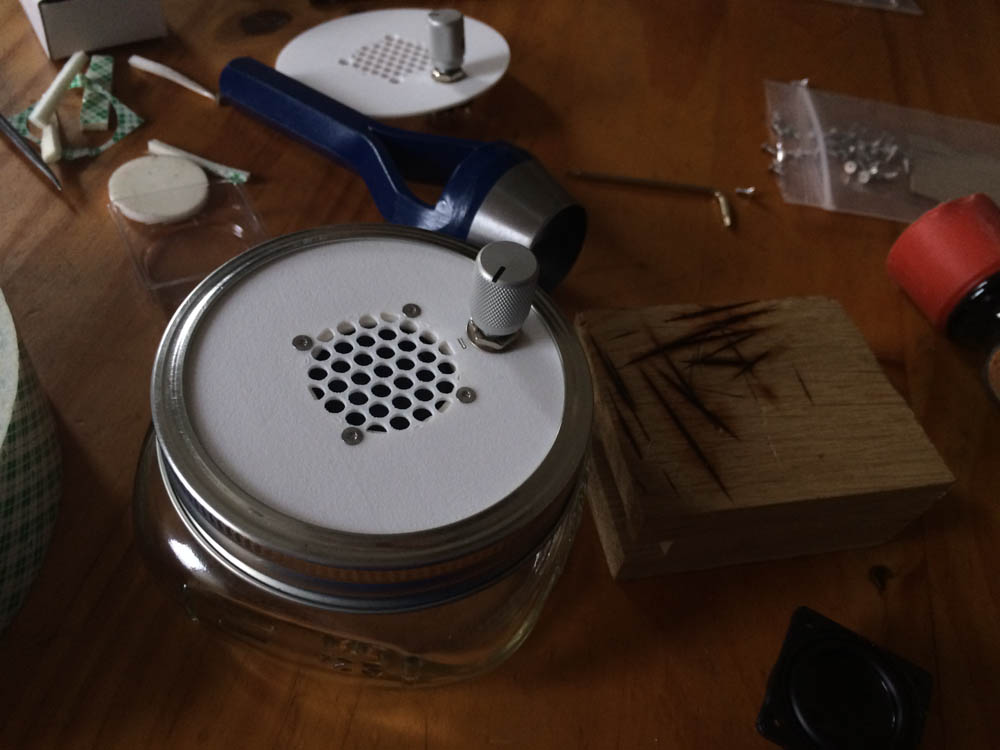
A few days ago Zach and I assembled the lids on the newest version of The Public Radio. 

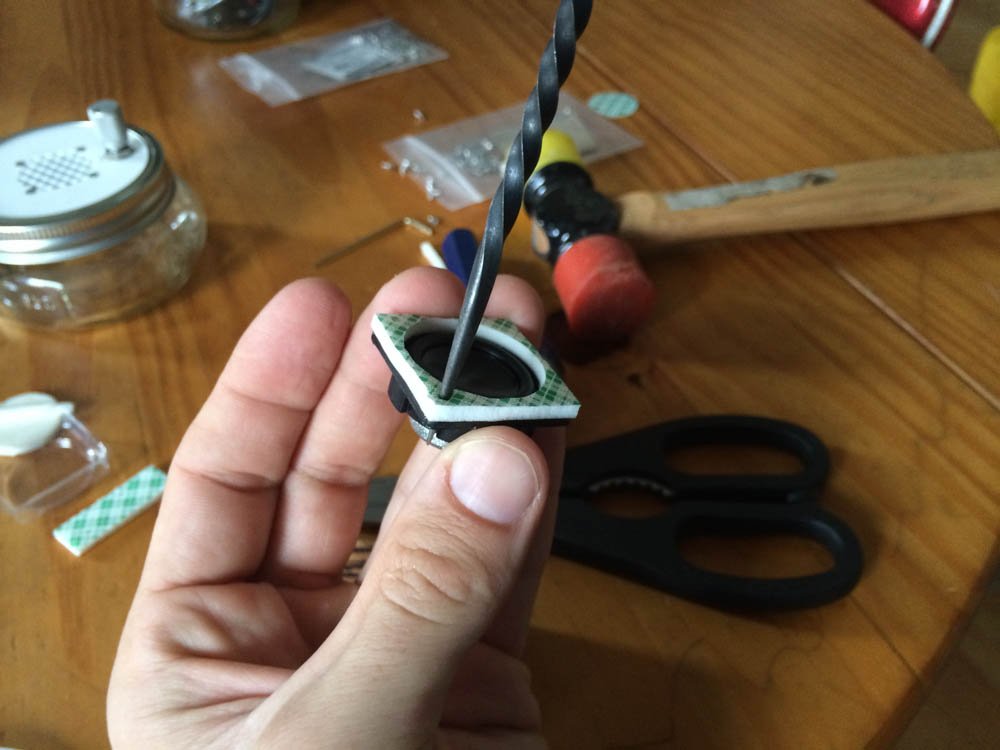
I had spent a bit of time thinking of how we'd streamline the process, and had purchased a round punch and some foam tape to make an adhesive backed spacer for the speaker. For production we'll get these die cut by a job shop, but for prototyping this worked very well.

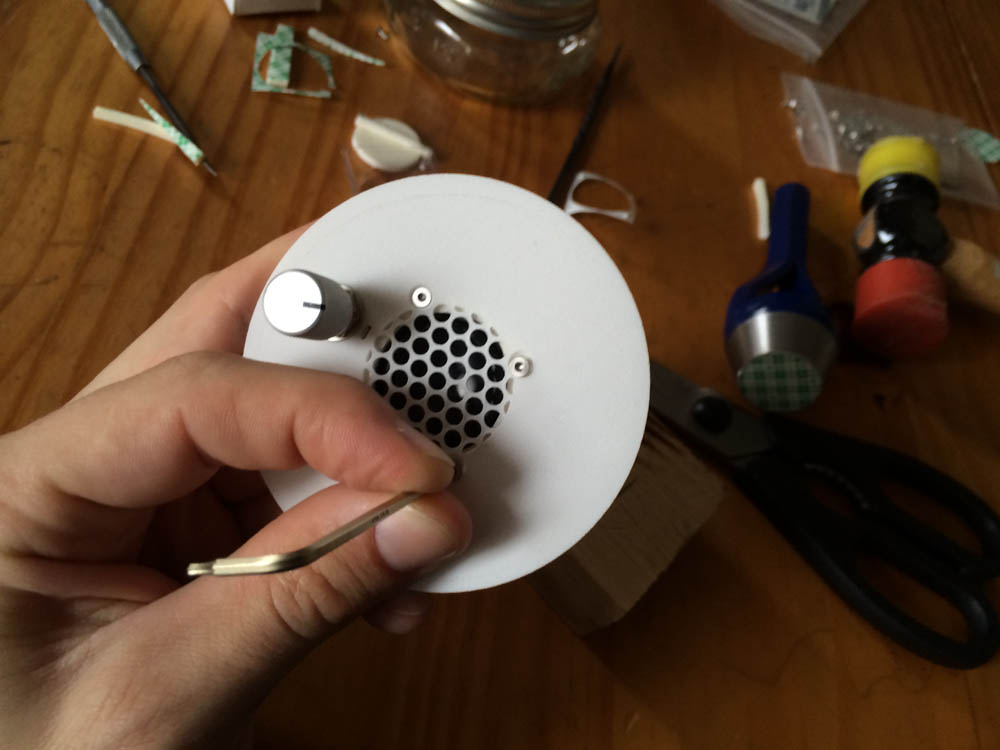
I was trying out two different varieties of mounting screws for this version. In order to make the lid cost effective, I designed it with countersunk thru holes and am mounting the speaker from above. That meant finding screws that would bite into the plastic speaker body well, and I bought a selection of thread-forming screws for that purpose. They've got cute little torx heads which - if I spend a little more time organizing the speaker perforations - will look pretty nice on a stamped (as opposed to this SLA printed) stainless steel lids.

Overall, the assembly worked very well. Honestly I'd prefer to nix the screws, but that's impractical... it's possible that I would design the lids in two parts (like a clamshell) instead, so that the mounting hardware could be hidden from view.  We'll see :)

We should be receiving new PCBs on Monday, and will be assembling a few v1.1s ASAP. Expect updates.

Strategy Tax

Added on by Spencer Wright.

From the second of Ben Thompson's posts on Microsoft's recent reorganization. Emphasis mine.

Let’s follow the typical path: Company A makes an amazing product, finds a great market fit, and starts to make a lot of money. They IPO. They continue to grow, and the stock goes up. And then the stock stops going up, because it’s not clear how they will continue to grow. A stock’s worth, after all, is simply the discounted sum of future earnings.

And so the company looks for another avenue of growth. They diversify, maybe successfully, but now they have two products. And soon, like DuPont, they see the wisdom in having two divisions.

Of course, those divisions are certainly related in some way, and it’s inevitable that considerations are given – or dictated, from the CEO – that decisions in one divisions favor the other division whenever possible. This consideration is called a strategy tax, and it’s a hindrance to product quality. So is the inevitable competition for resources, and the increasingly divided attention of the CEO.

Driver

Added on by Spencer Wright.

This one is silly. This is 2012, and I needed this dumb Maxon motor driver to be quickly reversible, etc., for mocking up BLDC motor assemblies. This thing was a major PITA... but it worked.

Ai & Paint

Added on by Spencer Wright.

Top: Illustrator artwork by yours truly. Bottom: Paint by Keith Anderson.

The funny thing about this is:

  • I had so little experience with Illustrator! The whole Creative Suite is still pretty opaque to me, but back then... I was making it up *seriously.*
  • I still really like this design. The customer didn't want any graphics, but I told him that I needed something on his frame. This was a pretty good compromise - I made it just for this one bike - and I think it holds up.
  • It was *impossible* to photograph. Damn round tubes.

Not ready for the Spotlight

Added on by Spencer Wright.

I ordered my Quirky Spotter on 2013.11.29. I received it on 2013.12.09, and plugged it in immediately. It remained plugged in but mostly inactive for all of December.

On 2013.12.23, I looked at the "Light" settings and noticed that Spotter had *never* seen any light, even though it had been sitting in my room - next to a window that gets direct sunlight - for about two weeks. 

IMG_6555.PNG

I noted the weirdness, but didn't change the alarm setting. I then went out of town for a few days, and was surprised a few days later to see this:

IMG_6571.PNG

It looks like I've got a few issues here. First, I'm guessing that the light sensor and its supporting hardware are indeed functional. The first problem would then be somewhere on either the firmware of the device, or on Wink's backend, or possibly on the Wink iOS app (though that seems unlikely). 

Second, Wink obviously has no idea what it means for a light to be turned on. All of these notifications happened when nobody was in my house, and I'm betting that ambient light at the Spotter was pretty consistent across these readings. So why is Wink sending me multiple notifications?

The net effect is that Spotter is pre-MVP - it's not really viable. I am the owner of a highly sophisticated piece of hardware, which can communicate with a slick iOS app, but whose supporting system infrastructure (the firmware and/or backend) simply isn't mission ready.

For obvious reasons I find this really disappointing. I had been hoping that Spotter would offer a few big improvements over Twine, which I also own. But Quirky is a fast-paced company, and they've sold me a product that - despite the encouraging anecdotes on their blog - just isn't trustworthy.

Lastly, I give you this:

Here, the organizational differences between Apple and Quirky strike me. Quirky thinks that the product stories will validate crappy execution. Apple, instead, has an ingrained (if delusional) belief in the superiority of their products, and that belief is shared throughout their company.

Home Depot, on the other hand, has neither story nor supposed superiority. They sell commoditized products and low-spec tools to a customer base that either doesn't know what they're buying or doesn't care. Their employees usually lack the training to give reliable recommendations, and their store layout - something that Apple spends a lot of time thinking about - is totally non-imageable (cf. Kevin A. Lynch, The Image of the City). 

Just because Home Depot sells "smart" products doesn't make them an advanced retail operation. And as I've experienced, Wink's "smartness" is questionable.

Note: Prior to writing this, I posted some photos on twitter and got a response - on Christmas Day - from Quirky Help. While I appreciate their assistance, I am nonetheless disappointed with the out-of-the-box performance of this high profile product... and its performance has remained, er, consistent. This taken today:

IMG_9583.png

Phew

Added on by Spencer Wright.

My notes from a few years back, when I took MITx 6.002x - Circuits & Electronics. 

If I recall correctly, this particular path was a wild goose chase - there's too much guzz here for it to have been the right solution.

Most recent revision: Dummy Headset

Added on by Spencer Wright.

I realized that I never posted photos of the most recent revision of my dummy headset. Here it is:

The major difference is that I removed a bit more material from the inner diameter of the part. The result is that it's lighter and less expensive to produce, while still holding a fork steerer gently & securely. 

The updated version is on Shapeways - please check it out and send any feedback my way!

PS - it's also available in black :) With more colors to come!

This is a well documented quote.

Added on by Spencer Wright.

Most quotes on MFG - whether from the US or overseas - leave a lot to be desired. This one is pretty good, though.

Note, that doesn't mean that I'm going to act on this quote. But I like the comments a lot - they show a lot of foresight and care on the part of the supplier.

Mailing List v1.0

Added on by Spencer Wright.

Mailing list: LIVE!

This is the best of the best of the stuff I've read in the past month or so. Check it out here, or subscribe!

Pathing.

  • Wikipedia: "Hedonic Treadmill." Basically, humans aren't very good at getting happier.
  • Wikipedia: "The Planning Fallacy." People are also terrible at planning, even when they're primed to be aware of that fact.


Developing.


Evaluating.


Reflecting.

  • Juliet Waters/NYTimes: "The Code of Life." A journalist learns a little programming, and discovers that it's not all bad.
  • FastCo: "Digital Cameras are Messing With Your Memory." This is great, but you really need to read to the end - I suspect that the way that many of us deal with digital photography avoids some of the pitfalls.
  • John Dickerson/Slate: "Note to Selfie." Dickerson gives an excellent, and heartfealt, defense of mobile technology and its place in our everyday lives.


And.

Love... your friendly host.

Batteries

Added on by Spencer Wright.

From Wired's (great) recent piece, "How Apple’s Lightning-Plug Guru Reinvented Square’s Card Reader."

But ditching the battery meant more than saving space. It was also a huge step towards that simplicity Dorogusker set out to achieve from the start. “With a battery, you have to somehow connect the battery to your circuit board,” he says. “You do that with two little wires. They have to be cut to length, stripped on both ends, tinned on both ends and hand soldered to the battery and then to the board. It’s a huge amount of labor.”

In my robot door life, we were lucky enough to have someone aboard to warn us of the physical danger of lithium ion batteries; we ended up finding some very powerful lead acid batteries to do the trick instead. But we spent a *lot* of time configuring our battery pack, which was a PITA to assemble and mount. Wires suck, and batteries often require them. Avoid if possible.

Marc Barros

Added on by Spencer Wright.

From his very good post, "What Can We Learn from Beyoncé?" Emphasis mine.

Having a purpose in the startup world is hard. The culture is built around ideas instead of meaning. Which is best exemplified by everyone’s two favorite questions: What do you do? and How big can this be?

Surround yourself with creators who first ask why you do it.

I've been asking this question of more and more of the folks I come into contact with when discussing a possible collaboration. I'm always surprised how few people seem to question why they're doing what they are, though I can relate - I've spent much time pursuing things for totally backwards reasons. I explored this a few months ago in relation to my experience building bikes, and have spent a lot of time in the past year thinking about how I want to address the Why of the next steps in my career. I certainly don't have it all figured out, but I definitely want to work with people who are thinking along these lines.

IRL Crowdfunding

Added on by Spencer Wright.

Every few days someone asks me about one of the projects I'm working on. Most often they've seen something I've put up on Instagram or Facebook, but didn't have enough context to really understand what it is I'm working on or even whether it's for sale.

Most of my projects will eventually be crowdfunded, and I expect to be able to convert some of the folks who I've talked to during development. But I had a thought the other day: Why not start taking orders immediately, whenever someone asks? 

The thought is this: If you ask me about The Public Radio, I'll give you my little pitch and then (assuming you've acted enthusiastic) ask for $20, cash, now. I'll then whip out my phone and email you an informal receipt, and will deliver you a v1.0 when it ships (probably the pre-Kickstarter version). 

This would help me in a few ways. First, it locks in a customer. Second, it lets me know whether I'm actually onto something - if everyone says "no," then maybe I should pivot. Third, it gives me a little cash to help keep the project moving forward. And I can be pretty sure that you'll ask me about the project status in the future, which is the most thrilling parts of building a product like this.

I think this is a decent idea. If you're reading this, ask me about what I've been working on the next time you see me - we'll see how it works :)

Touch-stuff

Added on by Spencer Wright.

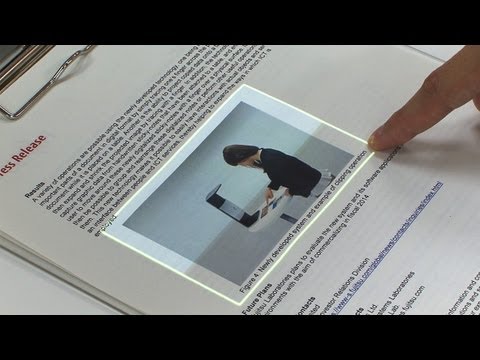
This system is super awesome. It's a haptic interface that uses a camera + a projector + spacial recognition software. Way cooler than Leap + a flatscreen display, if you ask me.

via Emmanuel Quartey.

NoHeadSet on Shapeways

Added on by Spencer Wright.

After a couple of revisions, my 3D printed dummy headset is on Shapeways!

It still probably needs a few refinements, but I'm hoping to get a little feedback on it before I make them. I did try it out in my shop recently (NYCVelo also has a prototype), and I can confirm that it looks great and works damn well.

The headset is two parts. The top half has two 3.3mm holes "drilled" in it; they need to be tapped M4 in order to make the assembly really work well. I would recommend using brass tipped set screws for aluminum or steel steerers, and nylon tipped set screws for carbon fiber. You can also experiment with thumb screws or plain old socket cap screws if you like.

This may seem like an obscure part, but for anyone who has spent any time handling bike frames & forks, it'll come in *really* handy. If that sounds like you, grab one on Shapeways and let me know how it works!

Estimates

Added on by Spencer Wright.

I've been really lagging on my rack ends project, but I wanted to post a quick update.

A few months ago I posted drawings and a STEP file to MFG.com. MFG is a sourcing platform for manufactured parts of all types, with suppliers and buyers from around the world. When I was building robot doors, I used MFG to source probably $50k worth of parts, mostly from contract machine shops around the US - but also from mainland China. MFG is a great place to get a *lot* of quotes quickly, and I've developed a few long-term relationships with great suppliers from it. 

My current project is a small one - there are certainly hundreds of job shops around the country who could handle it. I'm hoping to spend $2-3 per part in quantities in the 100s, though it remains to be seen whether that's possible. 

I got about twenty quotes back, though I scratched a few outliers off the bat. The remaining sixteen are below. Note that the 1st quantity is for 1000, 2nd quantity is for 100.

As it happens, I've received samples from a few of the cheapest suppliers on this list... they were pretty rough, with a lot of hand-finishing (presumably to cover up low quality machining).

Note also that I requested all pricing to be DDP, which means that the supplier is supposed to include all duties and shipping to my doorstep. From my past experience, a lot of Chinese suppliers either don't understand or don't care to quote these terms, though a few of the quotes here actually specify EXW, meaning that the supplier boxes up the goods and then leaves the rest for me to take care of. For a box of stainless steel in Guangdong, the cost of shipping could easily add 25-50% to some of these cheaper quotes.

For a part like this one, I could probably pick one of the lower bids and go with it. The part is simple enough; the worst I would deal with would probably be a bit of slag on some of the drilled holes. I want to be careful about material selection, though - I need the part to be 304 stainless, and the risk of a supplier using a different grade is nontrivial. 

The fun thing to do is to order the small quantity from one of the lowest bidders, and see how it turns out. For less than the cost of a used PS3, you can get a batch of parts that's probably ready to sell or use - *and* you might learn something interesting.

In reality, I'm more likely to buy the parts from a supplier I know (and found on MFG a few years ago). The quote I got from him was under $4 per, which is competitive with many of the Chinese suppliers here. He quotes EXW, but shipping UPS for these parts won't be more than $50. I would also follow up with all of the reasonable US firms here and see what their responsiveness was - especially if I can find someone local-ish.

This particular part is low priority right now, but I'll probably follow up on this early in January. Expect updates.

The Algorithms that became the Google Car

Added on by Spencer Wright.

Robert Scoble, in a good post on Quora about keeping up with technology.

I saw self-driving cars in 2007 at Stanford University, for instance, and interviewed the guy who built the algorithms for what became the Google car.

This may seem non sequitur, but I think it's remarkable. It really illustrates how much software is eating the world: a car ceases to be a thing with an engine and four wheels, and instead becomes an bunch of software. 

Pretty cool.