Manufacturing guy-at-large.

Angela Ahrendts

Added on by Spencer Wright.

From Fast Company's recap of their pre-Apple interviews with Apple's new consumer experience chief.  Emphasis is mine.

On brand culture: 

Everything we’ve done is counterintuitive to traditional selling organizations, with their traditional training. My dad used to always say that he could teach anything but he couldn’t teach how to feel. That’s the hardest part when you have 11,000 people: How do you teach them to feel how we feel? When I first started, we had no training programs--none of that. We had to put in world-class sales and service training programs. The thing is, I don’t want to be sold to when I walk into a store. I want to be welcomed. The job is to be a brilliant brand ambassador. Everybody is welcome. Don’t be judgmental whatsoever. Look them in the eyes. Welcome them. ‘How are you?’ Don’t sell! NO! Because that is a turnoff. So how do you hire all these amazing people and put them in a world-class retail setting and then say, ‘But you’re not allowed to sell’?! How do you put this whole digital team together and say, ‘But we are not doing any direct marketing to sell to you!’? The digital guys look at you like you’re nuts. But no, no, no, no, no. What we have wanted to do is build an amazing brand experience and an amazing way that people can engage with the brand. Then it will naturally happen. And then I don’t care where they buy. I only care that they buy the brand.

On desegregating digital from brick-and-mortar:

Traditionally, wholesale is wholesale. Digital people are incentivized to drive digital. And store managers are interested in the store. We blew that all up. I said, No, no, no, store manager in Detroit: You’re responsible for digital too. You’re telling me nobody in Detroit is shopping online? Wrong! Now London, for instance, every week has to report their online traffic and their offline traffic and what was their crossover. I hired a chief customer officer who came from Lloyds who built us a huge insights and analytics department. We put in traffic counters in all the stores, because I could get traffic online but I couldn’t get traffic offline and so I couldn’t get any crossover behaviors. We’ve got ten thousand iPads out there in the stores. And we’ve built this clienteling app. So if you buy in Hong Kong or if you went and bought online or even if you are just window-shopping and have stuff in your basket--we’ll know. Offline stores will be able to see all your behavior online. We are blurring the physical and digital, and it’s not just the retail experience. It is the service.

Fucking Fall.

Added on by Spencer Wright.
1) It’s fucking fall, it’s the best time of year. Period. Nothing makes me happier then the cold air starting to roll in and being able to dig all my warm clothes out of the back of my closet. I happened to be in Vermont last week shooting a music video for my wife just as the colors changed, it was stunning, I grew up there so I’ve seen it my whole life but it never ceases to amaze me. I got myself intentionally lost trying to cross as many mountains as I could on the way home without looking at a map, good times.

Rack Ends: Current design

Added on by Spencer Wright.

I'll be writing more about how I'm going about procuring my stainless steel rack ends later, but I wanted to give an idea of the sorts of design files one needs to supply machine shops with in order to get quotes. A dimensioned (and toleranced!) PDF is always key:

N.B., my drawing template is pretty lame right now. Not having standard tolerances listed is a total no-no, but most manufacturers assume +/- .005" on any distance and +/- 1 degree angular - so I should be okay. I really just need to spend a morning setting up a new template, but that's fairly low on my priority list right now. Anyway... do as I say, not as I do.

I also usually include a STP file, but as a rule that's *only* for reference. I suppose that if you had a particularly strong relationship with a supplier and were sourcing a part with *only* standard tolerances, skipping the PDF would be okay... but that's a rare scenario.

Aaaand, thanks to my friends on Twitter, you can see the part in 3D here:


More time reading

Added on by Spencer Wright.

I heard this quote on yesterday's Marketplace (which - let's be honest - is totally underrated). The topic of conversation was (unsurprisingly) the debate surrounding the government shutdown, and Kai noted a conversation that he had with Lisa Goldenberg, COO of Delaware Steel, who was quoted:

I was on the phone with several presidents [of other steel companies] just this morning and everyone is saying they're spending more time reading and trying to figure out what's going on than actually transacting [business].

And I'm thinking: If you're lucky enough to run a company and *not* spend most of your time figuring out what's going on, kudos to you. But what portion of midsize manufacturers are really doing that? And as ideas and business models continue to turn over at an increasingly rapid pace (citation needed), how long will the companies whose C-Suites *don't* spend most of their time paying attention to trends be able to stay around?

My feeling: If you're on your game, you're constantly struggling to stay ahead. It's okay if that's not you - but it's important to be honest with yourself about the consequences.  

Cold

Added on by Spencer Wright.

My old shop. Truckee, CA, 2007.  It was too small with the door closed to move around, and anyway it was unheated, so I would open it up and revel in the abject humor of the whole thing. I thought this photo (which I orchestrated with a tripod, etc.) was hilarious. 

Bacon Gone

Added on by Spencer Wright.

My Grandfather, Libo (for whom my German Shepherd is named) wrote this circa 2007. We were sitting around chatting and he jotted a few similar verses as we talked. I continue to think it's hilarious. 

From the Archives: Pizza, Philly, 2008

Added on by Spencer Wright.

In 2008, I was living in Philly and decided to start a blog about all the pizza I was eating. Suffice it to say that it never took off (I composed six posts over a three month period before drifting away from the idea), but I like some of the writing. Below is my (slightly edited) review of El Greco, a totally crappy joint near the totally crappy workspace I kept in North Philly. It was originally posted 2008.05.30. I particularly like the last paragraph, which sums up my feelings about slice shops well.


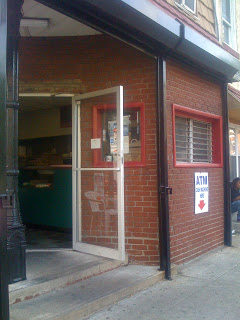
El Greco is a neighborhood shop, and it's just a few blocks from my workshop. I stop by every once in a while, and it's an experience.

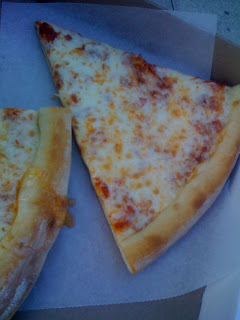
Today, as usual, there were a bunch of people inside. Three behind the small (but tall) counter, a driver or two outside, and three or four customers in the long, narrow area inside. I order two slices, which are put in a box. (A bit of a downer for me - what, they don't want me eating in front of the shop? Put it on a plate, please...) I go outside and stand by my bike and eat them - warm, gooey, and very sweet. The cheese is thick and chewy, the crust is soft and light, and the sauce is sugary and squirmy. 

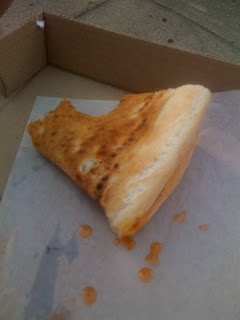
The slices are floppy - they fold, and don't crease - and drip red-orange oil as I squeeze the fluffy crust to keep the whole package together. The first bite requires me to hold the crust side above the rest of the slice, so that it doesn't unfold and go limp. Eating the slices produces a texture that resembles, almost, mollusks. As I stand there eating, I observe the scene. A tall, gaunt man sits on the stoop, then stands and mills around the storefront, smoking a cigarette. Three customers who came out of the shop just as I was entering sit on a stoop next door eating their slices and talking. The traffic on 2nd St. whizzes by, passing the small community at Jefferson - the slice shop, an auto tag store and a barbershop.

I like El Greco in a way. It's not exactly gourmet, but talking about the quality of the food misses the point of the business. It isn't high quality - some might go so far to argue that it's hardly pizza. Either way, it's food, it's part of a neighborhood. And sometimes that's all you need. 

Rack Ends: Background, Requirements & Design

Added on by Spencer Wright.

In the past few weeks, I've been reviving a product that I originally conceived of in 2010. I'll get more into its revival later, but I wanted to spend a little time documenting the development and design details here.


It was sometime in 2009 that I decided that rackbuilding was something I wanted to focus on. I had been building custom bike frames full-time for a year and a half, and had developed a sense that for most customers, custom frame geometry alone is just not sufficient reason to justify spending $3K+ on a bike. I had built a few nice road and mountain bikes in the $5-7K range, and I was proud of the results, but the value proposition for most customers just wasn't there. For that money, you can buy one hell of a Specialized off the rack at a LBS. And other than a sotto voce paint job (I tend to *hate* the design language that the big bike companies use), there was little I could offer to really distinguish myself.

I also wasn't totally immune to spotting trends. In March of that year, I attended a trade show and spent a while observing the way other folks were differentiating themselves. Fashion in the handmade cycling world tends towards the quaint, and rackbuilding offers framebuilders the opportunity to show their bikes carrying things like wine bottles and six-packs - stuff that most big companies would never display. 

Around this time, I was living in Philadelphia and spending a lot of time biking around and eating pizza. I spent a while thinking about what kind of rack I'd want for my bikes, and the best combination of whimsy and utility that I could come up with was a front rack that would fit a large pie. I was riding around a hardtail mountain bike at the time, and decided to build up what would become The Utility Bike - and, once it was mostly done, went about building my first real rack.

At the time, most custom builders were just cutting their own rack eyes out of plate or bar stock (Rack Lady, who I have a *lot* of respect for, is/was a great example of this).  A few folks (Signal stands out) were doing really beautiful things that more closely emulated lugged construction, but that was never really my aesthetic. Anyway, I wanted my rackbuilding process to be TIG only.

I started by having a bunch of plate-style eyes watercut from a sheet of stainless plate. The plate was .125" thick and came with a stain finish. The result was a pretty good start.

I was lucky to have access to a waterjet, where I had head badges and rack eyes cut. I didn't have any sway with the programmer, though, who used the controller's stock nesting protocol to place the eyes on the plate. I'm pretty sure you could lay these out a lot more intelligently if you did so 'by hand,' as it were - but I never got the chance to prove it :-/.

I used these on a couple of racks, and all in all they were a great improvement over cutting them by hand. I tried a few different methods. In at least one case I crimped the rack tubing over the tab itself, but it was a bit cleaner to slot the tubing and insert the tab into the slot. Welding the whole thing together was a bit sloppy (The wall thickness on the rack tubing is .028", which contrasts badly with the .125" thick plate eyes. The result is that keeping both parts right at melting temperature is tricky.) , but the result was passable.

This was my first nice rack. I eventually got Ian to make me some slats to fill in the deck and, and I made some custom length bungees too. I learned a lot in the process, and also tried out a detail that - although kind of silly - would end up informing the way my rack end design progressed. The rack required that a few tubes be terminated, and I turned down some solid stock to a point, relieved an area to insert into the tube, and lap welded the entire thing together. The result is below.

Right around this time, I started building bikes for both Saylor and Ian. Both required racks, and Ian got a chainguard as well. I spent a little while thinking about how to terminate all the tubing, and ended up making a batch of mill-turned rack ends that would become my go-to solution on a bunch of future projects. The process went turn-mill-turn, and included at least ten processes per part, described roughly below: 

The end result can be inserted into a piece of .375"x.028" tubing (cut square) and lap welded. I generally would then file and sand the result smooth. This assembly technique offered me a key feature: If a strut was just slightly too long, I would shorten it (by rolling it against a benchtop disc sander) quickly and in small increments. In addition, the entire assembly is self aligning - the rack end bolts to the boss and slips into the tube, which can have any orientation necessary. This method was much easier than if I had been using tabs & slots, which take a lot of work to align just right and is difficult to adjust the length of.

I got a lot of mileage on these parts, and adapted them for a few alternate configurations as well. I developed something of a symbiotic relationship between their design and my rackbuilding workflow, and the result has been (to me) great.  

I think these parts could be useful to a lot of framebuilders out there, and I'd be interested to hear from anyone who might be interested in them.  Drop me a line if that sounds like you. 

I want this bike back.

Added on by Spencer Wright.

Three iterations of a mountain bike I built in 2007. 

Immediately post-build, Truckee CA.

 @ The Candy Shop, North Phila, where I lived in 2008.

 @ TCD HQ - 2nd and Girard, North Phila, where I worked in 2008.

A weird translation

Added on by Spencer Wright.

From a message on mfg.com that I received the other day (emphasis mine): 

Hi Spencer,
Have a nice day. We are very interested in you project.
Could you advise your precious about our quote?
We sincerely hope to build a long-term cooperation relationship with you. We have been specialized in this area for several decades of years. And we have gotten ISO certificate. We always provide high-quality parts with reasonable price to our clients,  you could check our good rating commented by our clients. Hope starting work with you soon. Look forward to hearing from you soon.
Any doubt, please feel free to contact us at anytime.
Many thanks&Kind regards
[NAME REDACTED]

I can't for the life of me tell what they mean by this. Who is my precious? 

For anyone interested in these types of mistranslations, you should really check out Language Log's "Lost in Translation" posts. 

Man From Mars

Added on by Spencer Wright.

When I got out of college, I spent two years in construction management in Northern California. It was a stressful period for me - I was out of my element, alone, and over my head - and I struggled to fit in with the employees and subcontractors that I dealt with on a day-to-day basis.

It was towards the end of this time that I heard Tom Wolfe's 1987 interview with Terry Gross, in which he described the benefits of standing out. It's something that's stuck with me since. Emphasis below is mine.

Wolfe: I have discovered that for me - now, maybe it doesn't work for everybody - for me, it is much more effective to arrive at any situation as a man from Mars than to try to fit in.

When I first started out in journalism - in magazine work, particularly - I used to try to fit in. I remember doing a thing on stock car racing. I went down to North Wilkesboro, North Carolina, to do a story on a stock car racer named Junior Johnson. And I tried to fit in to the stock car scene.

I wore a green tweed suit and a blue button-down shirt and a black knit tie and some brown suede shoes and a round Borcelino hat. I figured that was really casual, it was the stock car races.

And after about five days, Junior Johnson, whom I was writing about, came up to me. He says, I don't mean to be rude or anything, he says, but people I've known all my life down here in Ingle Hollow - that was where he came from - he said, they keep asking me: Junior, who is that little green man following you around?

And it was then that it dawned on me that A, nobody for 50 miles in any direction was wearing a suit of any color; or a tie, for that matter; or a hat. And the less said about brown suede shoes, the better, I can assure you. So I wasn't - you know, I wasn't fitting in to start with.

I was also depriving myself of the ability to ask some very obvious questions if I thought I fit in. I was dying to know what an overhead cam was. People were always talking about overhead cams, but if you were pretending to fit in, you can't ask these obvious questions.

After that, I gave it up. I turned up - always in a suit and, you know, many times a white suit, and just be the village information-gatherer. And you'll be amazed, if you're willing to strike that role.

GROSS: When you were doing the research for your book "Electric Kool-Aid Acid Test," which is about Ken Kesey and the psychedelic acid trips, were you dressed like that, too?

WOLFE: Oh, yes. And actually, to have tried to fit into that scene would have been fatal - perhaps literally, fatal.

Kesey had this abiding distaste for pseudo-hippies or hipster -there was really no such term at that time, but we'll just call them pseudo-hipsters - you know, the journalist or the lawyer or teacher who on the weekends, puts on his jeans and smokes a little dope and plays some Coltrane records, and tries to be part of the scene.

And so he had a device called testing people's cool. And I remember once witnessing this. It was on one of these weekends. And he said: All right, let's everybody get nekkid(ph) - that was his word for naked - and get on our bikes and go up Route 1. This was in California.

And they did. They took off all their clothes, they got on their motorcycles, and they started riding up Route 1. Now, this separated the hippies from the weekend hipsters, if you will, very rapidly. But now, I didn't have to worry because I was in my three-piece suit with a big, blue corduroy necktie. And the idea that I was going to take any of this off for anybody was crazy.