I think this is done.




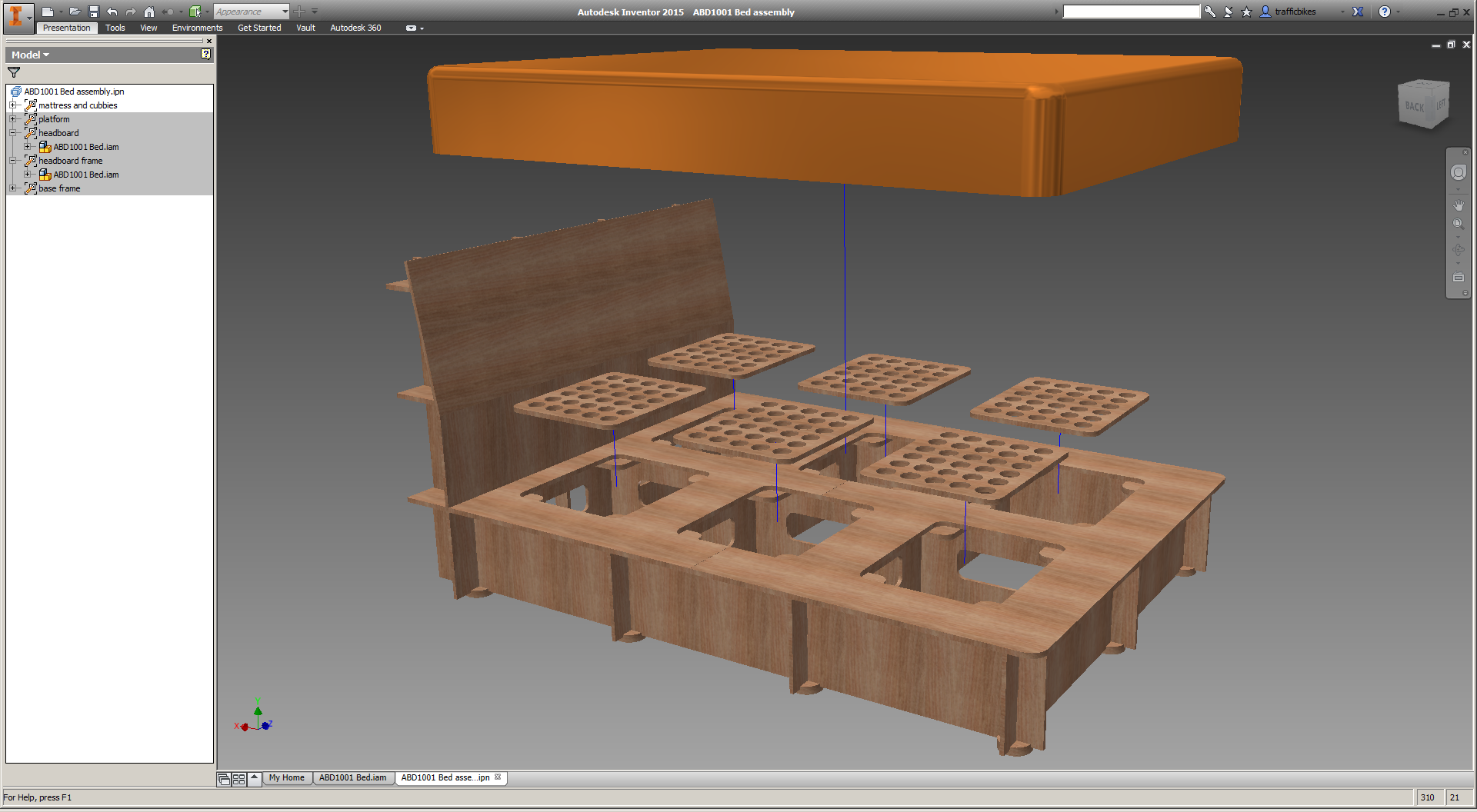





I think this is done.
The New York Infrastructure Observatory's inaugural journey is coming up! We'll be heading to the nearest Amazon distribution facility, in Middletown, Delaware, and will be touring one of the most impressive logistical operations in existence. If you're interested, throw your hat in the ring here - spots are *extremely* limited for this one, but we'll do everything we can to get you in!
A few weeks ago.
From a great interview with Randall Munroe (of xkcd) on Fivethirtyeight:
One thing that bothers me is large numbers presented without context. We’re always seeing things like, “This canal project will require 1.15 million tons of concrete.” It’s presented as if it should mean something to us, as if numbers are inherently informative. So we feel like if we don’t understand it, it’s our fault.
But I have only a vague idea of what one ton of concrete looks like. I have no idea what to think of a million tons. Is that a lot? It’s clearly supposed to sound like a lot, because it has the word “million” in it. But on the other hand, “The Adventures of Pluto Nash” made $7 million at the box office, and it was one of the biggest flops in movie history.
It can be more useful to look for context. Is concrete a surprisingly large share of the project’s budget? Is the project going to consume more concrete than the rest of the state combined? Will this project use up a large share of the world’s concrete? Or is this just easy, space-filling trivia? A good rule of thumb might be, “If I added a zero to this number, would the sentence containing it mean something different to me?” If the answer is “no,” maybe the number has no business being in the sentence in the first place.
From an interesting article about placebos and nocebos:
Although it is hard to imagine that nocebos would be purposely used in the practice of Western biomedicine, it is very likely that the nocebo effect is much more prevalent than either patients or physicians recognize. For example, when doctors highlight the potential side effects of new medications, such as GI distress or sexual dysfunction, patients complain of these much more frequently than when they are minimized. The same is true with pain caused by medical procedures: Women in labor who are given an epidural anesthetic are much more likely to report discomfort if the procedure is described beforehand as being more, rather than less, painful.
People are weird.
A strong argument (by 3M and HBR) against bullet points:
In every company we know, planning follows the standard format of the bullet outline. It fits the way we’re used to writing and presenting information. It’s economical. It reduces complex business situations to a few, apparently clean points. It allows for conversation around the issues and gives presenters the freedom to move, modify, clarify, and revise on the fly. In a sense, the bullet list may be an artifact of the way business takes place in the course of strategic planning: it mirrors the character of meetings and the highpressure pace of the manager or planner who must reduce the complex to the short and clear.
So what’s the problem?
If the language we use in writing strategic planning reports were only a matter of presentation, of the way we package ideas and offer them to others, it would not matter much how we wrote them. But writing is thinking. Bullets allow us to skip the thinking step, genially tricking ourselves into supposing that we have planned when, in fact, we’ve only listed some good things to do.
...
Requiring that a plan have a narrative logic forces to the surface the writer’s buried assumptions about cause and effect. The act of writing a full, logical statement encourages clear thinking and brings out the subtlety and complexity of ideas. Indeed, sometimes we sit down to write believing we have a clear idea, but our difficulty in getting it down on paper exposes the flaws in our thinking.
From a very interesting article about organizing engineering teams for product development:
Universities have, since the 12th century, and certainly since von Humboldt's reforms in the 19th century, been organized around specialized areas of knowledge. Thus we find departments of chemistry, physics, mechanical engineering, history, mathematics and so on. Each of these will often have sub-groupings representing sub-specialites within each discipline...The system works very well, primarily because until very recently universities have not been called upon to do very much cross-disciplinary research. Industry has not had that luxury. Cross-disciplinary work is the norm in industry. Products are seldom based opon single disciplines or specialties. It normally requires a blending or integration of knowledge from different specialties to develop even relatively simple products.
If you ask me, modern education should follow product development's lead - and break down the divisional structures they've used for so long.
This resonates with me:
I don’t tolerate slack in an organization. When someone is underperforming I’ll point it out. While interning at a large electronics manufacturer I used my final presentation to highlight multiple issues in the company that I had observed. My manager squirmed wearily in his seat. The CTO called me to his office for more details. He thanked me for my candor.
That manager never did offer me a job. In fact, most of the department was laid off a month later. That department was broken. The fact that an intern broke the ice was case and point. I’m glad that my words made a difference for the employees who remained.
In a good article questioning the human drive for more power, emphasis mine:
Even if you don't buy into this picture of Pleistocene richness replaced by modern poverty, it is clear that the immense rise in human power has not been matched by an equal rise in human happiness. We are a thousand times more powerful than our hunter-gatherer ancestors, but not even the most optimistic Whig can believe that we are a thousand times happier. If we told our great-great-grandmother how we live, with vaccinations and painkillers and running water and stuffed refrigerators, she would likely have clasped her hands in astonishment and said: "You are living in paradise! You probably wake up every morning with a song in your heart, and pass your days walking on sunshine, full of gratitude and loving-kindness for all." Well, we don't. Compared to what most people in history dreamed about, we may be living in paradise. But for some reason, we don't feel that we are.
One explanation has been provided by social scientists, who have recently rediscovered an ancient wisdom: our happiness depends less on objective conditions and more on our own expectations. Expectations, however, tend to adapt to conditions. When things improve, expectations rise, and consequently even dramatic improvements in conditions might leave us as dissatisfied as before. In their pursuit of happiness, people are stuck on the proverbial "hedonic treadmill", running faster and faster but getting nowhere.
A few weeks ago, right near here..

Scotland, last month, with Jordan and Vlad.
Recent successes in the field:
;)
From a good piece on time and cost estimation in software engineering, emphasis mine:
All software development effort estimation, even when using formal estimation models, requires expert judgment. But although expert judgment can be very accurate, it’s also easily misled. Perhaps the strongest misleading happens when those responsible for the effort estimates, before or during the estimation work, are made aware of the budget, client expectations, time available, or other values that can act as so-called estimation anchors. Without noticing it, those people will tend to produce effort estimates that are too close to the anchors. Knowing that the client expects a low price or a low number of work - hours, for example, is likely to contribute to an underestimation of effort. Expert judgment can also be misled when an estimation request includes loaded words, such as, “How much will this small and simple project cost?”
In spite of much research on how to recover from being misled and how to neutralize estimation biases, no reliable methods have so far been found. The main consequence is that those in charge of effort estimation should try hard not to be exposed to misleading or irrelevant information - for example, by removing misleading and irrelevant information from requirements documentations.
I'm always shocked when a supplier asks me for a target price on a part I've asked them to bid. Customer-driven price anchors are really dangerous; I avoid them at all costs.
I've been thinking a lot about what kind of effect I want to have on the world, and this passage of Letter from Birmingham Jail came to me. In case you haven't read it recently, this document is incredibly powerful; I know of no thinker more masterful in his ability to direct the listener towards a particular moral perspective.
Emphasis below is mine.
I must make two honest confessions to you, my Christian and Jewish brothers. First, I must confess that over the past few years I have been gravely disappointed with the white moderate. I have almost reached the regrettable conclusion that the Negro's great stumbling block in his stride toward freedom is not the White Citizen's Counciler or the Ku Klux Klanner, but the white moderate, who is more devoted to "order" than to justice; who prefers a negative peace which is the absence of tension to a positive peace which is the presence of justice; who constantly says: "I agree with you in the goal you seek, but I cannot agree with your methods of direct action"; who paternalistically believes he can set the timetable for another man's freedom; who lives by a mythical concept of time and who constantly advises the Negro to wait for a "more convenient season." Shallow understanding from people of good will is more frustrating than absolute misunderstanding from people of ill will. Lukewarm acceptance is much more bewildering than outright rejection.
...
I have just received a letter from a white brother in Texas. He writes: "All Christians know that the colored people will receive equal rights eventually, but it is possible that you are in too great a religious hurry. It has taken Christianity almost two thousand years to accomplish what it has. The teachings of Christ take time to come to earth." Such an attitude stems from a tragic misconception of time, from the strangely irrational notion that there is something in the very flow of time that will inevitably cure all ills. Actually, time itself is neutral; it can be used either destructively or constructively. More and more I feel that the people of ill will have used time much more effectively than have the people of good will. We will have to repent in this generation not merely for the hateful words and actions of the bad people but for the appalling silence of the good people. Human progress never rolls in on wheels of inevitability; it comes through the tireless efforts of men willing to be co workers with God, and without this hard work, time itself becomes an ally of the forces of social stagnation. We must use time creatively, in the knowledge that the time is always ripe to do right.
From the Wikipedia page for "Self-serving bias," emphasis mine:
Locus of control is one of the main influences of attribution style. Individuals with an internal locus of control believe that they have personal control over situations and that their actions matter. Those with an external locus of control believe that outside forces, chance, and luck determine situations and that their actions cannot change anything. Individuals with an external locus of control are more likely to exhibit a self-serving bias following failure than those with an internal locus of control. The difference in attribution style between individuals with internal and external loci of control, however, is not as marked in successful outcomes, as individuals with both types attribution style have less need to defend their self-images in success. Airplane pilots with an internal locus of control were likely to exhibit a self-serving bias in regard to their skill and levels of safety.
This is mostly done.






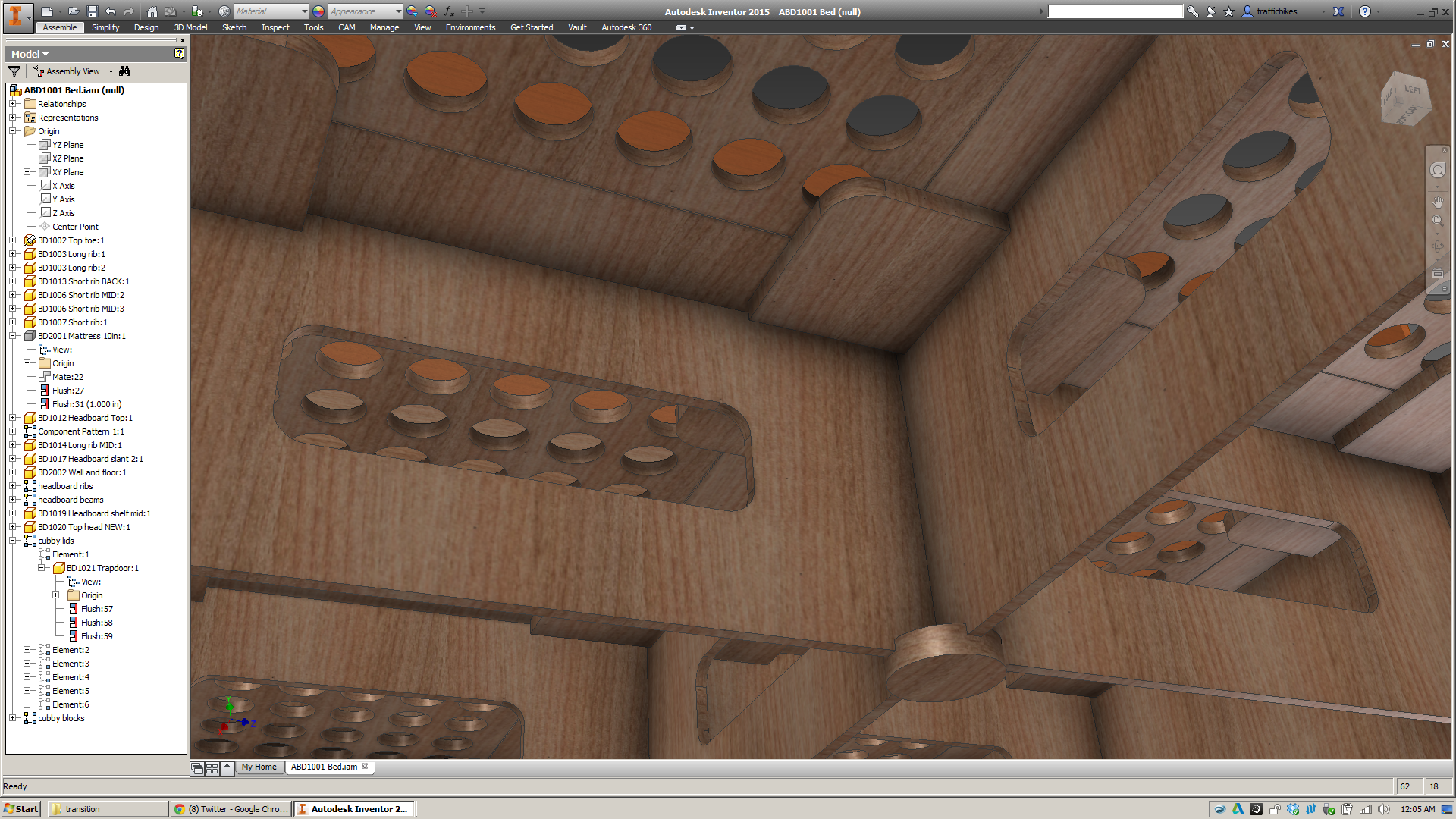
The base has a six interconnected cubbies in it. Lift the mattress to access their doors. The doors themselves are perforated for ventilation (I figure that's a feature, right?) and to make it easy to see what's inside (pretty sure this'll be useful).
The headboard has a bunch of little slots on the sides for storage. The one thing I really want to add still is a convenient way to charge your phone there, plus an outlet for a light (I'm thinking a pair of small clip-on fixtures similar to a Luxo). I might just hardwire in an outlet (with integrated USB) on each side of the headboard and run a piece of fixture cord out of the back... we'll see. I figure there's a pretty good chance that you've got an outlet somewhere behind the headboard, so routing the power conveniently out to each side is kind of a nice courtesy.
The big thing that's missing here is a fastener system for the headboard. The base basically just snaps together, but the headboard will need a few fasteners. I'm trying to use barrel nuts (a.k.a. "cross dowel nuts") but it'll require a bit of finagling to make it work.
The one thing I'm a bit insecure about is the top of the headboard. I couldn't find a good way to terminate the slanted part, so I just let it stick up a little. That top shelf isn't going to be very useful for storing stuff, but I guess at least nothing will fall off the front.
Oh, and the headboard is a little overbuilt... but it's okay for now.
It's been a minute since I've done anything in Inventor worth posting.
This is a bed frame that'll be made from plywood. It'll assemble with almost no fasteners and will knock down into manageable, lightweight pieces for easy moving.
More progress soon.
I've been thinking a lot (perhaps obviously) about my beef with slide decks, and came up with a list of tentative rules that I want to hold myself to. Many of these could be generalized for communication writ large, but for now they're tailored for decks.
These are in service of two things:
Basically:
If my audience doesn't have the time or attention to hear an appropriately nuanced argument, they don't really want to work with me.
There's probably more work to be done on these, but they're a start - and in many circles, they're pretty radical.
* Translation: Don't write an essay and then chop it up into pieces to display on a page. Paginated prose is an idiosyncrasy of an outdated delivery medium (printed paper). If you're writing prose today, do like the web does, and use infinite scroll.
Both from "How to Make Wealth:"
When you're starting a business, it's easy to slide into thinking that customers want what you do. During the Internet Bubble I talked to a woman who, because she liked the outdoors, was starting an "outdoor portal." You know what kind of business you should start if you like the outdoors? One to recover data from crashed hard disks.
What's the connection? None at all. Which is precisely my point. If you want to create wealth (in the narrow technical sense of not starving) then you should be especially skeptical about any plan that centers on things you like doing. That is where your idea of what's valuable is least likely to coincide with other people's.
and:
Faced with the idea that people working for startups might be 20 or 30 times as productive as those working for large companies, executives at large companies will naturally wonder, how could I get the people working for me to do that? The answer is simple: pay them to.
Internally most companies are run like Communist states. If you believe in free markets, why not turn your company into one?
Hypothesis: A company will be maximally profitable when each employee is paid in proportion to the wealth they generate.
From an excellent 2004 essay called "How to Make Wealth:"
Someone graduating from college thinks, and is told, that he needs to get a job, as if the important thing were becoming a member of an institution. A more direct way to put it would be: you need to start doing something people want. You don't need to join a company to do that. All a company is is a group of people working together to do something people want. It's doing something people want that matters, not joining the group.