Manufacturing guy-at-large.

Shop Visit: EXOVault

Added on by Spencer Wright.

Today I met up with an internet acquaintance to drop off some of my rack ends. I needed to do a bit of lathe work, so we met at a shop that he's associated with, which is also the manufacturing facility for EXOVault.

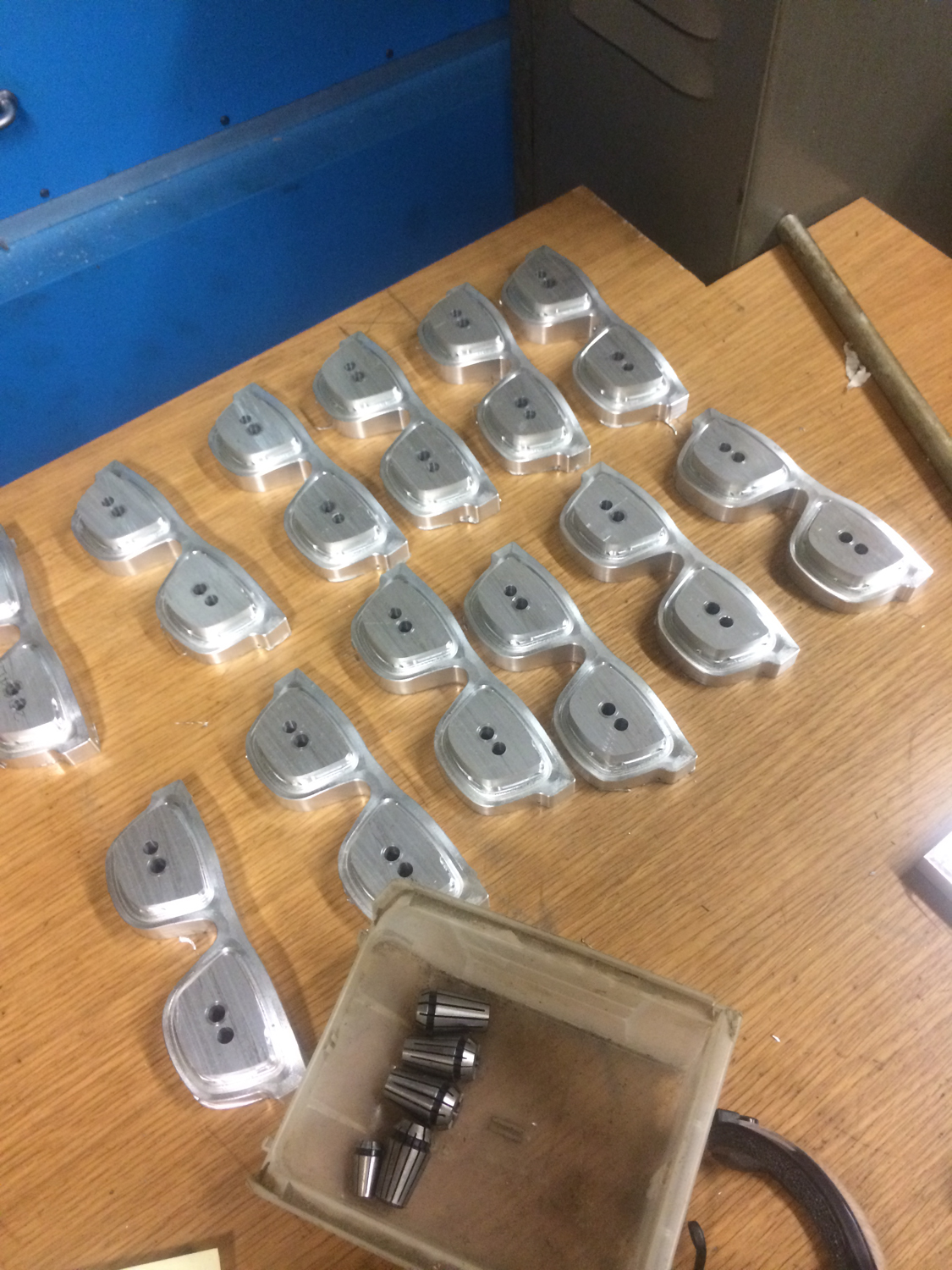
Besides their crazy iPhone cases, EXOVault makes some really interesting CNC machined aluminum eyeglass frames. It was *really* cool seeing their build process around the shop.

Their fabrication shop was a treat to see, and had a couple weird things hanging around - like this:

exovault-1.jpg

I love seeing shops. If anyone knows of a shop that I should see, please let me know!

Frosh > Frish

Added on by Spencer Wright.

Dan Jurafsky, writing about the phonetics of the names we give ice cream flavors. Emphasis mine. 

In one marketing study, for example, Richard Klink created pairs of made-up product brand names that were identical except for having front vowels or back vowels: nidax (front vowel) verus nodax (back vowel), or detal (front vowel) versus dutal (back vowel). For a number of hypothetical products, he asked people which seemed bigger or smaller, or heavier or lighter, with questions like:

Which brand of laptop seems bigger; Detal or Dutal?
Which brand of vacuum cleaner seems heavier, Keffi or Kuffi?
Which brand of ketchup seems thicker, Nellen or Nullen? 
Which brand of beer seems darker, Esab or Usab?

In each case, the participants in the study tended to choose the product named by back vowels (dutalnodax) as the larger, heavier, thicker, darker product. Similar studies have been conducted in various other languages.

The fact that consumers think of brand names with back vowels as heavy, thick, richer products suggests that they might prefer to name ice cream with back vowels, since ice cream is a product whose whole purpose is to be heavy and rich.

Indeed, it turns out that people seem to (at least mildly) prefer ice creams that are named with back vowels. In a study in the Journal of Consumer Research Eric Yorkston and Geeta Menon had participants read a press release describing a new ice cream about to be released. Half the participants read a version where the ice cream was called "Frish" (front vowel) and the other half read a version where it was called "Frosh" (back vowel), but the press release was otherwise identical. Asked their opinions of this (still hypothetical) ice cream, the "Frosh" people rated it as smoother, creamier, and richer than the "Frish" people, and were more likely to say they would buy it. The participants were even more influenced by the vowels if they were simultanously distracted by performing some other task, suggesting that their response to the vowels was automatic, at a non-conscious level.

People are *so* weird.
Accountability is a Team Concept

Added on by Spencer Wright.

From a piece in Fast Company about the (DoD-funded) Software Engineering Institute:

Importantly, the group avoids blaming people for errors. The process assumes blame - and it's the process that is analyzed to discover why and how an error got through. At the same time, accountability is a team concept: no one person is ever solely responsible for writing or inspecting code. "You don't get punished for making errors," says Marjorie Seiter, a senior member of the technical staff. "If I make a mistake, and others reviewed my work, then I'm not alone. I'm not being blamed for this."

It's my belief that organizations run best when accountability - for both failures and successes - is shared widely. At SEI, where NASA flight software is developed, big failures can be catastrophic. In order to ensure the overall project success, all individual output is reviewed at multiple stages of development; if errors are overlooked, responsibility falls to the team – not to any individual in the process.

Weak ties that last

Added on by Spencer Wright.

From a *long* article in TechCrunch about the San Francisco housing market. Emphasis mine.

San Francisco’s population hit a trough around 1980...But that out-migration reversed around 1980, and the city’s population has been steadily rising for the last 30 years.

This is a phenomenon that’s happening to cities all over the United States...

Its rapacious speed may even be accelerating. Witness hyper-gentrification in Brooklyn and Manhattan, or the “Shoreditch-ification” of London.

Why?

People are getting married later and are living longer. Nearly 50 percent of Americans, or more than 100 million people are unmarried today, up from around 22 percent in 1950.

The job market has changed as well. In 1978, the U.S.’s manufacturing employment peaked and the noise and grit of the blue-collar factories that once fueled the flight of the upper-middle-class disappeared. These vacant manufacturing warehouses turned into the live-work spaces and lofts that emerged in the 1980s and 1990s in cities like New York and San Francisco.

The concept of lifetime employment also faded. Today, San Francisco’s younger workers derive their job security not from any single employer but instead from a large network of weak ties that lasts from one company to the next. The density of cities favors this job-hopping behavior more than the relative isolation of suburbia.

Being Prepared.

Added on by Spencer Wright.

Links for the week! Sign up here.

Pathing.

Manufacturing.

Logistics.

Reflecting.

Stuff that doesn't fit into my dumb/arbitrary categories.

And.

 Love, Spencer.

ps - Thank you to everyone - especially my friends at Gin LaneUndercurrent, and on twitter - who referred me to everything here.

One Hardware Thing

Added on by Spencer Wright.

Please, leave comments on this post!

If you had a group of 20 or so intelligent, inquisitive people - but none of them have any experience with hardware writ large - what is the one lesson/exercise that you would run them through? Assume a 90 minute session.

My thoughts: 

  • Fix a flat on a bike
  • Just tighten/loosen screws/nuts
  • Overview of metric vs. English standards
  • Overview of hardness vs. tensile/compressive/shear strength
  • Basic solid modeling tutorial in Fusion 360
  • Basic mechanical feature overview (lever, gear, screw, etc.)
  • Industrial vs. Mechanical vs. Embedded design
  • Analog & digital circuits

What are your thoughts? 

"Quick, Big Wins."

Added on by Spencer Wright.

According to his LinkedIn page, Piet Morgan began working on Hammerhead in September 2012. Hammerhead went on to raise $190K on Dragon in October of 2013. Immediately afterwards, they entered the R/GA+Techstars accelerator, where they received a $20K stipend + (I'm guessing here - it's a safe bet) an additional $100K convertible note.

Hammerhead matriculated from R/GA in March, and today TomorrowLab announced that they've been hired by Hammerhead to "get to market by September 2014."

They also have Brad Feld and Scott Miller as advisors - two consummate hardware startup experts.


Things take time. Developing products is hard. Sure: money, guidance, and a space to work in help. But product development is still time consuming, and quick, big wins don't come easily.

As a cyclist, I must say that I'm not particularly interested in Hammerhead; it's just not my style. But I saw their pitch in person at a meetup a few months back, and I must say that it was very good. Piet seems really smart, and the team appears to be down-to-earth and rather personable. We've got friends in common, and from everything I know about their team it seems like they're kicking ass.

But launching things is hard, and quick, big wins are elusive. Remember this, and don't trick yourself into thinking you're above it.

Personal OKRs

Added on by Spencer Wright.

First: You should know what OKRs are. I'm not saying there the end-all be-all, but they're totally a thing.

Yesterday I updated my personal goals in the format of OKRs and habits. Here they are.

Objective 1:

Be smarter than I really am.

I use this as a euphemism for formidability & staying on top of shit.

Key Results:

  • I’m more organized, and hence more at ease.

  • My output results in more inbound traffic.

  • My relationships are strengthened through my reliability and ability to communicate effectively.

Habits:

  1. Keep a daily checklist & maintain a high “done” rate.
  2. Pitch something unironically on a weekly basis.
  3. Ship my newsletter weekly.
  4. Post 250 words publicly on a weekly basis.
  5. Post 750 words publicly on a monthly basis.

Objective 2:

Broaden and deepen my perspective and skillset.

Key Results:

  1. A full stack of maker skills.
  2. A continually broadening knowledge base.
  3. A continuous stream of completed & documented projects.

Habits:

  • Lunch/coffee/drinks with someone outside of my immediate sphere on a weekly basis.

  • Show continued progress on extracurricular projects on a monthly basis.

  • A half-hour of terminal time on a weekly basis.

  • One unstructured weekday on a monthly basis.

These will change over time - perhaps sooner than later - but I feel good about them. Wish me luck.

When the Leadership can fail

Added on by Spencer Wright.

Astro Teller, talking about the culture of failure at Google X:

When the leadership can fail in full view, "then it gives everyone permission to be more like that."

Cultures that allow for failure at the top are (in my experience) extremely rare. Success and age breed risk adversity (cf. this excellent post by Felix Salmon), and leadership positions tend to be filled by successful people. 

Willingness to fail is also, in my mind, the single most important factor to long term success. Failure offers lessons which are more learnable - and more causal - than success does. In the absence of failure, one's ability to learn is highly compromised.

To me, willingness to fail should be a top priority to everyone. Discussions of risk should be between all parts of an organization. A company's policy on risk & failure should be explicit, and its implications should be clear to all employees and stakeholders.

Not 10 times as hard

Added on by Spencer Wright.

From TechCrunch's excellent article about Google X:

No idea should be incremental. This sounds terribly clichéd, DeVaul admits; the Silicon Valley refrain of "taking huge risks" is getting hackneyed and hollow. But the rejection of incrementalism, he says, is not because he and his colleagues believe it's pointless for ideological reasons. They believe it for practical reasons. "It's so hard to do almost anything in this world," he says. "Getting out of bed in the morning can be hard for me. But attacking a problem that is twice as big or 10 times as big is not twice or 10 times as hard."

Old models

Added on by Spencer Wright.

These are robot door parts I designed in 2012. And I gotta say, this (the black rod in the middle of the photos) was a dumb but kinda clever solution to a shitty problem.

Departure from the default

Added on by Spencer Wright.

Daniel Kahneman, in Thinking, Fast and Slow. Emphasis mine:

People expect to have stronger emotional reactions (including regret) to an outcome that is produced by action than to the same outcome when it is produced by inaction. This has been verified in the context of gambling: people expect to be happier to gamble and win than if they refrain from gambling and get the same amount. The asymmetry is at least as strong for losses, and it applies to blame as well as to regret. The key is not the difference between commission and omission but the distinction between default options and actions that deviate from the default. When you deviate from the default, you can easily imagine the norm - and if the default is associated with bad consequences, the discrepancy between the two can be the source of painful emotions. The default option when you own a stock is not to sell it, but the default option when you meet your colleague in the morning is to greet him. Selling a stock and failing to greet your coworker are both departures from the default option and natural candidates for regret or blame.

In a compelling demonstration of the power of default options, participants played a computer simulation of blackjack. Some players were asked "Do you wish to hit?" while others were asked "Do you wish to stand?" Regardless of the question, saying yes was associated with much more regret than saying no if the outcome was bad! The question evidently suggests a default response, which is, "I don't have a strong wish to do it." It is the departure from the default that produces regret.

The Wrong Idea

Added on by Spencer Wright.

Lou Lenzi, GE General Manager of Industrial Design, talking with The Atlantic about outsourcing: 

“What we had wrong was the idea that anybody can screw together a dishwasher,” says Lenzi. “We thought, ‘We’ll do the engineering, we’ll do the marketing, and the manufacturing becomes a black box.’ But there is an inherent understanding that moves out when you move the manufacturing out. And you never get it back.”

Take note of this. Look around the hardware world today, and you'll see dozens of consultancies & outsourcing platforms that are dedicated to making manufacturing a black box. Their aims are good: to alleviate the strains of launching a hardware product. But the results can be highly problematic.

Designers who aren't knee deep in the making of their products are taking huge, unknown risks. Out of sight/out of mind is a recipe for avoidable mistakes.

Old (ish) goals

Added on by Spencer Wright.

Me, last June

i have spent a while recently thinking about what, exactly, i have liked about my career. a few points:

  1. i like being appreciated.
  2. i like being compensated.
  3. i like being a little over my head. i prefer to stay right on the edge between the things i know i don't know and the things i don't know that i don't know.
  4. i like collaborating with people who are better at what they do than i am.
  5. i like having an understanding of long-term objectives, and i like being a significant factor in the achievement of those objectives.
  6. i like working with people like myself.
  7. i like being fully responsible for the execution of a project, however large or small.
  8. i like working on a new thing that will change some part of the world.
  9. i like working in emerging markets.
  10. i like working on things that people like me want, and want to interact with intimately.
  11. i like for the product values and interests that i have to overlap significantly with those of my collaborators and our product's users.
  12. i like being rewarded for my ability to identify, assess, analyze and solve problems, and i like it when those problems require me to learn about a new area of the world.
  13. i like clear objectives - and clear metrics by which they can be judged - over aesthetic, or "gut" feelings.
  14. i like working on general purpose technologies.
  15. i like working on cross-functional teams, and having responsibilities in many categories of business

I like this. Probably worth updating.

What should we all do

Added on by Spencer Wright.

Steven Sinofsky, talking on the a16z podcast about how real-time metrics tracking has changed the nature of management (edited for readability):

If you think about the average large company meeting, the vast majority today start off with somebody showing up and passing out a printed version of a work product. You just don't see that in a company of less that a thousand people. And the interesting thing about it is that it's not just that everybody got emailed the attachment for the meeting. It's that [managers] are looking at things like live data. So when managers at a small company look at their current telemetry of their app, their site, their service, they're all looking at the actual tools that are used by the marketing team to manage that information. They're not looking at a snapshot from even a few hours earlier. So you cut out all of this "well, those numbers aren't ready, let me go do them." You don't have presentations where a picture of the numbers are embedded in the presentation. 

These are these huge cultural shifts in how you manage an organization. What a manager's role is in a meeting is not to be reported to, because if you wanted to know, you should just go visit the place that everybody on the team is using to keep track of their information. 

Then when you get everybody together, it shouldn't be to argue the pros and cons of how the information was gathered or is it the right number... It should be: We all agree, this is the number. What should we all do to change that number?