-me.
Manufacturing guy-at-large.
New Standards
I've posted previously about my procurement process and elided a crucial detail: my part documentation for the past year has been pretty atrocious. Partly that's because I haven't been buying mostly 3D printed parts, which (when you buy from Shapeways et al) are documented only with STLs, but it's also because I haven't taken the time to set up my own drawing standards. Until yesterday.

This drawing is of the lid for The Public Radio. Depending on quantity it'll either be stamped or laser cut. I'd prefer stamped, but that's mostly because it'll be much less expensive at quantity - and I'd rather sell thousands of parts, not hundreds.
The details of the drawing itself are rather mundane, but the title block and drawing format involved a number of weighty decisions. A few points:
- I'm using an ISO A3 paper size. Because ISO is cool.
- I'm dimensioning in millimeters, and have default tolerances in millimeters too. This was a bit of a hurdle for me - I'm comfortable with metric dimensions but used to thinking of tolerances in thousandths of an inch - but I'm excited to be all (or mostly all) metric. Most of the tolerances here are three decimal places, which is basically the same at .13mm = .0051", is totally translatable for me.
- I'm using decimal points (instead of commas) between the ones column and the tenths column. Because Europe isn't right about everything.
- I don't have any "approved by" field. Fuck standard title blocks, right?
- "BREAK ALL SHARP EDGES." Yes.
- Note: As I'm looking at this, I'm realizing that I should probably relax a number of these tolerances. Which often happens, the more you look at a drawing.
- Revision tables. I start my drawings at "REV -", and then I increment alphabetically from there. This particular drawing was submitted to a few suppliers prior to this drawing standard, so I've incremented to "A" already... it's a little weird, but it works.
- I'm not a huge fan of "TYP" or "typical," but in some cases it makes sense.
- I'm using my part filename as a field in my title block. I considered separate boxes for part number and name, but I'm careful with filenames and this makes it easier.
- I'm using an ISO time string (but with decimal delimiters) throughout. Because ISO is cool.
- I'm a little flippant in my title block (the "info, documentation & jokes" thing), but it's better than having to list my phone number.
Changes I should probably make:
- I probably need a logo... or something. I don't know, a circle with a dot in it?
- Line weights are off.
- Do I really need to say what sheet it is? It's really only useful if you're documenting assemblies - at least with the simple parts I tend to design.
- I guess I should be marking zones of the drawing space, but I've never done so in the past and never felt like I was missing anything.
- I wish I could get rid of the file extension.
Overall I'm happy about this. Pretty fun.
Being Copied
Bunnie Huang, responding to a question about IP theft in Chinese contract manufacturing. The question is at about 22:30, here.
I'm different than a lot of people - I'm a big fan of open hardware, so before I get to that point with the factory I'll publish my schematics and everything online anyways. Feel free to copy me. Right? And the good news is that your idea was good. You were copied. None of my ideas are ever copied, so obviously they're not very good.
Found
Battery clips on GrabCAD
In case you're designing a piece of electronics and need a battery clip modeled... this MPD PCB mount one that I modeled is on GrabCAD.

Hario Driver from Shapeways
Got this yesterday:
This is a socket bit that can be chucked in a drill and used to grind coffee with a manual burr grinder. I'm toying with the idea of having some CNCd, but this 3D printed steel version will work well for testing.
I don't own the Hario grinder that it's designed for, but I'm hoping to test it this weekend at a friend's house. Expect results soon :)
Working on The Public Radio v1.3
Screenshots from both Zach and myself - we've swapped back and forth on layout duties.
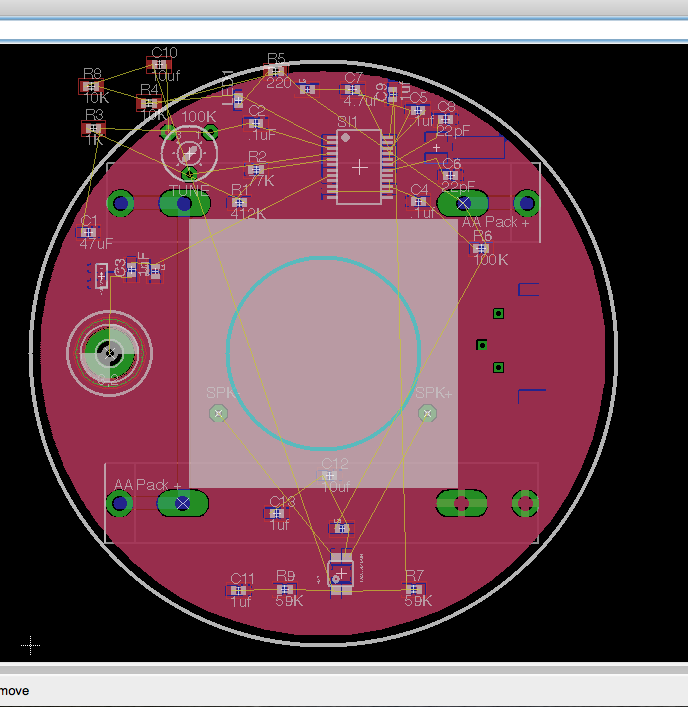
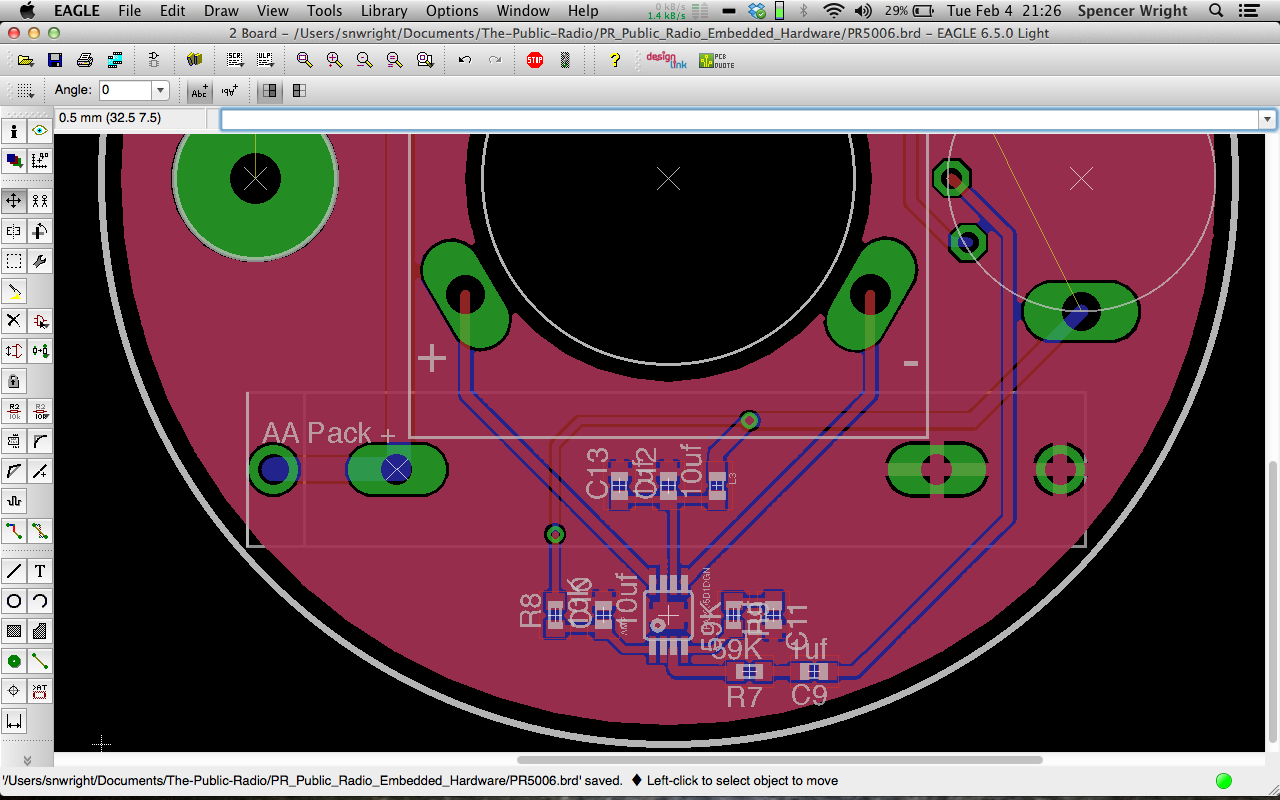
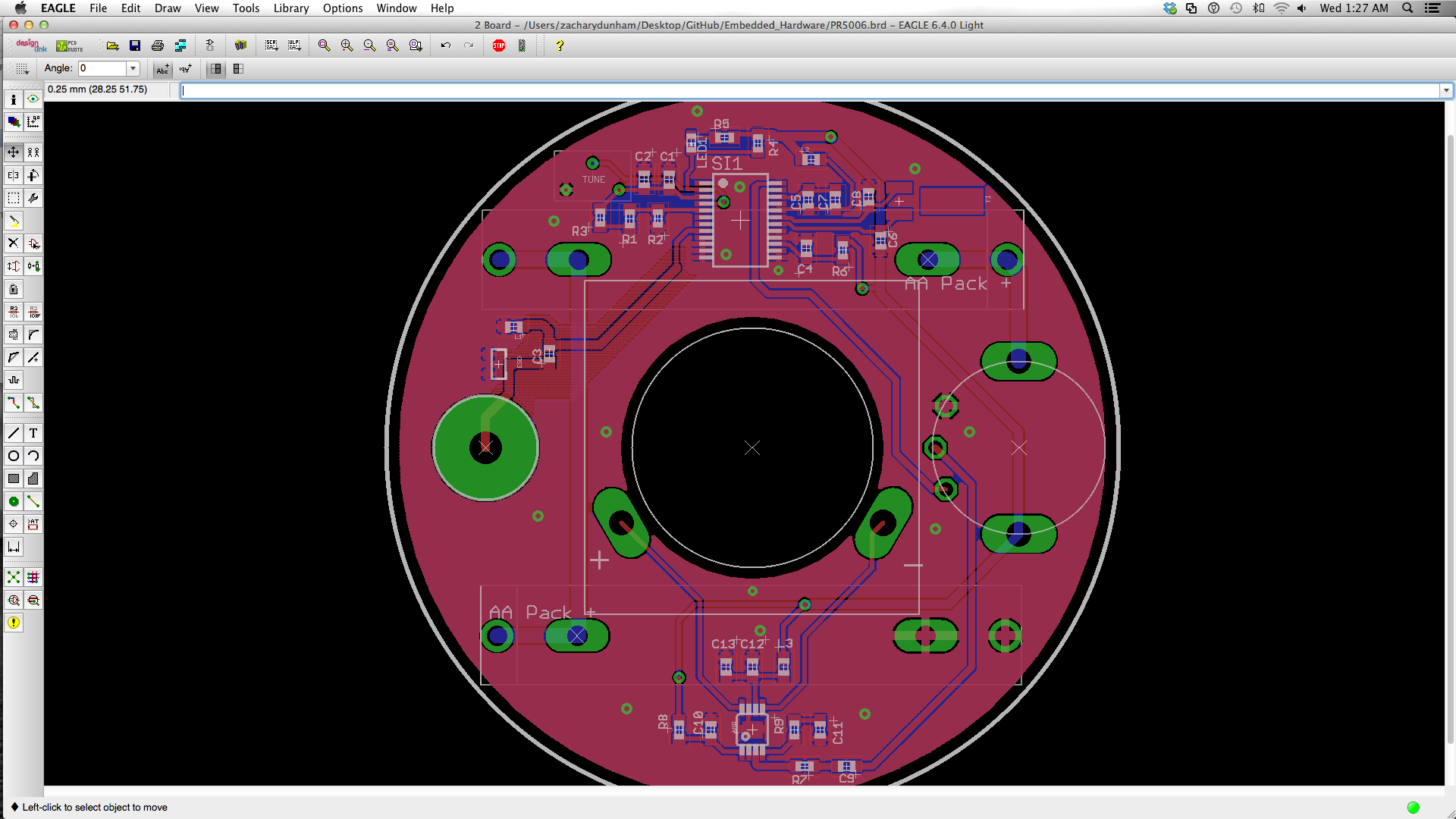
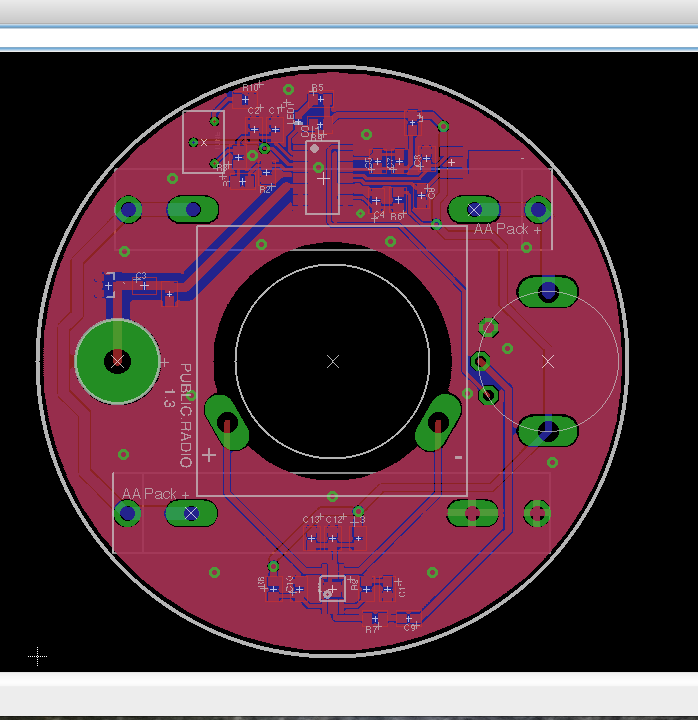
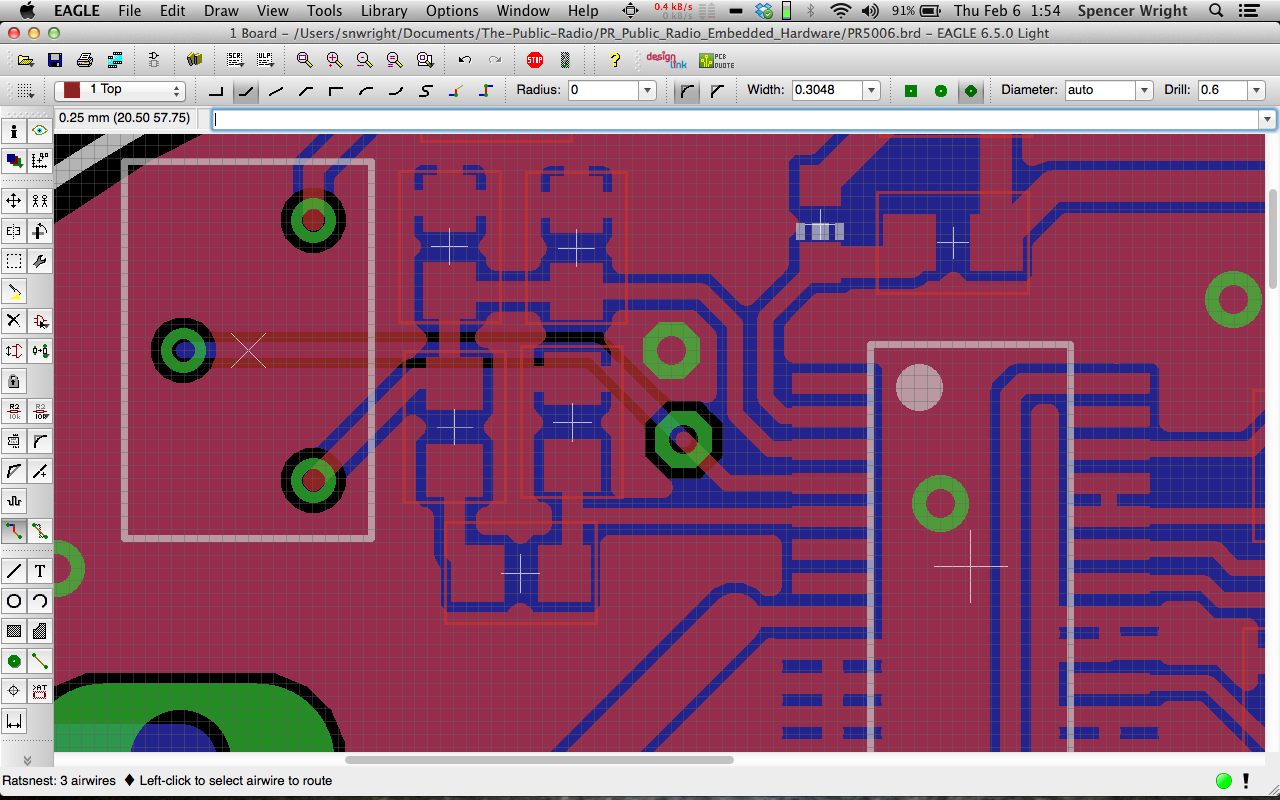
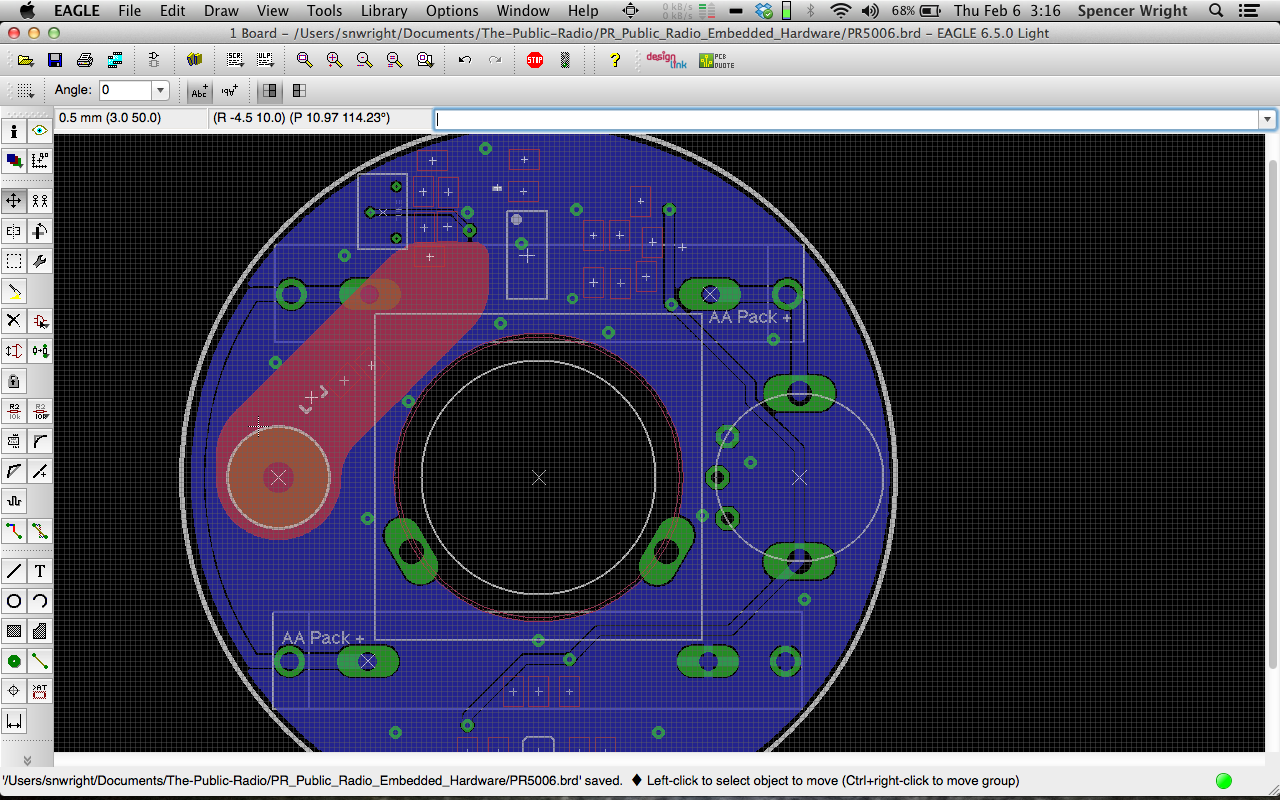
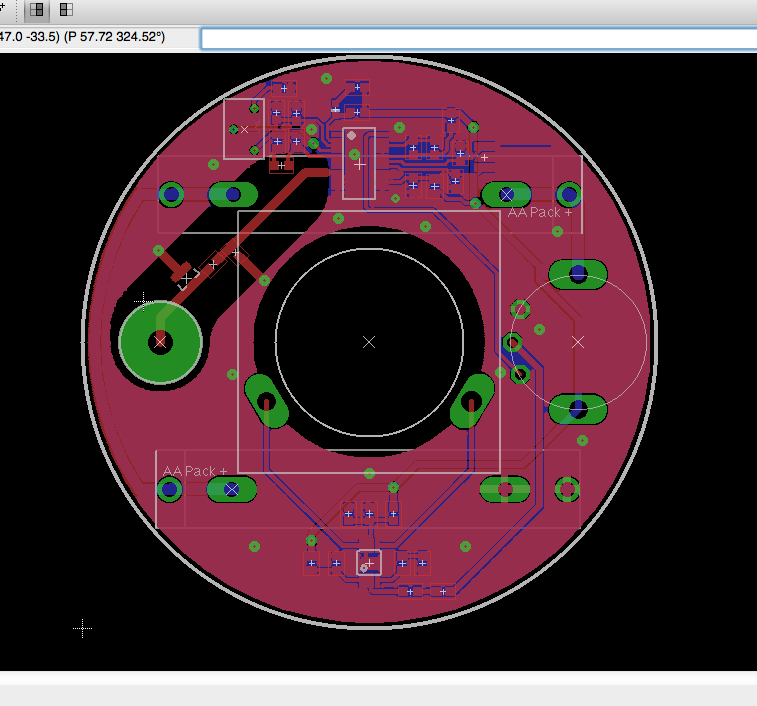
The FM IC (Si4831) is at the top of the board; to its left is the tuning circuit and trimpot. On the right edge of the board is the power & volume pot, and on the bottom is the amplifier, and on the left is the antenna connector. The middle of the board has a big cutout for the speaker body to fit through; we'll solder the speaker terminals directly to the board.
I got a little cute with the restricts near the antenna trace, and ditto on the power trace along the left edge of the board :)
Meanwhile, I spent a little time today modeling the battery connectors in Inventor:
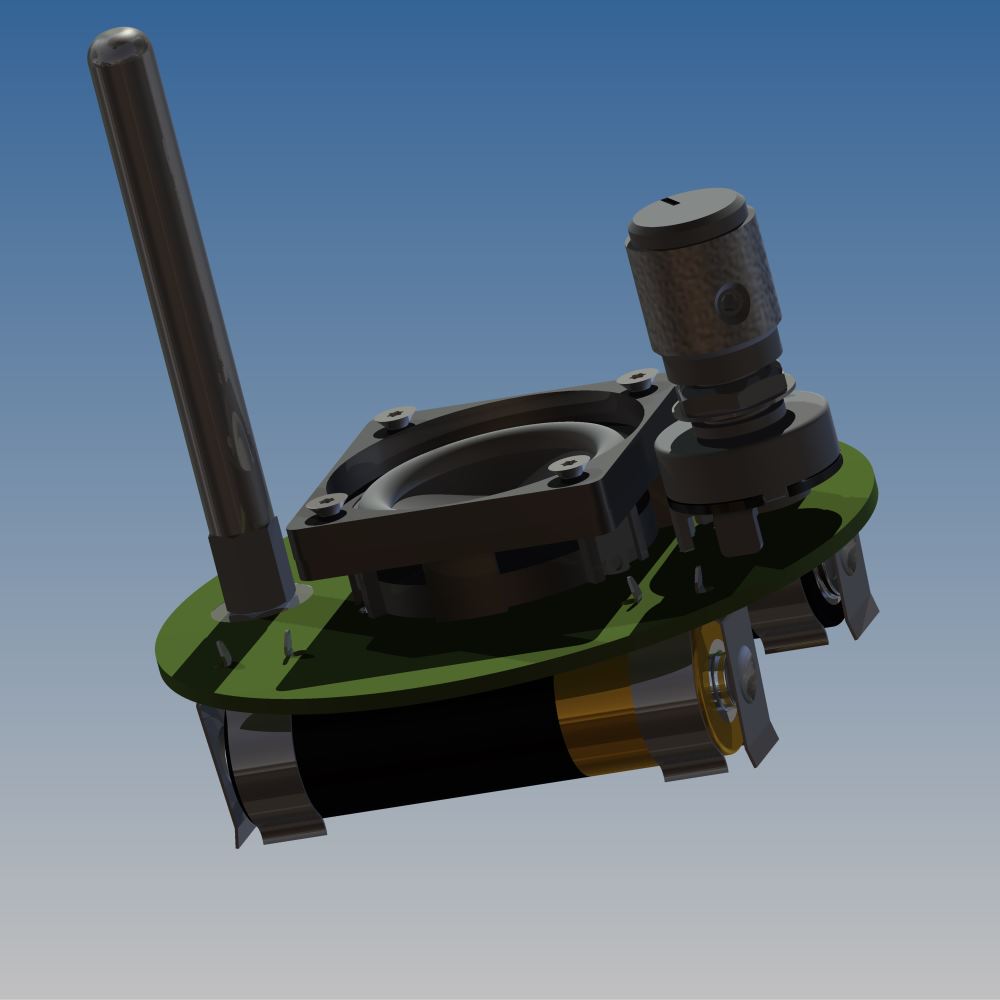
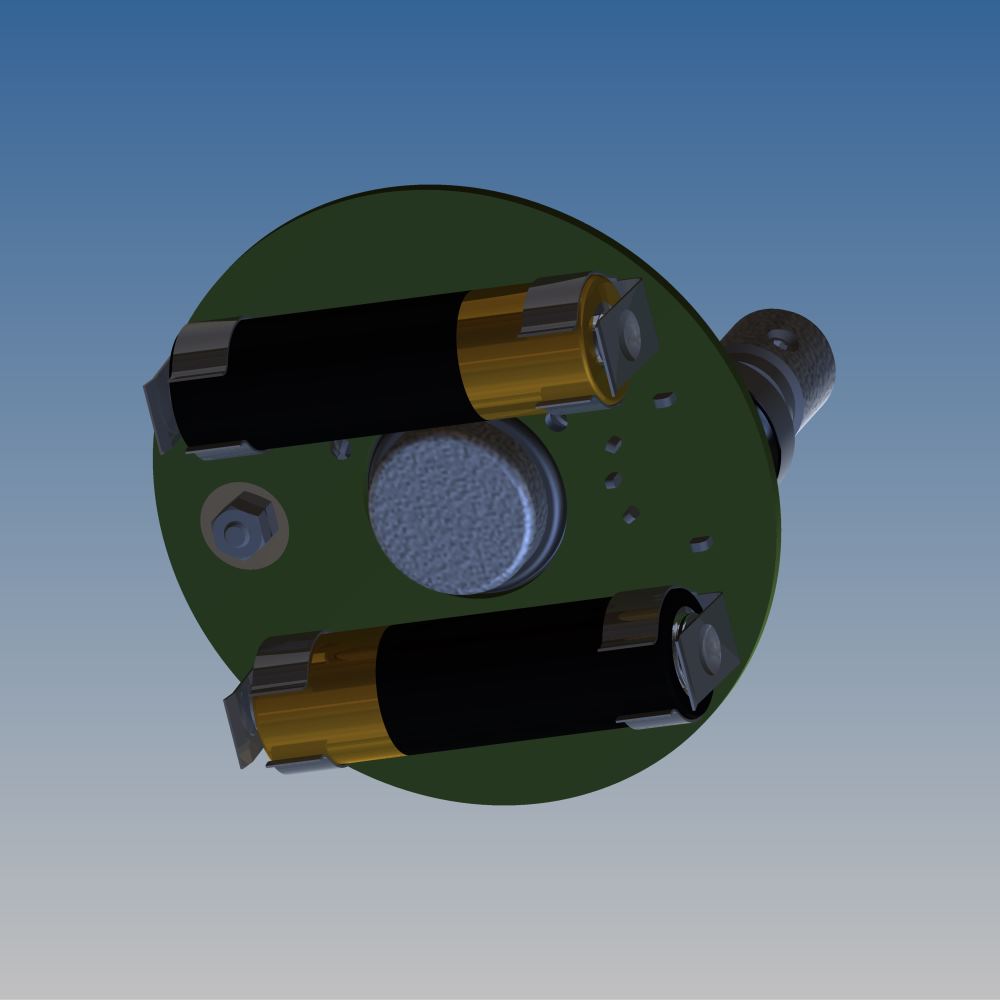
Finding nice through-hole AA battery connectors is *tough.* I'm hopeful about these - I think they'll hold the cell firmly but allow for easy removal too. The only downside is that they're not polar in any way, so we'll need to mark the PCB clearly to show which direction the batteries need to face.
Our antenna standoff is kind of exciting too. We're running a trace to a plated hole (with a *big* pad) on the PCB, and then fastening a male-female threaded standoff to the hole with a hex nut. The antenna itself will thread into the standoff, making it easy to remove/install for shipping, transportation, etc.
We're in the process now of getting quotes for a couple of custom pieces of hardware: the antenna, the knob, the potentiometer, and the speaker gasket. We've also gotten a few quotes for the lid, which will either be stamped or laser cut stainless steel. And when PCBcart comes back from Chinese New Year, we'll order a batch of new boards to get into the hands of our beta testers.
This is an exciting time in the project. Things are coming together quickly :)
Shapes
Scott DeFelice, CEO of Oxford Performance Materials, said something in conversation yesterday that I found really prescient. I'm paraphrasing this a bit from my notes, but the feeling is there:
There is a business selling shapes. It's not a new business. Shapeways and MakerBot are doing interesting things with the business model, but it's the same business.
The business of selling *useful* shapes is totally new.
What Scott's saying here rings true to me: When designers are able to create shapes that are functional in and of themselves, the nature of the product - and its value to the end user - changes dramatically.
If I'm selling shapes, I want to be selling useful ones.
Public Radio Progress
The last few days have been a bit of a whirlwind.
First, we visited Todd to discuss some circuit layout concerns. On the way over we nabbed a cheap radio at RadioShack, and took it apart with Todd..

What we found was really interesting. The device uses a different chip than we had been prototyping with, and as a result their circuit is *much* simpler. Our chip (Silicon Labs' Si4703) requires digital tuning, which we were accomplishing with a microcontroller. But RadioShack was using the Si4822, which is mechanically tuned. The result is drastic from a circuit standpoint - they no longer need a voltage regulator, or a microcontroller, or a bunch of additional passive components on the board. They're also in a better position re: noise on the board: an MCU (and a voltage regulator too) will produce a bunch of noise that might get on the antenna, affecting reception. RadioShack doesn't need to worry about this at all.
Over the past few weeks, we've been looking for just a breakthrough like this - a way of rethinking the problems we were dealing with. Our issue was that we were stuck conceiving this as an Arduino-descended product, which it doesn't need to be.

We also made a bit of progress reengineering the hardware layout of the board. Our new design (this is just the board layout, not the circuit schematic) will be significantly easier to assemble, program & service.

We're also pretty sure we can shorten the antenna *significantly.* The mockup here shows a custom solid stainless steel antenna, 50mm long. I rather like it, and it's designed such that a longer telescopic antenna can be swapped in easily.

Our PCB will now be circular, and we're soldering the potentiometer and speaker directly to the board. There will be a bunch of SMT stuff on the top (same side as the speaker & pot) and a battery back and trimpot (not shown) on the bottom.
I *really* like where this is headed. More updates soon.
Radio Monogamy
"Radio monogamy" was suggested by a few friends during discussions on The Public Radio. I'm mulling a storyboard for a short video, and jotted this down last night :)
Every once in a while, paper prototyping is really effective.
McKinsey
Two excerpts from a short piece on 3D printing by McKinsey. Emphasis mine:
As of 2011, only about 25 percent of the additive-manufacturing market involved the direct manufacture of end products. With a 60 percent annual growth rate, however, that is the industry’s fastest-growing segment. As costs continue to fall and the capabilities of 3-D printers increase, the range of parts that can be economically manufactured using additive techniques will broaden dramatically. Boeing, for example, already uses printers to make some 200 part numbers for ten different types of aircraft, and medical-products companies are using them to create offerings such as hip replacements.
And:
Design is inherently linked to methods of fabrication. Architects can’t design houses without considering construction techniques, and engineers can’t design machines without considering the benefits and limitations of casting, forging, milling, turning, and welding. While there is a wealth of knowledge around design for manufacturing, much less is available on design for printing. Our conversations with executives at manufacturing companies suggest that many are aware of this gap and scrambling to catalog their design know-how.
Incidentally, I'm not sure that the premise of that second quote is necessarily true, regardless of what I believe *should* be the case.
Hot Links
My mailing list. Gogetit. Here.

Light
A week or two ago, at Jace's.
Von King
Memphis, Libo, Zach, and The Public Radio, getting our ya-yas out after a good day of work :)
I very much like this calendar
Seen at Gin Lane; designed by Jonas Wyssen.
I've had similar thoughts about the circular display of time (which I described in part in a post last June), though I never fleshed them out fully. This is a very good treatment.
Execution
Joanna Beltowska in a good post on Medium:
It’s hard to invest in ideas alone. The old startup adage rings true: ideas are worthless unless executed.
True.
Junk Science
Two bits from a good article from The Guardian on wine tasting:
More evidence that wine-tasting is influenced by context was provided by a 2008 study from Heriot-Watt University in Edinburgh. The team found that different music could boost tasters’ wine scores by 60%. Researchers discovered that a blast of Jimi Hendrix enhanced cabernet sauvignon while Kylie Minogue went well with chardonnay.
and:
Colour affects our perceptions too. In 2001 Frédérick Brochet of the University of Bordeaux asked 54 wine experts to test two glasses of wine– one red, one white. Using the typical language of tasters, the panel described the red as "jammy' and commented on its crushed red fruit.
The critics failed to spot that both wines were from the same bottle. The only difference was that one had been coloured red with a flavourless dye.
The Public Radio on Adafruit
We started from the bottom, you know? And now we're here.

Notes on Powersaving modes
Today Zach and I are playing with powersaving modes on The Public Radio. This was all done with this commit; cases were tested by commenting out lines 42, 45 and 46 and varying volume via our potentiometer. Current is being measured on Vout of the VREG on hardware v1.1.
- MCU ON (sleep disabled)
- Amp OFF (shutdown enabled)
- Si4703 ON
- .019A
- Si4703 OFF
- .004A
- Si4703 ON
- Amp ON (shutdown disabled)
- Volume @ 100%
- Si4703 ON
- .050-.100A
- Si4703 OFF
- .004A
- Si4703 ON
- Volume @ 0%
- Si4703 ON
- .026A
- Si4703 OFF
- .004A
- Si4703 ON
- Volume @ 100%
- Amp OFF (shutdown enabled)
- MCU OFF (sleep enabled)
- Amp OFF (shutdown enabled)
- Si4703 ON
- .016A
- Si4703 OFF
- .004A
- Si4703 ON
- Amp ON
- Volume @ 100%
- Si4703 ON
- .030A-.090A
- Si4703 OFF
- .004A
- Si4703 ON
- Volume @ 0%
- Si4703 ON
- .023A
- SI4703 OFF
- .004A
- Si4703 ON
- Volume @ 100%
- Amp OFF (shutdown enabled)
There are some weird things going on here. Our powersaving mode isn't having quite the effect we're looking for, either.
More work to come.
The Public Radio v1.2
Ordered yesterday from OSHPark.
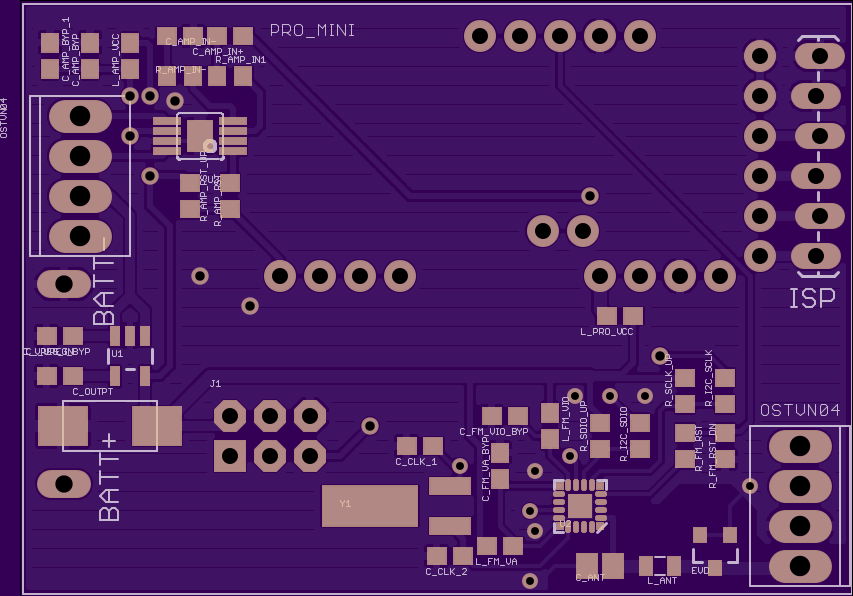
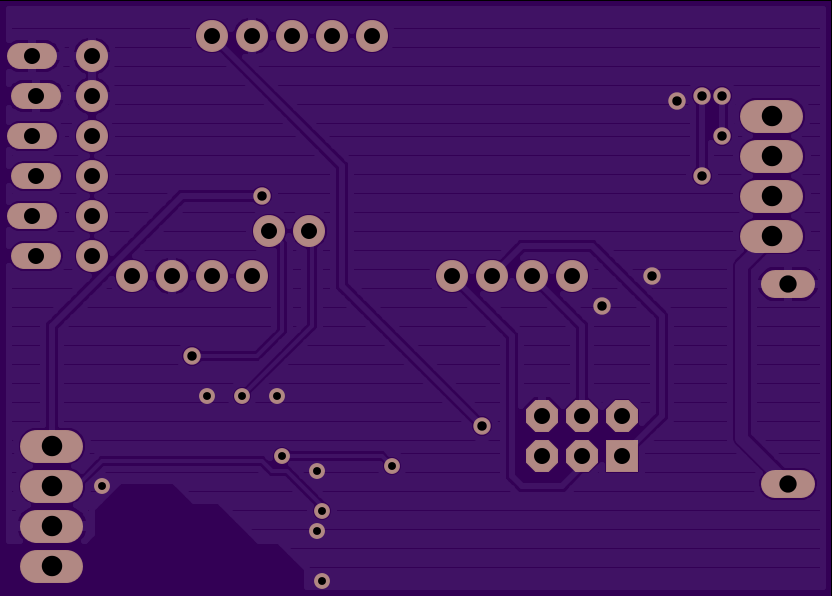
This board uses an Arduino Pro Mini, which can be programmed from either an FTDI cable or via an AVRISP (which we'll do to shorten powerup time). The rest of the circuit is all discrete components, mostly SMT. The whole thing mounts on the backside of a 3xAAA battery pack.
We should receive these boards around Valentine's day, and will be testing and iterating on them shortly afterwards.