Manufacturing guy-at-large.

Hackweek Day 5

Added on by Spencer Wright.

Friday was Rubyday.  

On Thursday, Zach and I had banged out about a third of the Codecademy Ruby class. It was a good primer on Ruby syntax and basic usage, and I'll be completing it this week. But we wanted to get a little web dev practice in, and so on Friday we went through the "Getting Started with Rails" tutorial on RailsGuides.

The tutorial is great. My method is to hand-type (not copy/paste)  every section of code. I keep two BASH terminal windows open and got the Sublime Text command line tool running so I can quickly create files and edit them without touching my mouse.  There were a few anomalies in the tutorial that I had a little trouble with, but googling solved them in short order (It seems that the guide is written for Ruby 1.9.3, and the syntax for 2.0.0 requires a few changes).

By the end of the day, I had created a simple blog app and was hosting it locally. I should note that I don't totally understand the structure of all of what I did, but I got a bit of debugging in, and just typing the entire thing out really did help develop a basic feel for the framework.  I think it's also worthwhile to go through simple exercises like this, just to understand how little you know about the basic tools (e.g. blogs) that you get used to using on a daily basis. 

The net effect of the week: Every week should be like this. Which is to say, every week is hustle week.  

Of course, shit will get in the way. This week I need to be out of town for a couple days, and that'll inevitably throw me off a bit. But I will finish the Codecademy Ruby class. And I will make progress on my seatpost project, and I will move on to the Ruby On Rails Tutorial book. This last one is the most significant of the three, but I would hope to complete it in a matter of a week.

:Sigh: 

You know, for three years I worked alone building bikes. It was an incredibly lonely, frustrating time of my life, and in the end I allowed those factors to prevent me from learning all the relevant lessons that were available to me. I didn't hustle hard enough; I had a hard time learning things quickly enough. I'm learning more quickly now, and hustling harder. And though the burn will remain slow for a while, I'm betting that the blaze that results will be quite a bit more satisfying.
Hamish McKenzie on content providers

Added on by Spencer Wright.

Hamish McKenzie, writing on Pandodaily about Spotify and the future of content providers.

I’ve said it before, and I’ll keep saying it until the publishing world has fully adapted to this ongoing tectonic shift in media: In a world in which digital content is increasingly being distributed via all-you-can-eat platforms like Spotify, Netflix, and Oyster at the same time as social networks like Twitter, Facebook, Reddit, Digg, and email are pushing content to people rather than the other way around, and as we increasingly consume media on one-thing-at-a-time mobile devices, the “bundle” doesn’t matter nearly as much as it did in the print or Web 2.0 eras.
Homepages are becoming less relevant.
Stories have to stand on their own.
Content owners have to get used to the idea that their carefully curated packages are being blown to bits. 

Jeff Bezos on being misunderstood

Added on by Spencer Wright.

Amazon's Jeff Bezos at the Aspen Institute in 2009. Via The Motley Fool (emphasis mine).

If you look at where we are today, it's half luck, half good timing, and the rest has been brains. So in some ways, I think we have not been tested. You know, we were unprofitable for so long, and people predicted our demise for so long, that we did develop thick skins - which I think is very valuable for invention, because often times invention requires a long-term willingness to be misunderstood. You do something that you genuinely believe in, that you have conviction about, but for a long period of time, well-meaning people may criticize that effort. When you receive criticism from well-meaning people, it pays to ask, 'Are they right?' And if they are, you need to adapt what they're doing. If they're not right, if you really have conviction that they're not right, you need to have that long-term willingness to be misunderstood. It's a key part of invention.


Jeff Bezos on regrets

Added on by Spencer Wright.

Amazon's Jeff Bezos, quoted by The Academy of Achievement in 2008. via The Motley Fool (emphasis mine).

So, it really was a decision that I had to make for myself, and the framework I found which made the decision incredibly easy was what I called -- which only a nerd would call -- a "regret minimization framework." So, I wanted to project myself forward to age 80 and say, "Okay, now I'm looking back on my life. I want to have minimized the number of regrets I have." I knew that when I was 80 I was not going to regret having tried this. I was not going to regret trying to participate in this thing called the Internet that I thought was going to be a really big deal. I knew that if I failed I wouldn't regret that, but I knew the one thing I might regret is not ever having tried. I knew that that would haunt me every day, and so, when I thought about it that way it was an incredibly easy decision. And, I think that's very good. If you can project yourself out to age 80 and sort of think, "What will I think at that time?" it gets you away from some of the daily pieces of confusion. You know, I left this Wall Street firm in the middle of the year. When you do that, you walk away from your annual bonus. That's the kind of thing that in the short-term can confuse you, but if you think about the long-term then you can really make good life decisions that you won't regret later.

The best question

Added on by Spencer Wright.

The best question is the one that gets the most interesting response, whether it answers the question or not.

The best interviewer is the person who elicits the most interesting response - not the one who asks the most interesting question.

The best interviewee is the one who is able to both yes-and the interviewer (it's not about agreement, it's about agreeability) and provide the most interesting response to the question at hand.

A real wine test

Added on by Spencer Wright.

Hey, look: we're all intelligent people who make careful, considered decisions. And in the interest of maximizing our reward-to-cost ratio, I think that we should inform ourselves as to what really makes us happy.

It's been a number of years since I first heard the Freakonomics on whether expensive wines taste better, and it has informed the way I think about my own tastes in profound ways. But every time I bring it up with people who know wine, the conversation goes nowhere.

I'd like to hold an event. Call it an experiment, call it a party, call it interactive performance art.  We find a venue - probably not a wine bar, but an event space with a liquor license - and all chip in on a big double-blind test. We pre-sell tickets to fund the purchase of a variety of bottles, and have some knowledgeable - and some not-so-knowledgeable - people curate the tasting selection. Then, while most of the crowd mingles, small batches of participants are called forward to have their preferences tested. As the night goes on, we all get to taste, and by the end of the evening we're ready to release results and show what we, as a group, all really like. 

I think it might teach us all a lot about ourselves and the degree to which we really know what we like - and better yet, I think it'll be fun! 

If you agree and live in/can get to NY, fill in your info below and I'll be in touch. 

Chopshop

Added on by Spencer Wright.

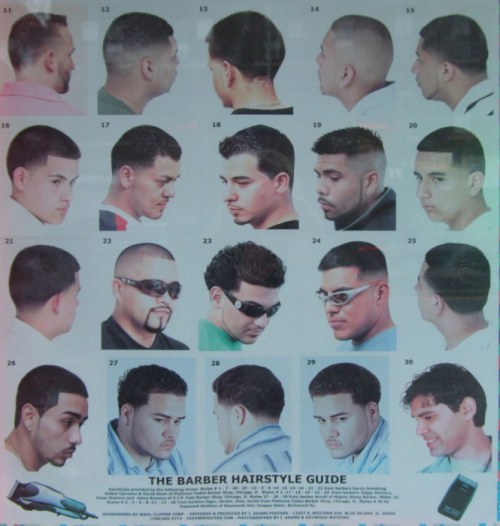
Why aren't barbershops tracking customer preferences?

haircut-chart.jpg

I have never, not once, felt confident enough to point at the barbershop haircut charts when sitting down to get a trim. I suspect I'm not alone. 

I've also never had a regular enough barber to develop any degree of aesthetic understanding and trust. This leaves me in a tricky position. I want to look good, and I want my barber to have some creative input. I want a stylist, really, but without a long-term relationship with my haircutter, that's difficult to establish.

It's only recently that I decided to load my phone with photos of haircuts I liked before getting a trim. It was somewhat effective, but it has this basic problem: those guys aren't me. And telling my barber that I want to look like him isn't really true. I want to look like the best version of myself.

So. An app that integrates with my barber's POS. When I'm done with my cut - right after they take the stupid mirror and show me my neck (in fact, the app should replace the mirror) - they take a quick GIF showing me from a bunch of angles. It's saved in my customer file, and accessible by my barber when I come in next month. It's something we can discuss and point at - a jumping off ground for experimentation. My haircut becomes a work in progress instead of a one-time gig. 

For the customer: Consistency. For the barber: The opportunity to develop a long term relationship that can transcend staffing changes.  The app becomes a whiteboard for discussing style.

Am I missing something? For the right kind of customer and shop, I think it'd be a killer match.  

Scott Belsky

Added on by Spencer Wright.

From "Finding Your Work Sweet Spot: Genuine Interest, Skills & Opportunity" by Scott Belsky (emphasis mine).

As you contemplate your next career move or a new project, you should take the intersection of your genuine interests, skills, and opportunities into consideration.
Contemplate the three circles of the Venn diagram above  –  one circle encompasses your genuine interests; one, your skills; and one, the stream of opportunities available to you. An intersection between just two of the circles doesn’t cut it. A love for basketball and a connection to an NBA scout won’t help you if you lack the skills to play ball. You need to find YOUR trifecta. When you engage with a project that finds this intersection, you’ve entered your zone of maximum impact. In such a state, you are a potent force of nature  –  your avocation becomes your vocation. You can work with full conviction, without ambiguity, and you can transcend your reliance on short-term rewards and societal approval.
As leaders, we must help our partners and employees find work at the ISO intersection. Legendary managers seek to understand the genuine interests and skills of their employees, and are constantly trying to create opportunities within the intersection. Want to change the world? Push everyone you know to work within their intersection. Mentor people to realize their genuine interests, skills, and to capitalize on even the smallest opportunities that surround them. When it comes to your own career, make every decision with a constant eye for work in the intersection.

Rubyday photos

Added on by Spencer Wright.

From yesterday. 

In my own experience, working with dogs around is incredibly inefficient. It's also fun sometimes. In the afternoon we took a walk down to Prospect Park for a little while, and Zach threw some treats in a ziploc. So, there you go.

The Rashomon Effect

Added on by Spencer Wright.

from Wikipedia

The Rashomon effect is a term that has been used by a number of different scholars, journalists and film critics to refer to contradictory interpretations of the same events by different persons, a problem that arises in the process of uncovering truth.
The idea of contradicting interpretations has been around for a long time and has implications to ethics in journalism. It is studied in the context of understanding the nature of truth(s) and truth-telling in journalism...
It is named for Akira Kurosawa's film Rashomon, in which a crime witnessed by four individuals is described in four mutually contradictory ways...

In The Simpsons episode Thirty Minutes Over Tokyo, Marge comments that Homer liked Rashomon, but Homer replies that he remembers it differently.

I can only hope that the Rashomon effect colors my idea of the fallibility of my own perception in a profound way. 

Hackweek Days 3-4

Added on by Spencer Wright.

For reasons I'll get into below, I've got a bit less to show for the past few days. 

The major theme of the past eight months of my life has been to form a new path towards long term stability, satisfaction and happiness. Some of that has been personal: I've spent a lot of time with friends; I've done my share of dating; I've been about as physically active as ever. But a major component has been my career.

I'm skeptical about anyone who claims a high degree of authority over their own emotional state. I tend to think that statements of ultimate preference (e.g. "I could never be happy in finance" or "I'm not satisfied unless I'm building something") tend to fall to post hoc ergo propter hoc fallacies. I want to be happy, and I refuse to let my career get in the way of my happiness. 

That said, I have a particular set of goals vis a vis my career, and high on the list is to be appreciated for my ability to break down complex problems on a range of subjects. And it so happens that the types of problems I'm interested in solving are largely strategic rather than technical, and it so happens that I see the most interesting strategic problem solving happening in the tech world.

I have spent most of my adult life learning skills, but software development is not one of them. I'm probably more comfortable at a command line than the average person, and I can talk generally about a tech stack, but I am not a programmer. Except in certain contexts that fact doesn't bother me. I'm not an engineer either; nor am I a certified welder or a particularly well practiced machinist or carpenter. But I've got all of those skills nonetheless, and I've put enough time in on those types of projects to communicate well with people whose careers are dedicated to those crafts. 

I don't want to be a developer any more than I want to be a bike mechanic. Skills are like tools - I like having them, but I'm wary of committing to any particular one, lest I view the entire world through a single lens. Some problems require a hammer; some require knowing the first damn thing about how serial port emulators work. I want to be a general purpose problem solver; I want to bring a wide variety of skills and experience to the table. I want my range of conceptual frameworks to be broad. I want to be intellectually agile. 

Also - and I don't mean this to be trite - I like computers. 

So Zach and I spent most of yesterday doing an overview of the tech stack required for a basic web app. We've got a couple of ideas that would fall across hardware and software, and it would seem that an RoR backend would fit our needs nicely. We'll still probably be programming our hardware in C, and will have a bit of HTML/CSS on top, but the meat of it - and, really, the fun stuff - would be Rails.

So today, we got about a third of the way through the Codecademy Ruby class. The Codecademy site is pretty slick. It's weird doing programming classes in this context, though. I took a few CS classes in college, but that was before laptops were ubiquitous, and I never really got comfortable with the format. Doing Codecademy is a lot cleaner - I like having the instruction and the execution all in one interface - but there's something about it I haven't gotten totally used to yet. I suspect that'll go away, but it was there a little bit today.

I'm excited to bang this class out over the next few days. I'd also like to be making concrete progress on a project, though, and it's hard to know how the two mesh. Not wanting to be a developer puts me in a weird position in the tech world. I'm a bit of a spectacle - a guy who swatted nails for a few years and can talk with some conviction about the benefits of climb milling. For the most part, that's fine with me, but the romanticism that the tech world has for physical objects - and old ones in particular - strikes me as a bit condescending and disrespectful. And all things being equal, I'd rather not be the one being condescended to. 

But, whatever. Sorting hashes is fun, and I relish the opportunity to flaunt my command of logical structures. I'm enjoying learning a new skill, and if history is any guide, I'm sure I'll find a way to put it to use. 

Josh Levin on Mediocracy

Added on by Spencer Wright.
I think the larger issue that this points out is that everyone wants every team to have a great stadium, a beautiful downtown ballpark...I was incredibly sad when RFK stadium stopped hosting the Nationals here in DC. It is fine for not every team to have this impeccable ballpark...There should be some acceptance in American society for not everything being above average. There needs to be a below-average stadium, for us to maybe appreciate what we have in this world...A bad stadium with a good team: there's something to rally around there. 

Josh Levin on the always excellent Hang Up and Listen podcast.